How Does Qantas Calculate the Distance Between Airports?

When Qantas announced in 2024 that it was launching direct Brisbane-Manila flights, I wanted to find out how many Qantas Points it would cost to book a Classic Flight Reward seat on the route.
Qantas Frequent Flyer uses a distance-based reward table, and the cost depends on the number of miles flown. So, I looked up the distance between the two airports.
My go-to source for distance calculations is normally Great Circle Mapper (gcmap.com). This is easy to use and generally reliable. According to that website, the distance between Brisbane Airport and Manila’s Ninoy Aquino International Airport is 3,596 miles.
On the Qantas Classic Flight Reward table, flights between 2,401 and 3,600 miles in distance are classified as “Zone 4” redemptions. Flights covering 3,601-4,800 miles are in Zone 5.
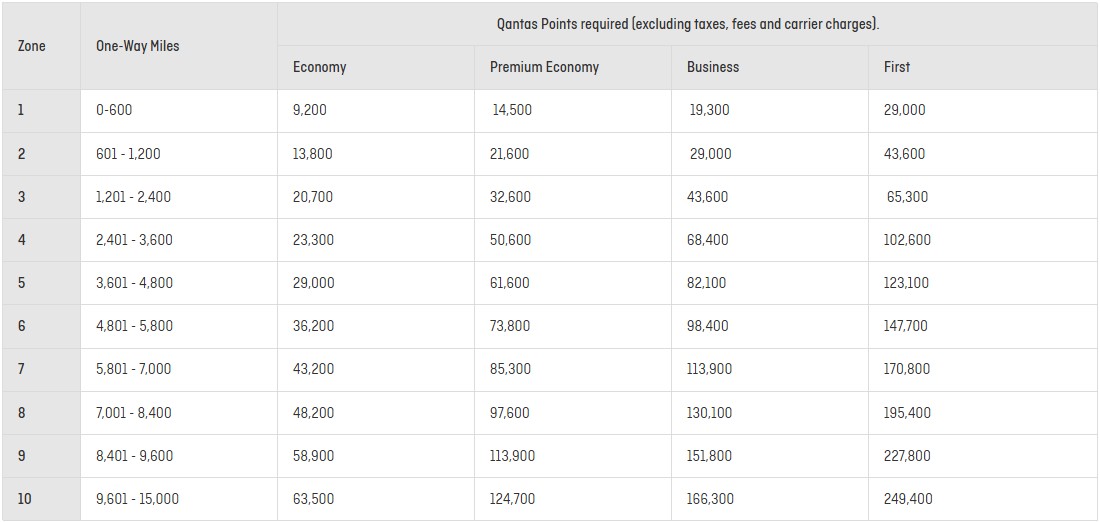
With a distance of 3,596 miles between Brisbane and Manila, I assumed this would be a Zone 4 redemption. So I was surprised to see that Qantas was actually pricing it in Zone 5.
It got me wondering: How does Qantas actually calculate the distance between two airports? So, I asked them…
Airport coordinates used
My first thought was that Qantas might be measuring the distance between the two city centres – or even just the far ends of each airport – rather than the published airport coordinates. Or, I wondered if perhaps Qantas might be using the coordinates of the wrong airport, like it did for many years with the Bangkok-Kuala Lumpur route.
But that’s not the case. Qantas confirmed to Australian Frequent Flyer that it measures the great circle distance using airport to airport coordinates.
This matches what the Qantas Frequent Flyer terms & conditions say regarding the earning of Qantas Points. On routes not specifically included in the Airline Tables, Qantas calculates “the shortest distance on the surface of the globe between the origin and destination of the Flight Segment, regardless of any intermediate stops” for the purpose of awarding points.
Different ways to measure great circle distance
But that’s not the end of the story. My curiosity sent me down a rabbit hole and along the way, I discovered that there are actually two different ways to measure the great circle distance between two points on the globe.
One method assumes that the earth is a perfect sphere. But in reality, planets are not a perfect spherical shape. They are ellipsoids because they are slightly larger when measured latitudinally around the equator compared to the longitudinal circumference. The “ellipsoid” calculation method used by Great Circle Mapper accounts for this, making it more accurate.
Although Qantas didn’t reveal exactly which method it uses, they told us at the time that it’s consistent across all routes. Qantas also pointed out that its method and data source may vary compared to those used by publicly available sources on the internet.
The “ellipsoid” method calculates the distance between Brisbane and Manila as 3,596 miles. But the “sphere” method, which uses something called the “Haversine formula”, puts it at 3,606 miles – leaving this route at the lower end of Zone 5 on the Qantas reward chart. Therefore, I had to assume that Qantas was using the latter method.

Qantas recently changed how it calculates distances
Fast forward to June 2026, and an eagle-eyed AFF member noticed that Qantas had posted the following notice on its points calculator page:
We’re updating how we calculate airport-to-airport distances to ensure more accurate and consistent measurements. Only a small number of routes are affected. Use our calculators to quickly check how many points you’ll earn, or need, for your next trip.
Following this change, the Brisbane-Manila route moved from Zone 5 into Zone 4. The reason is that Qantas now uses “Vincenty’s formulae” to calculate distances. This (more accurately) assumes the globe is an ellipsoid, rather than a perfect sphere.
The main real-world implication of this change is that Classic Reward seats from Brisbane to Manila are now a bit cheaper. Which, frankly, is fair when Qantas is about to switch out the Airbus A330 that currently operates this route to an Airbus A321XLR configured for short-haul operations. Qantas’ A321XLR lacks lie-flat Business seats and doesn’t even have seat-back entertainment screens.
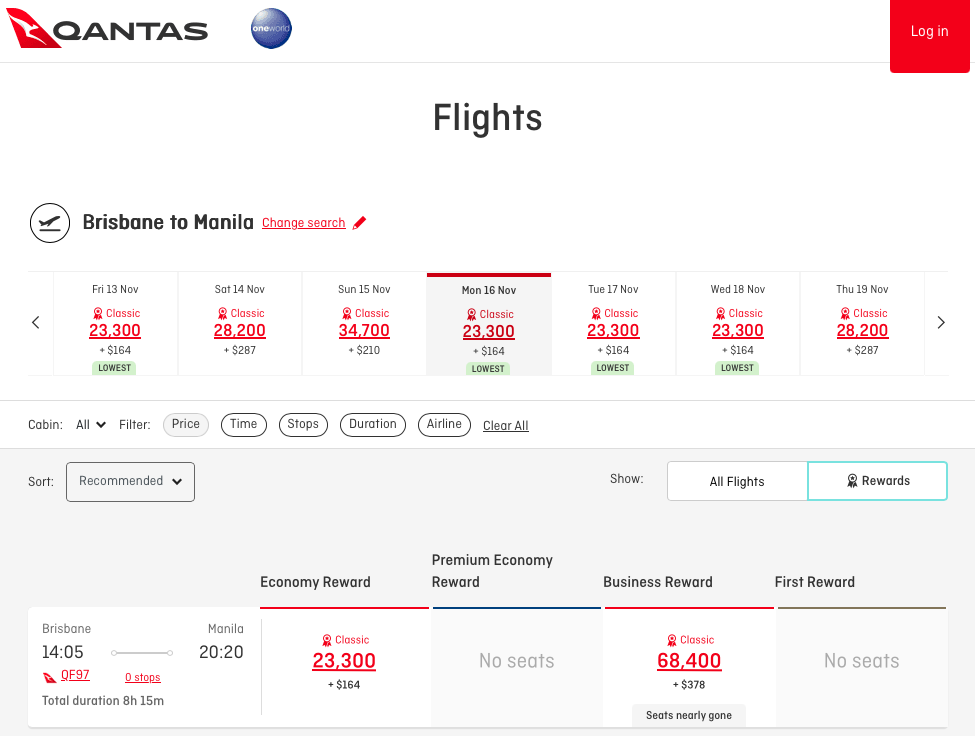
For what it’s worth, the International Air Transport Association (IATA) calculates the great circle distance between Brisbane and Manila as 3,563 miles. But IATA calculates the ticketed point mileage on the same route as 3,607 miles.
Related Articles
-
 15 June, 2024Airlines, Miles and Points
 -
 23 March, 2026Qantas
 -
 31 August, 2023Planning & Booking
Community Comments
Loading new replies...
Join the full discussion at the Australian Frequent Flyer →