How to Calculate the Cost of Any Qantas Classic Reward Booking
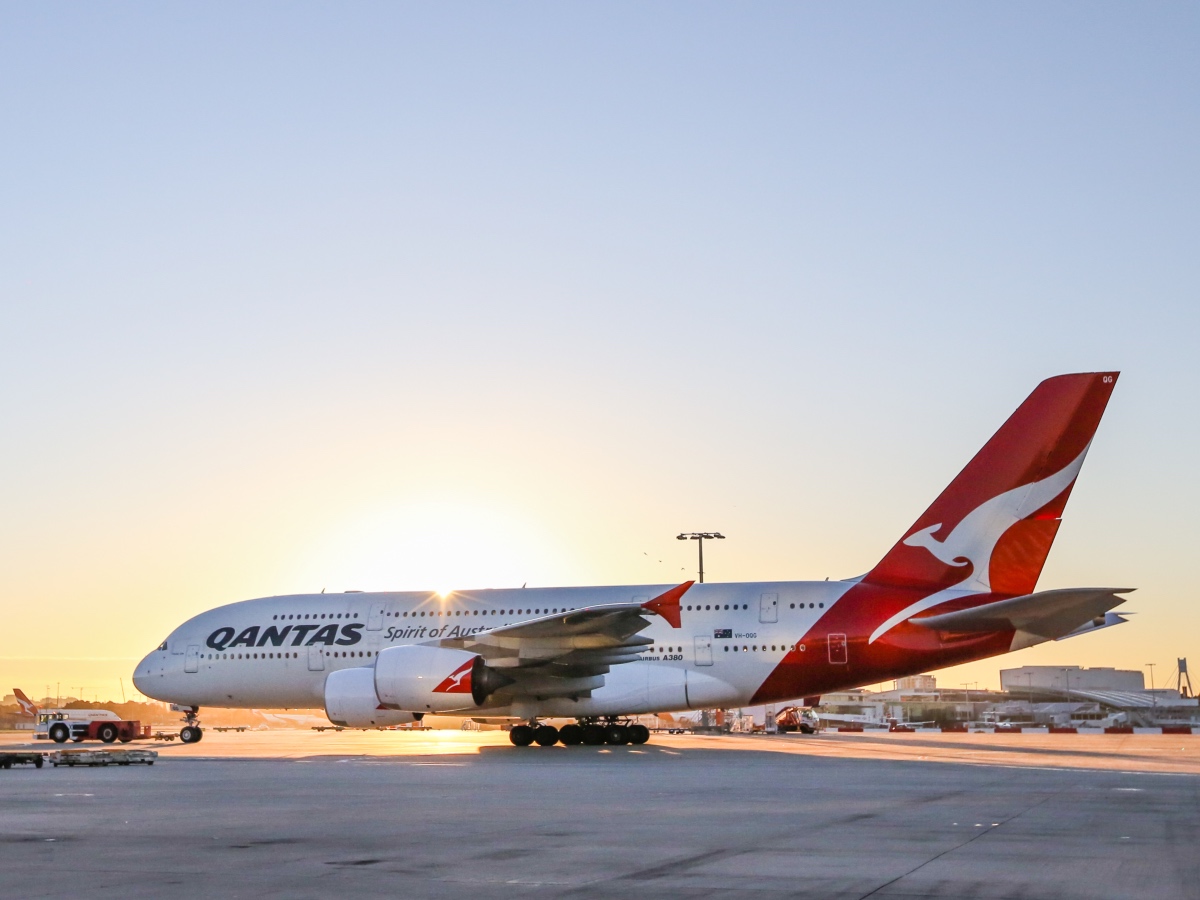
When redeeming Qantas points to book a flight, the number of points you’ll need is based on the four Classic Flight Reward tables on the Qantas website.
To work out how many Qantas points you need to fly anywhere, you can refer to the award chart/s that applies to your itinerary. The cost of your Classic Flight Reward booking will depend on the airline/s you’re flying, the distance flown and your class of travel. You’ll also need to pay any taxes & carrier charges applicable, in addition to the Qantas points.
In August 2025, Qantas increased the cost of their Classic Flight Rewards. The information below is updated to reflect these changes. However, these increases only apply to bookings made from 5 August 2025. So if you made a reward booking before this date, and are now wanting to update or change it, the old rates still apply!
Here’s what you need to know to calculate the points needed to book any Qantas Classic Flight Reward…
The Classic Flight Reward tables
Qantas publishes four different award charts that cover the variety of airlines you can book with Qantas points. These are the:
- Qantas Classic Flight Reward table,
- Jetstar Classic Flight Reward table,
- Partner Classic Flight Reward table,
- Oneworld Classic Flight Reward table, and
- Emirates Classic Flight Reward table (from 31 March 2026)
You can view any of these tables on the Qantas website.
Qantas Classic Flight Reward table
The Qantas Classic Flight Reward table covers flights on Qantas, Fiji Airways, Air Vanuatu and American Airlines. If your Classic Reward only contains travel on these airlines, and was made after 5 August 2025, the points cost below will apply:
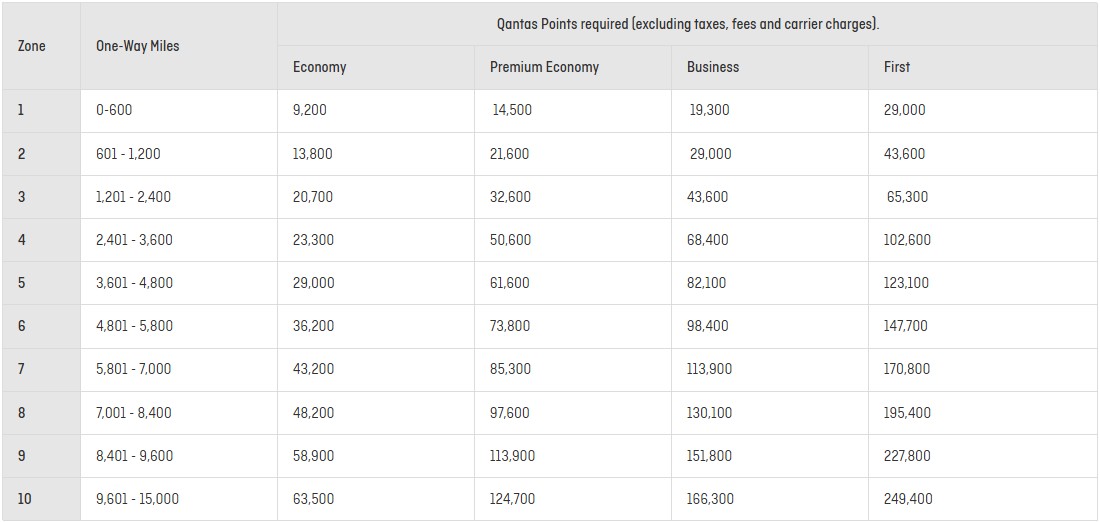
This award chart also applies to QF-coded Air Tahiti Nui reward flights between Auckland, Los Angeles and Papeete.
If you’re combining airlines on the Qantas Classic Flight Reward table, such as Qantas and American Airlines, then the one award table will apply.

Furthermore, if you’re combining airlines listed on this award table, then the price calculated is simply the distance you fly. That means a flight from Dubbo to Nadi via Sydney on Qantas and Fiji Airways in Economy Class costs 20,700 Qantas Points. Sydney-Nadi on Fiji Airways in Economy also costs 20,700 Qantas Points. This is because they both fall within the 1,201-2,400 mile bracket.
Jetstar Classic Flight Reward table
Classic Flight Rewards on Jetstar and Jetstar Japan use the same zone-based table, although the pricing is slightly different.
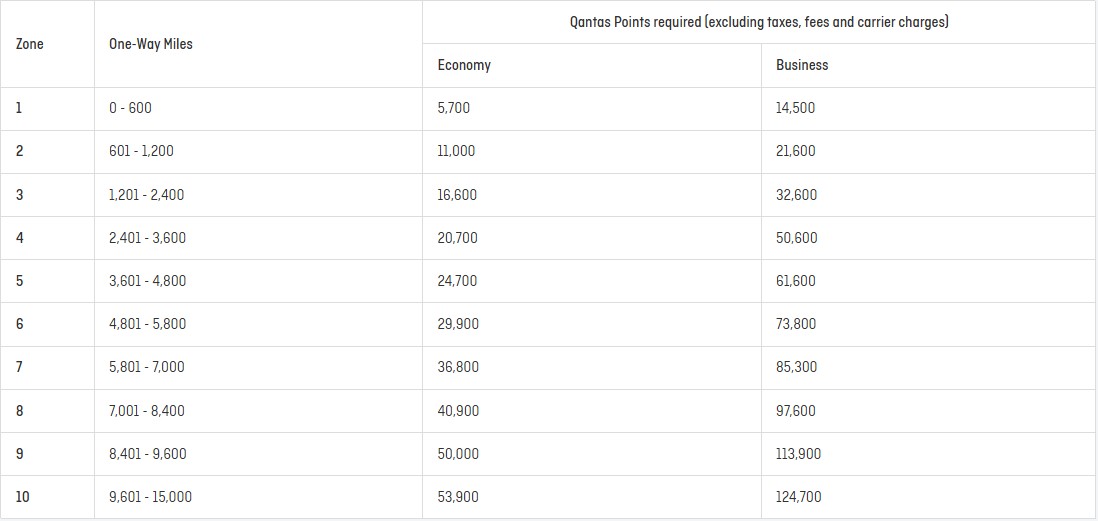
If you’re flying on Jetstar or Jetstar Japan in Economy, the price of a Classic Reward seat is lower than an equivalent Classic Reward seat on Qantas. This is due to the reduced amenities and comfort you find on a Jetstar flight versus ostensibly full-service airlines.
Jetstar Business Class is the same price as Premium Economy on the Qantas Classic Flight Reward chart. This only refers to Jetstar’s Boeing 787 Business Class, which is relatively similar to a Premium Economy offering on full-service airlines.

Partner Classic Flight Reward table
The Partner Classic Flight Reward table covers all other airlines bookable using Qantas Points (except Emirates from 31 March 2026). These include Oneworld airlines such as Japan Airlines or British Airways, and non-alliance partners like Air France.
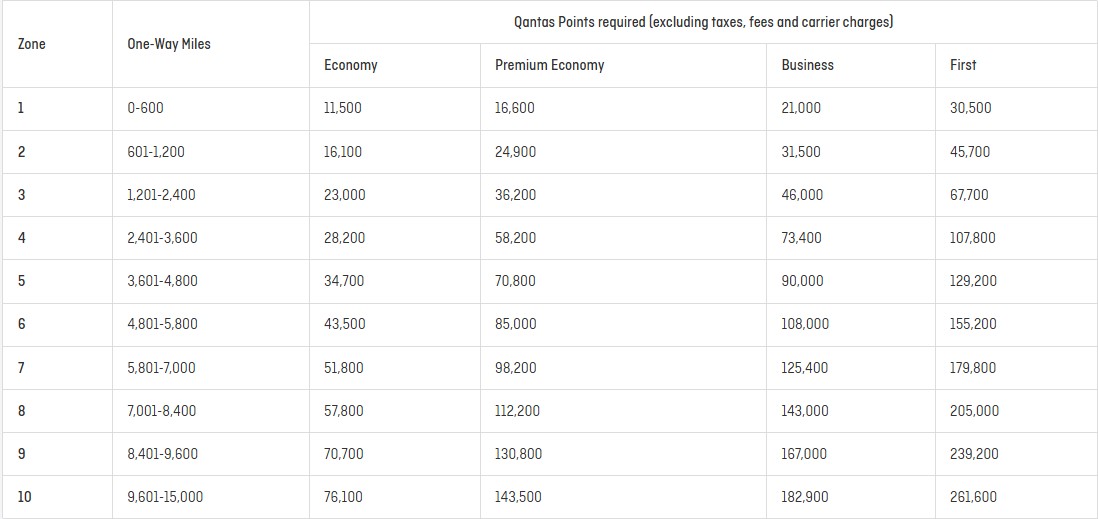
The Partner Classic Reward table uses the same distance-based zones as the Qantas and Jetstar tables, but is more expensive. For example, a one-way flight from Sydney to Tokyo (Zone 6) in Japan Airlines Business Class would cost 108,000 Qantas Points. But flying Qantas on the same route and cabin class would only cost 98,400 points.
Emirates Classic Flight Reward Table
From 31 March 2026, Emirates will have their own Classic Reward table, separate from other partner rewards. This is in addition to new age and status restrictions for booking First Class rewards on Emirates.
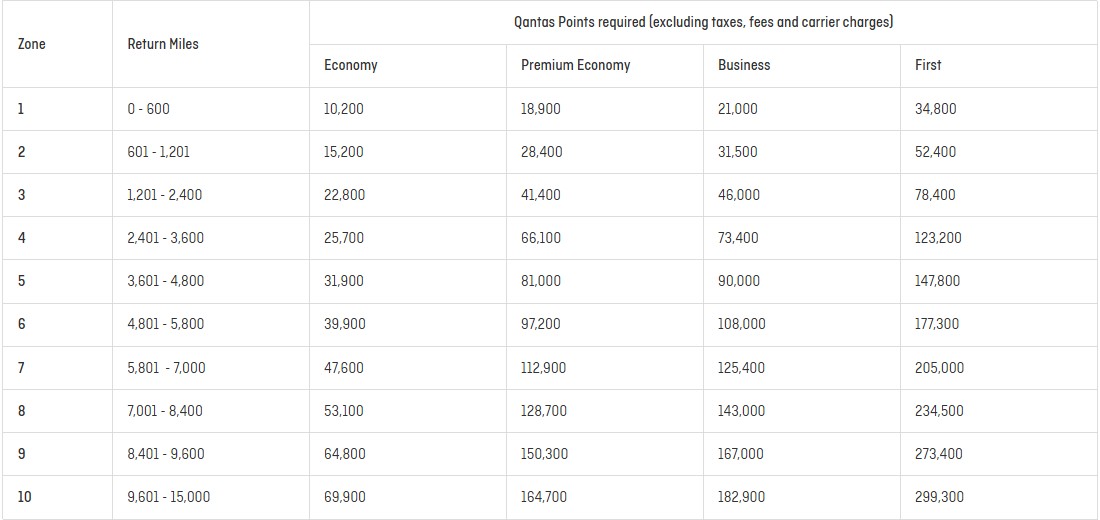
This also means combining Emirates flights with other partner airlines will be more expensive.
How to calculate the distance flown
How far you fly determines the amount of points required for a Classic Reward. So it’s important to know how to figure out the distance you’re flying. Luckily, there’s a very easy-to-use tool for this.
This tool is Great Circle Mapper. Simply, you input the IATA codes for your origin and destination airports, and it draws a line between the two locations.

The top bar, where “syd-sin” sits, is your input bar. You do need to know your IATA airport codes for this, although if you’re unsure you can search your city by entering it into the input bar and clicking search. Or, just Google it.
You can see the straight-line distance between two airports below the map, as well as the heading of the route. Note that your frequent flyer program may measure the distance between two airports or cities slightly differently.
In the example above, the one-way distance between Sydney and Singapore is 3,908 miles. This is between 3,601 and 4,800 miles, so it falls into Zone 5 on the Qantas Classic Flight Reward tables. A Qantas-operated Classic Reward from Sydney to Singapore will set you back 82,100 Qantas Points in Business Class.
You can also do multi-city itineraries in Great Circle Mapper, by adding airports. For example, you could input SYD-HNL-SFO-LAX-JFK-AKL-SYD, and it displays the total distance covered and the distance of each individual segment.
Interestingly, Qantas uses a slightly different way to calculate the distance between two points than one used by Great Circle Mapper. But this is unlikely to affect the points required!
If you’re seeing a much higher number of Qantas points, you may be seeing the Classic Plus Reward price. This is a different type of reward which converts the cost of a commercial airfare into points at a fixed rate. The number of points needed for a Classic Plus booking is often much higher than a Classic Reward booking, but more seats are available.
Calculating the cost of more complex itineraries
You can use the total distance flown to calculate the cost of flying a single class on the same airline. But what happens if there’s two airlines on different reward tables in the same booking? Or a mixed-cabin itinerary?
Combining airlines on different reward tables
How many Qantas points you need when combining airlines in different award tables does depend on which tables you combine.
If you fly both Qantas and Jetstar on a single booking, the Qantas Classic Flight Reward table generally applies to the total distance flown. However, if it’s cheaper to add the individual segments, the lowest price applies.
For example, flying from Sydney to Tokyo would be 98,400 Qantas Points in Business Class if you use the Qantas Reward table. However, if you fly Qantas Business from Sydney to Brisbane, and then Jetstar Business from Brisbane to Tokyo, it would be much cheaper to add the cost of the individual segments together. The price for that would be 80,900 Qantas points (19,300 points for Sydney-Brisbane on Qantas, plus 61,600 points for Brisbane-Tokyo on Jetstar).

The Partner Classic Reward table works a little differently than the Qantas and Jetstar tables. When flying on two different airlines that are both on the partner award chart, the cost is the sum of the individual airline portions.
For example, if you fly British Airways from Paris to Hong Kong via London, and then Cathay Pacific from Hong Kong to Brisbane, you would take the sum of the cost of 6,211 miles flown on British Airways, plus 4,306 miles flown on Cathay Pacific.

Lastly, if you combine airlines on the Partner Reward table with the Qantas or Jetstar Reward table, it is simply the sum of each part.
Mixed cabin bookings
If you book a mixed-cabin Classic Reward, the cost is either based on the highest cabin class flown, or the sum of the sections flown in each cabin class – whichever is lower.
For example, it costs 182,900 Qantas points to fly from Sydney to London via Tokyo in Business Class with Japan Airlines. The same itinerary would cost 261,600 Qantas points in First Class. If you flew Sydney-Tokyo in Business and Tokyo-London in First Class, it would still cost 261,600 Qantas points because that’s cheaper than the sum of the individual segments.
Oneworld Classic Flight Reward table
The Oneworld Classic Flight Reward table is actually based on return flights, not one-way journeys. With this table, you can book a multi-city itinerary with up to five stopovers along the way. This makes it great for booking a round-the-world trip with Qantas points!
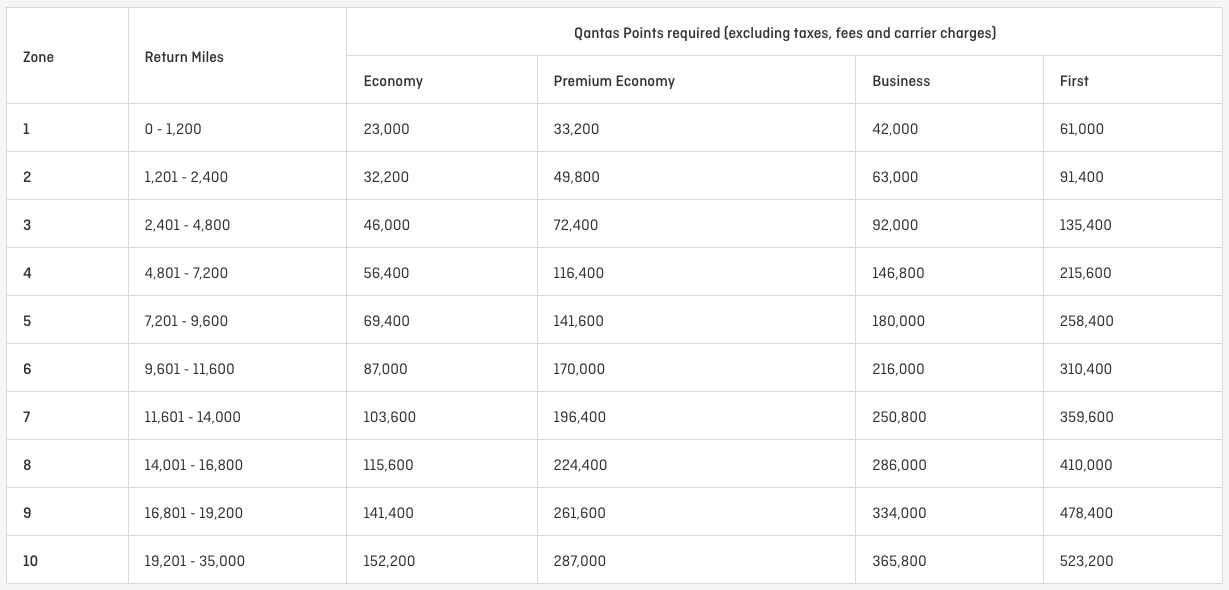
You must fly on at least two Oneworld airlines besides Qantas for this table to apply. However, you can still fly Qantas as well, if you wish. You cannot travel on non-Oneworld airlines such as Jetstar or Emirates though.
With this table, if your final destination is different to your point of origin, the distance back to where you started is also included in the calculation.
For most one-way or return trips, you probably won’t use this table. However, for bigger trips, the Oneworld Classic Flight Reward is one of the best uses of Qantas points.
The number of points needed to book a Oneworld Classic Flight Reward is the same as booking a return trip on a partner airline. If you want to include stopovers or fly on multiple different partner airlines as part of your round trip, then the Oneworld Classic Flight Reward will probably work out to be cheaper.
Frequently asked questions (FAQs)
This depends on the distance you’re flying in miles, which you can work out using Great Circle Mapper. The cheapest flight is flying Jetstar up to 600 miles away, for example from Sydney to Gold Coast, which costs 5,700 Qantas Points + taxes & carrier charges.
You can fly around the world on Oneworld airlines for as little as 152,200 Qantas Points in Economy with the Oneworld Classic Flight Reward. If you’d prefer lie-flat seats, you can fly Business Class for 365,800 Qantas Points.
If you want to use your Qantas points to book a flight, you could get a Business Class flight from Sydney to Tokyo on Qantas for 98,400 Qantas points + taxes & carrier charges. Alternatively, you could get four return Economy Class flights on Jetstar between Melbourne and Brisbane for 88,000 Qantas points + taxes & carrier charges. The number of points needed to book a flight depends on your class of travel and the airline you’re flying with.
If you’d rather use your points on the ground, you could get approximately $500 worth of gift cards for 100,000 Qantas points.
If you’re flying from Melbourne, Sydney or Brisbane to Bali (Denpasar), you’ll need 23,300 Qantas points for a one-way Economy flight or 68,400 Qantas points for Business Class, flying Qantas. Jetstar is cheaper at 20,700 Qantas points for Economy, and 50,600 Qantas Points for Jetstar Business.
Qantas points are only worth what you redeem them for. If you spend your points on a gift card, you may only get 0.5 cents per point in value. However, redeeming them for premium cabin seats or upgrades might get you over 5 cents per point in value! Ultimately, it’s up to you how you value your points.
Related Articles
-
 21 April, 2022Points Inspiration, Qantas
 -
 24 April, 2026Qantas
 -
 31 August, 2023Planning & Booking
Community Comments
Loading new replies...
Join the full discussion at the Australian Frequent Flyer →