Surcharges Banned, Lower Interchange Fees: The 2026 RBA Changes Explained

The Reserve Bank of Australia (RBA) will ban card payment surcharges from 1 October 2026. It will also reduce the maximum interchange fees that merchants can be charged for processing debit and credit card transactions.
While the end to credit card surcharges is a popular move, the RBA knows that this will also lead to a significant reduction in credit card reward points and benefits. It doesn’t care. It considers that a minor inconvenience, which will be outweighed by the benefits.
The RBA’s Review of Merchant Card Payment Costs and Surcharging Conclusions Paper, released today, provides full details of the changes and the reasons for them. I know many people will find this document gripping reading… but for those who don’t want to read all 201 pages, I’ve put together a summary below of the changes that will affect consumers. 😉
So, what exactly is changing?
The main changes announced by the RBA are:
- A ban on debit and credit card surcharges
- A reduction in interchange fee caps for most types of card payments
- Increased transparency from card networks to give merchants better visibility of wholesale fees and scheme fees
Let’s look at the first two changes, which will have the biggest impact on consumers, in more detail…
Ban on card payment surcharges
From 1 October 2026, businesses will no longer be allowed to add a surcharge on EFTPOS, Mastercard or Visa payments. However, other payment types (such as American Express) do not fall under this regulation.
This means, for example, that payment terminals will no longer be able to add an extra surcharge after you’ve tapped your card. It will affect all businesses processing payments in Australia – including our airlines.

Interchange fee reductions
Interchange fees are the costs that a merchant’s bank pays to the card issuer when processing a card payment. They are generally a percentage of the transaction value.
The RBA has already regulated interchange fees for some time. The most recent reduction in reduction in interchange fees was on 1 July 2017. On the day those changes took effect, most Australian banks drastically cut the points-earning rates on their credit cards.
The reserve bank is now reducing its caps on interchange fees even further, for most card types. It’s also eliminating the interchange fee benchmarks that it had previously set for credit card payments. Those benchmarks capped the weighted-average of the interchange fees card networks could collect across all transactions.
The reductions depend on the type of card:
- From 1 October 2026, the debit card interchange fee cap reduces from 0.2% to 0.16%, or from 10 to 8 cents if a fixed amount per transaction. The benchmark remains at 8 cents.
- From 1 October 2026, the consumer (personal) credit card interchange fee cap reduces from 0.8% to 0.3%. This is the same cap that applies in the UK and European Union.
- From 1 April 2027, the interchange fee cap on foreign-issued card transactions reduces from 2.4% to 1%.
- The RBA is not changing the interchange fee cap on commercial (business/corporate) card transactions, which will remain at 0.8%. But the 0.5% benchmark will be abolished on 1 October 2026. This could actually cause the average interchange fee on business card transactions to increase.
Why is the RBA making these changes?
Apart from making Australia’s payments system more efficient, one of the RBA’s primary goals is to end the widespread practice of card payment surcharges.
Banning surcharges is broadly popular. The central bank’s research found that 76% of Australian consumers want surcharging to stop.
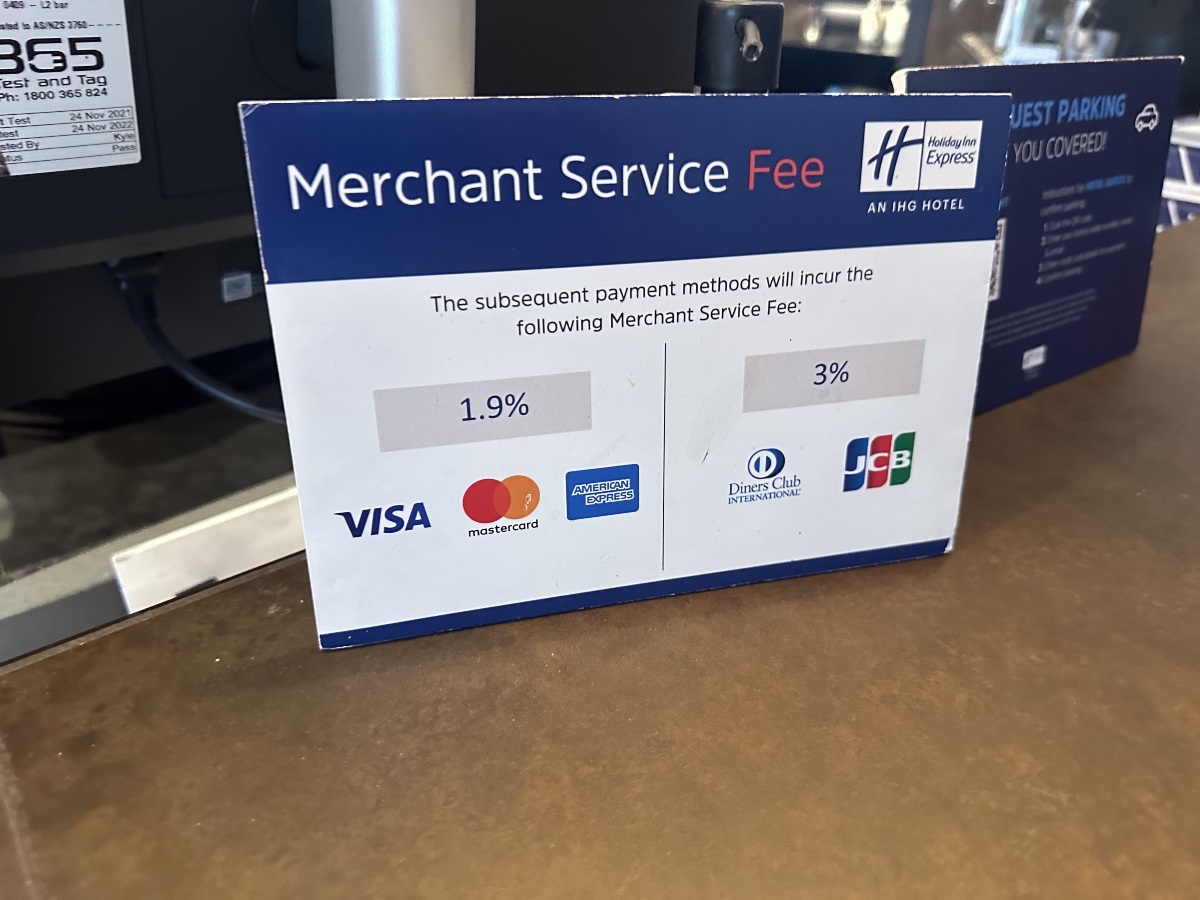
Consumers especially hate surcharges because they often lack transparency. And although it’s technically illegal, many businesses seem to be adding a surcharge that’s above their actual cost of accepting a given payment. For example, some Australian hotels are adding a 1.9% surcharge on Visa and Mastercard payments – even though the current interchange fee cap on domestic-issued credit cards is 0.8%.
Surcharges and payment costs are not standalone issues. To achieve its goal of ending surcharging, something had to give.
As the RBA explains in its Conclusions Paper:
The [Payments System Board’s] view is that surcharging and merchant card payment costs are interconnected issues. Removing the ability of merchants to surcharge without introducing corresponding regulatory actions to lower their card payment costs would simply redistribute costs in the payments system onto merchants while allowing inefficiencies in card payment costs to remain.
The RBA knows this will reduce credit card rewards
Australia-wide, the RBA estimates that its 2026 changes will reduce payment costs for merchants by around $910 million per year. That’s $910 million less that banks will have to fund credit card reward points and other benefits (as well as things like technology investments).
During its consultation process, several large banks told the RBA that they would respond to interchange reductions to maintain their profitability. They would do this by “reducing the benefits they provide to their consumer credit cardholders or by increasing card fees and interest rates”.
Specifically, banks told the RBA they would respond to a reduced interchange fee cap on personal credit cards by:
- Increasing card fees (e.g. monthly or annual fees)
- Increasing interest rates
- Reducing card rewards programs (e.g. by decreasing the earn rate of points)
- Reducing investment in fraud prevention and investments in new technologies
- Approving fewer credit card applications by tightening their credit assessments
Nonetheless, the RBA felt that the benefits of reducing interchange fees strongly outweighed the downsides.
The RBA believes this is fairer
In its Conclusions Paper, the RBA says:
The RBA has set interchange caps using eligible issuer costs as a reference point. This is consistent with a ‘user pays’ philosophy, where merchants should not have to subsidise benefits, such as rewards points, that issuers offer their cardholders to encourage them to use more expensive credit cards.
And:
Lowering interchange fees on consumer credit cards will also reduce the extent to which lower income cardholders cross-subsidise benefits received by holders of premium credit cards (which are held primarily by higher income households).
In other words, the RBA does not believe it’s fair for merchants, nor for people using lower-end credit cards that attract lower fees, to be subsidising the reward points and benefits that wealthier premium credit cardholders receive.
The RBA further suggests that:
Lower card payment costs should eventually flow through to consumers, since merchants will be able to set lower advertised prices for their goods and services.
Yep, we all know that businesses will pass on their lower costs to customers! 😉
Transactions on foreign-issued cards
The RBA believes it’s fair for card networks to charge more for accepting foreign-issued credit cards in Australia, as there are higher costs involved. One of the reasons for this is a higher instance of fraud on foreign cards. However, the RBA does not believe these costs are so much higher that they justify an interchange fee that’s 1-1.5% higher than that for domestic cards. That’s why it will reduce the maximum interchange fee for foreign card transactions from 2.4% to 1%.
The RBA notes in its paper that foreign cards currently account for 3% of total transactions in Australia, but 20% of total interchange fees paid by merchants.
However, this statistic does not account for the actual transaction values – which may be higher on transactions processed with foreign cards. Interchange fees are paid as a percentage of the transaction amount, not based on the total number of transactions. So, in my opinion, the figures the RBA provided here are not that meaningful.
Why the RBA isn’t cutting interchange fees on commercial cards
It’s important to note that American Express (Amex) does not fall under the remit of these RBA regulations. Amex is the largest issuer of commercial credit and charge cards in Australia.
It would be unfair to Visa & Mastercard
According to the RBA, many stakeholders were concerned that Amex would ban merchants from surcharging, while still being able to fund higher reward point earn rates through higher interchange fees. They were worried that merchants would bear the cost of this because they would still feel obliged to accept Amex payments.
The RBA believes Amex would still be restricted by commercial pressure, noting:
The lower rate of merchant acceptance of American Express relative to designated card networks suggests merchants opting out of the American Express network exerts some measure of competitive pressure on its merchant fees.
Nonetheless, the central bank chose not to reduce the interchange fee cap on commercial credit cards. A key reason is that this could be unfair to Visa and Mastercard. It says:
Allowing for a separate interchange cap for commercial credit cards supports a more even playing field between Mastercard, Visa and American Express. American Express is the largest issuer of commercial cards and on average these cards cost more for merchants to accept than cards processed through the Mastercard and Visa credit networks.
However, the RBA plans to commence a further review in mid-2026. This will consider public interest issues involving Amex, and Buy Now Pay Later (BNPL) services which are also not covered by these new rules.
Other reasons for maintaining commercial card interchange fees
The RBA further argued that:
- Commercial card issuers are less about to recoup their costs through interest payments, as many of these cards are charge cards that the business pays off in full every month
- There are fewer viable substitutes for business and corporate cards
- Commercial cards are apparently more expensive to issue
- The European Union, UK and New Zealand do not cap commercial card interchange fees
That last point is worth noting as the RBA referenced existing practices in the UK and Europe quite heavily in its paper. Some might say that it’s taken a lot of “inspiration” from the existing regulations in those markets.
Business cards could soon be more attractive
Currently, there isn’t a substantial difference in the amount of points you can earn on a personal credit card compared to a business card in Australia. That could soon change if banks cut rewards on personal cards, but not business cards, in response to these changes.
Debit cards are also emerging as a new option for valuable rewards.
What do you make of these changes?
Share your thoughts, and read the opinions of other AFF members, on our forum:
Related Articles
-
 16 July, 2025Credit Cards
 -
 7 January, 2026Credit Cards
 -
 26 June, 2024Credit Cards