Superannuation Discussion + market volatility

You mean they overestimate their weekly budget?
Yes in a way. I see how people think they need $2000 a week income (just random number ) and they are working out on a very low return on their superannuation. So they end up with more in superannuation cause they are restricting themselves from spending

Ok I think that waffle above may have gotten away from me trying to explain lol.
 
From first hand experience, very few unadvised clients have done the research to know how much capital they need in retirement - and by the time they do, it can be too late to either contribute, or to accept the level of risk needed (or even a combination of the two). The ASFA retirement standard numbers are generally sobering for most: Retirement Standard
Interesting, even the highest level "comfortable lifestyle" provides for only 1 domestic flight pa and 1 OS per 7 years!
Need an "aff lifestyle" category.
 
Retirement Standard
The problem there is the assumption of the "average" house and its associated costs.
Some who have large houses at retirement would need to downsize to get into the numbers quoted.
I think the numbers would be Ok for a freestanding house with a rebuild insured value of about $1-1.2M

And looks like only 1 car?
 
Last edited:
Do you think people perhaps a inflated view of how much is needed in retirement ? Not including those who currently rent due to inability to purchas , they have a horrendous time .

Notwithstanding I know a lot of people have aversions to Centrelink but it is there as a backup
The issue for many is the cost of special care at home or transfer to a nursing home.
 
cost of special care at home or transfer to a nursing home.
If the retiree wants greater choice of NH -especially the nicer ones.

.....
how much capital they need in retirement

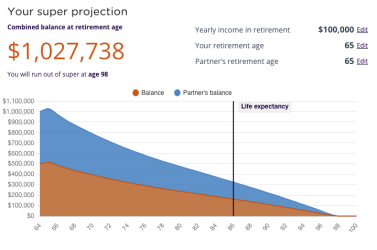
So how much capital is required for say $100K /year ($50Kx2) (say the AFF "Y" retirement level) , age of retirement 65 and no other assets, home owner, couple, and using the retirement standard
My guess is $1M combined capital for a couple with capital runout by age 100?
 
Last edited:
When I last looked 8% of people get to NH.
MOST non-travellers would struggle to spend $300 each and everyday
That’s $2,100 per week
$109,500 per year
Or $220,000 per couple each and everyday over many years

Of course, it’s not impossible

New furniture, fixtures and fittings
House repairs
Regular upgrades of Nice cars
Cats & Dogs
Gardens
Bank of Mum & Dad Donations
Sponsoring
Fine dining
Dental
Medical
Hobbies
Memorable AFF events
Events, shows, concerts, socialising
 
$109,500 per year
I think $100K per couple would be very reasonable - at least initially in retirement.
For some it would be very difficult to immediately downsize to "comfortable retirement standard' of $77K/yr immediately on retirement.
I wonder have people calculated a super projection where the first decade of retiree couple spends 1.5x "comfortable retirement standard" and then a reduction in expenditure of 10-15% each retirement decade?
 
Last edited:
If the retiree wants greater choice of NH -especially the nicer ones.

.....


So how much capital is required for say $100K /year (say the AFF "Y" retirement level) , age of retirement 65 and no other assets, home owner, couple, and using the retirement standard
My guess is $1M combined capital for a couple with capital runout by age 100?
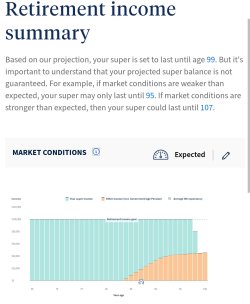
Lots of calculators out there, this from Unisuper $1.6m runs out at 99 if needing $100k pa, some of which comes from part gov pension from age in 80s.
Presumes investment in "balanced" and matches historical returns and, the big presumption, no lump sum withdrawal to pay, say, partner's RAD.

Edited, again, for clarity.


Screenshot_20260601-151737.Chrome~2.jpg
 
Last edited:
The problem there is the assumption of the "average" house and its associated costs.
Some who have large houses at retirement would need to downsize to get into the numbers quoted.
I think the numbers would be Ok for a freestanding house with a rebuild insured value of about $1-1.2M

And looks like only 1 car?
Correct, most don't look to downsize until they are thinking aged care, rather than in early retirement years (they are keeping it so the kids and grandkids can visit and have rooms to stay). But looking after the house draws a re asonable amont of $ which reduces their retirement balance. More need to think of doing it sooner
 
The issue for many is the cost of special care at home or transfer to a nursing home.

Seems that all the sums assume eventually casting oneself into the tender arms of guvmn't care.
I had no idea retiring at 55 where we might end up.
Times have been good and the bank remains full.
This happy situation saw plans for estate dispersal (using a trust !!!!!!).. and some happy kids.
Now I expect to spend x% of the ski content on continuing a comfortable lifestyle and employing folks to help maintain it
 
The costs of downsizing with stamp duties, agent and sales costs, then buying into an appropriate sized home and favourable area are prohibitive.
Yes
Agent 3% to sell and 3% to buy
The stamp duty 1.25%
Conveyancing fees
Removalists

Can easily be $200,000 assuming Sydney property prices but that unlocks some capital tax free assuming downsizing in capital value as well, and if downsize into a new house, could drastically reduce maintenance and upgrade costs.
 
Yes
Agent 3% to sell and 3% to buy
The stamp duty 1.25%
Conveyancing fees
Removalists

Can easily be $200,000 assuming Sydney property prices but that unlocks some capital tax free assuming downsizing in capital value as well, and if downsize into a new house, could drastically reduce maintenance and upgrade costs.
Don't forget the styling now and the storage costs while the house has been styled.

Friends recently had to move out and were lucky they were able to stay with a family member but otherwise the rent would have been horrendous. They couldn't buy until they knew how much they sold for so it hasn't been a fun experience
 
If the retiree wants greater choice of NH -especially the nicer ones.

.....


So how much capital is required for say $100K /year ($50Kx2) (say the AFF "Y" retirement level) , age of retirement 65 and no other assets, home owner, couple, and using the retirement standard
My guess is $1M combined capital for a couple with capital runout by age 100?
That may work on average but I think vulnerable to poor investment returns in early years
The 'safe' withdrawal level without loss of capital is usually recommended as 4% (i.e less than the mandatory) so I guess it's something inbetween (especially with aged pension kicking in) almost certainly closer to your figure than $2.5M
The 4% 'safe' withdrawal method ends up with a higher capital balance than you started with more times than not
 
Last edited:
Yes
Agent 3% to sell and 3% to buy
The stamp duty 1.25%
Conveyancing fees
Removalists

Can easily be $200,000 assuming Sydney property prices but that unlocks some capital tax free assuming downsizing in capital value as well, and if downsize into a new house, could drastically reduce maintenance and upgrade costs.
Smaller does not mean less expensive these days.
 
I would have to do (organise) some home maintenance lol to be able to sell.
However we aren't the regular demographic for downsizing. Our place is a two bedroom townhouse reasonably sized . So not much to downsize

If income was needed I think the Centrelink Home Equity would be utilised .
 
How many (I know some have) AFFers have actually had a hard look at how much they have spent per year over (for example) the last 5 years? If you were asked what your 5 biggest expenses each year had been & how much (to the nearest $'000) would you know?

Most people (surveys continue to show) spend multiples the amount of time planning their holidays then managing their finances.

Things change once you fully retire, and somewhat when you partially retire.

For example the need for multiple vehicles can disappear for 50 or more weeks per year and it becomes significantly cheaper (savings on insurance alone) covers rental cost for that 1 or 2 weeks per year when an extra vehicle comes in handy.

For some, dry cleaning costs nearly disappear, distances driven due to daily commuting ceasing plummet and all associated costs accordingly even if you don't downsize your vehicle fleet. Similarly, travel costs can also reduce substantially (when points are not available) as you are no longer locked into the old restrictions of when you could organise annual leave for. Being able to take advantage of super cheap airfares at the last minute can generate meaningful savings (provided you've kept your passport current, or with at least more than 6 months to expiry).

The tax free nature of super (for most) makes a massive difference when pre-tax & post-tax are the same for super (now pension) income.

Simplest way to get rough idea of how much spent each year. Tax return net income less change in bank balances and less any net investments made. Then, as all diehard AFFers do, check all your CC spending perhaps using a simple spreadsheet with columns for say, house/rent expenses, vehicle/transport, utilities, health, clothing, travel, general living (food, hair cuts, etc), entertainment, furniture/tech.

Divide it up however best suits your lifestyle. If pedantic (detail oriented) then out the CC date spent per item - that way you can resort the spreadsheet in different ways such as by category, amount, timing etc.

Remember: Proper Planning Prevents Poor Performance or "you get out of life what you put into it".

 

Become an AFF member!

Join Australian Frequent Flyer (AFF) for free and unlock insider tips, exclusive deals, and global meetups with 65,000+ frequent flyers.

AFF members can also access our Frequent Flyer Training courses, and upgrade to Fast-track your way to expert traveller status and unlock even more exclusive discounts!

AFF forum abbreviations

Wondering about Y, J or any of the other abbreviations used on our forum?

Check out our guide to common AFF acronyms & abbreviations.
Back
Top