



Card payment sucharges banned in Australia from 2026

You don't find it odd then that they didn't canvass any policy options around capping merchant fees in their review last year?
They did. They indicated a preference for banning surcharges, and limiting interchange fees.

However, the legislation to regulate Amex etc hadn't passed Parliament at the time consultation kicked off so Amex's fees were not included. One thing at a time...
 
Why is this so hard in Australia? Is it our big 4 banks having so much power?

Surcharge bans have been enforced with 100% compliance in the UK and EU, so why can’t we do the same in Australia?
You have this backwards! When the banks controlled it, there were no surcharges. It's the Reserve Bank that forced banks to allow surcharging.

All the blame for this is on every Treasurer for the last 20+ years.
 
They did. They indicated a preference for banning surcharges, and limiting interchange fees.

However, the legislation to regulate Amex etc hadn't passed Parliament at the time consultation kicked off so Amex's fees were not included. One thing at a time...

Amex doesn't have interchange fees. That's my point - how do they implement it?
 
Amex doesn't have interchange fees. That's my point - how do they implement it?
By capping merchant fees that Amex charges. But this wasn't canvassed because legislation covering Amex hadn't yet passed.
 
From the RBA minutes last week. A consultation paper on Amex etc will be released mid next year covering a broad range of issues.

“Members welcomed the recent amendments to the PSRA. There will be a public consultation in mid 2026 on the Board’s regulatory priorities, taking into account these amendments, technology development and innovation in the payments industry, and payments regulatory issues that extend beyond the Review of Merchant Card Payment Costs and Surcharging. The consultation would include efficiency, competitiveness and safety issues with mobile wallets, three party schemes, buy-now-pay-later providers and e-commerce platforms.”
 
An interchange fee cap is simply a price control.

Amex also charge prices. The RBA can control that too.

What's so hard to understand?

If they have the power to fix merchant rates, why do they only fix interchange?

If they were to cap the merchant rate Amex charges, to make a level playing field they would also need to do it for the Visa and MC schemes too. Far as I know (from their public statements), they haven't proposed anything like that yet.
 
If they have the power to fix merchant rates, why do they only fix interchange?

If they were to cap the merchant rate Amex charges, to make a level playing field they would also need to do it for the Visa and MC schemes too. Far as I know (from their public statements), they haven't proposed anything like that yet.
One follows from the other if your guiding principle is maintenance of well-functioning competition.

The RBA regulates interchange fees because competition does not work — as the RBA has said, 'in contrast to normal markets for goods and services, competition in well-established payment card networks can lead to the counterintuitive result of increasing the price of payment services to merchants'.

However, the big four banks are loudly complaining that regulation of interchange fees creates a different form of competitive failure because it means some financial institutions (eg Amex) are not subject to price controls while others (ie the big four) are.

The RBA would adopt an alternative mechanism to level the playing field — we do not yet know what that is, but regulation of merchant fees that Amex charges is one option.

There does not need to be equivalence in treatment between Amex and Visa/Mastercard because they are not equivalents.
 
Last edited:
Thank you for taking the time to explain that. I see your point. But I'm still curious about the practicalities. Is there really power for them to regulate the merchant rate? Isn't it more a touch point between a scheme and a user - but not between scheme participants. And they only have power to regulate the latter?

Or would they just do something convolted like say Amex department A cannot charge Amex department B more than X%, and Amex department B cannot charge Amex department C more than Y%, and so the price is effectively capped at X% + Y%?
 
Thank you for taking the time to explain that. I see your point. But I'm still curious about the practicalities. Is there really power for them to regulate the merchant rate? Isn't it more a touch point between a scheme and a user - but not between scheme participants. And they only have power to regulate the latter?
Yes, they can regulate the merchant rate, and no they're not limited to who they regulate (provided there's a nexus to a payment system).
 
so how is this still legal?
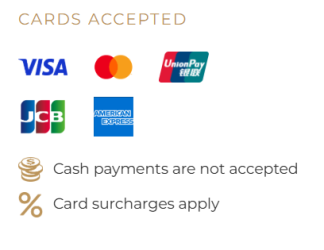
View attachment 485626
thought if they didn't accept cash they couldn't surcharge cards?
They don't have to accept cash, but they MUST provide an alternate payment method that avoids transaction fees, such as direct deposit/PayID etc.
Do they accept any other payment form without transaction fees?
Which company is this?
In other words, they must provide a payment method so you can buy said product or service for the advertised price.
 
Last edited:
They don't have to accept cash, but they MUST provide an alternate payment method that avoids transaction fees, such as direct deposit/PayID etc.
Do they accept any other payment form without transaction fees?
Which company is this?

Nope incorrect

A business can be card ONLY and doesn't have to accept PayID etc.


"In general, businesses can charge a surcharge for paying with a credit, debit or prepaid card, but there are rules around what businesses can include in calculating these costs.

If there is no way for a consumer to pay without paying a surcharge, the business must include the minimum surcharge payable in the displayed price for its products"

Also

 
Nope incorrect

A business can be card ONLY and doesn't have to accept PayID etc.


"In general, businesses can charge a surcharge for paying with a credit, debit or prepaid card, but there are rules around what businesses can include in calculating these costs.

If there is no way for a consumer to pay without paying a surcharge, the business must include the minimum surcharge payable in the displayed price for its products"

Also

It's not incorrect, read what you have pasted, again (last line of text).
They can build the transaction fee into the advertised price, which means you are paying the advertised price (no laws broken).
So in that case there is no need to provide another payment method as there are no hidden or extra fees (you pay the price you see).
They key is, you MUST be able to buy and product or service for the advertised price with no additional fees on top of the advertised price (by at least 1 payment form).
In the example above, it says no cash but then shows an extra fee for cards (on top of the advertised price), in this case they must provide another payment form without extra fees.
Just as Virgin Australia and Qantas does, in the form of PayID.
 
Last edited:
"They don't have to accept cash, but they MUST provide an alternate payment method that avoids transaction fees, such as direct deposit/PayID etc"
 
so how is this still legal?
View attachment 485626
thought if they didn't accept cash they couldn't surcharge cards?
Well, they may offer some card payments with a surcharge (e.g. Amex) and others surcharge-free (e.g. Visa/Mastercard). As others have noted, if they're applying card surcharges to all cards, that's a problem.
 
"They don't have to accept cash, but they MUST provide an alternate payment method that avoids transaction fees, such as direct deposit/PayID etc"
In the ABOVE example, yes, because if you look at the screen shot it says they don't accept cash, and you must pay an extra fee on top of the advertised price via any card (no other payment options) Therefore making it impossible to buy the product or service for the advertised price, which is illegal.
In simple terms, there must always be at least 1 payment method that allows you to purchase the product or service at the exact advertised/shelf price.

You even posted this yourself from the ACCC site...
"If there is no way for a consumer to pay without paying a surcharge, the business *must* include the minimum surcharge payable in the *displayed price for its products*"
AKA built into the advertised price.
 
Last edited:

Become an AFF member!

Join Australian Frequent Flyer (AFF) for free and unlock insider tips, exclusive deals, and global meetups with 65,000+ frequent flyers.

AFF members can also access our Frequent Flyer Training courses, and upgrade to Fast-track your way to expert traveller status and unlock even more exclusive discounts!

AFF forum abbreviations

Wondering about Y, J or any of the other abbreviations used on our forum?

Check out our guide to common AFF acronyms & abbreviations.
Back
Top