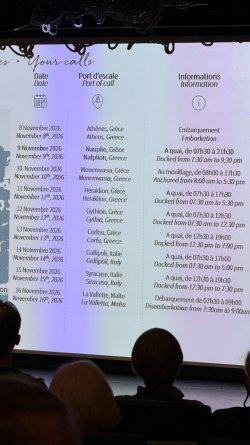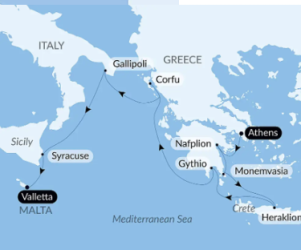





Cruise across the Mediterranean - Athens to Malaga, via Valletta

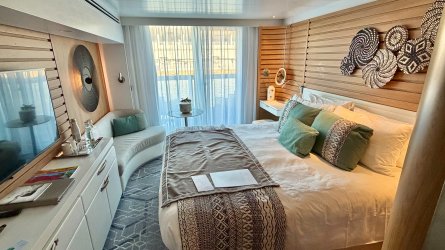
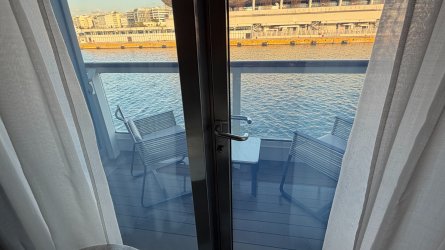
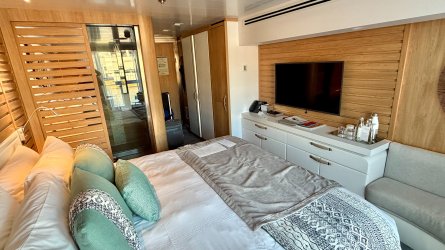
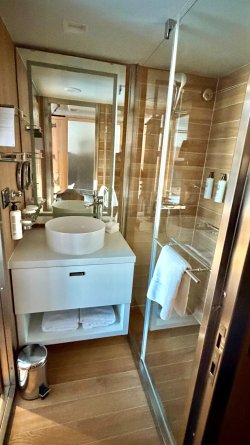
So, to boarding. No upgrade :confused: So kept my 'upper deck balcony stateroom' which means I get a door or a sliding door onto my balcony (I got a door) and I've chosen midships of deck 4. Deck 3 only has a door on a smaller balcony. Deck 5 has the same room, but is more expensive due to being higher and deck 6 has most of the suites.

Le Champlain.

1794738055208.png


IMG_3318.JPEG

IMG_3319.JPEG

IMG_3320.JPEG

IMG_3321.JPEG

Fully stocked and included minibar, refreshed daily. You can ask for your particular sprits, mixers etc

IMG_3322.JPEG

Summary of the cruise

IMG_3325.JPEG 1794732967947.png

There was a 'solo passengers get together, with canapes and Champagne', and I found a great group of about a dozen - USA, Canada, Switzerland, France, Australia. We socialised, trivia-ed and ate together throughout the voyage.

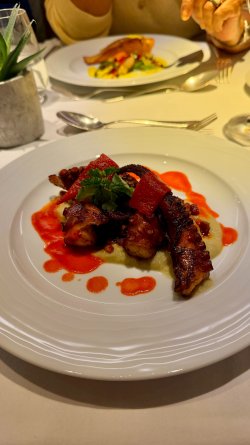
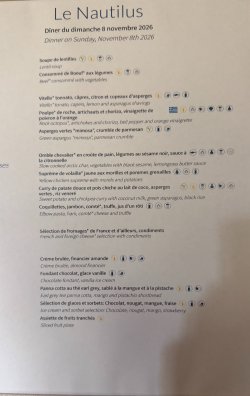
You can eat in the a la carte restaurant, Le Nautilis on deck 4 or buffet and a la carte on the outside pool deck, deck 3.
IMG_3326.JPEG

Occy

IMG_3327.JPEG
 
Last edited:
We sailed in calm seas overnight to Nafpilon and from there to visit Edpidaurus and Myceanae

1794736529892.png

There are usually 2 included excursions choices at each port, do one. Then the pax for each excursion are divided into French and English groups, separate busses and guides.

Driving out to Epidaurus
IMG_3330.JPEG

There we found out about Asklepios. He was the Greek god of medicine and healing. He was the son of Apollo and a mortal woman, Koronis. The myth says Koronis was unfaithful to Apollo while pregnant, and she was killed, either by Apollo’s sister Artemis or by Apollo himself. As her body burned on the funeral pyre, Apollo snatched the unborn child from her. One tradition, including one connected to Epidaurus, say Koronis gave birth in secret and exposed the child on a mountain, where he was nursed by a goat and guarded by a dog.

His wife was Epione, whose name means “soothing,” and their children personified aspects of health. Hygieia stood for hygiene and prevention (the root of our word “hygiene”), and Panakeia was the all-healing remedy (the root of “panacea”). Iaso represented recovery, Aglaia radiance, and Akeso the healing process. His sons Machaon and Podaleirios were physicians who served with the Greek army at Troy in Homer’s Iliad, where Asklepios himself appears only as a human healer, a sign that his divine status developed later.

Asklepios became so skilled that he could bring the dead back to life. Zeus, fearing this would upset the natural order, struck him down with a thunderbolt. Apollo, furious, killed the Cyclopes who forged the bolt, and was punished with a period of servitude to a mortal. Zeus then placed Asklepios among the stars as the constellation Ophiuchus, the “serpent bearer.” His most recognizable emblem is the Rod of Asklepios, a staff with a single snake coiled around it. Snakes symbolized renewal, since they shed their skin, and harmless snakes were kept in his sanctuaries and allowed to crawl among sleeping patients. The Rod of Asklepios is the emblem of the World Health Organization.

The Epidaurus site was a complex of a healing centre. Its most famous part is the theatre, well preserved and having almost parfect acoustics.

By the sixth century BCE the sanctuary of Asklepios was developing, and by the fourth century it had become the most celebrated healing center in the Greek world. Pilgrims came to sleep in the abaton, a dormitory where they hoped the god would visit them in dreams and prescribe a cure. Inscribed stone tablets recorded miraculous recoveries. Alongside this religious practice, the sanctuary offered baths, diet regimens, exercise, and rest, so it blended ritual and practical care.

In the late fourth century BCE, the architect Polykleitos the Younger designed the sanctuary’s theatre, famous also for its harmonious proportions. It seated around 14,000 spectators and hosted dramatic and musical contests during festivals such as the Asklepieia. Other structures included the tholos, a temple of Artemis, a stadium, and guesthouses for visitors.

IMG_3332.JPEG

IMG_3336.JPEG

IMG_3339.JPEG

There is a small museum, containing medical artifacts and and statues.

IMG_3345.JPEG

IMG_3346.JPEG

IMG_3349.JPEG


Statue of Hygea, with snake.

IMG_3350.JPEG

A stadium for racing, exercise etc

IMG_3364.JPEG

Quite a bit more to the site - dorms, refectories etc for the pilgrims

IMG_3363.JPEG


1794737871556.png
 
Read our AFF credit card guides and start earning more points now.

AFF Supporters can remove this and all advertisements

Become an AFF member!

Join Australian Frequent Flyer (AFF) for free and unlock insider tips, exclusive deals, and global meetups with 65,000+ frequent flyers.

AFF members can also access our Frequent Flyer Training courses, and upgrade to Fast-track your way to expert traveller status and unlock even more exclusive discounts!

AFF forum abbreviations

Wondering about Y, J or any of the other abbreviations used on our forum?

Check out our guide to common AFF acronyms & abbreviations.
Back
Top