0.1% but that was from the RBA that also said these changes would people money, so I expect more then 0.1%
Labor MP Jerome Laxale says focus will now shift to payments costs for business, issuing a warning to payment service providers and digital wallets.

www.afr.com
Higher interest rates, is great for me though

You are perfectly right to expect individual price changes higher than 0.1% at the cash register. The 0.1% figure is a macroeconomic calculation by the RBA based on the total net impact across the entire economy.
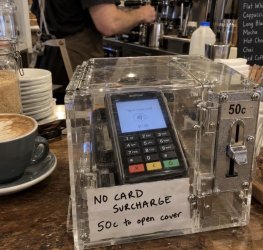
Menu and shelf item adjustments will be larger at the individual level; when a business includes payment terminal fees into its general pricing they must round up to the nearest logical cash tier, so with a $5.00 coffee having a 1.5% processing fee factored in by a café, the item cost increases by 7.5 cents to $5.08. Because there are no 1¢ or 2¢ coins this needs to be rounded up. That coffee will likely become $5.10, $5.20, or even $5.50.
So, the out-of-pocket variance on a specific retail item or meal in some places will seem much more pronounced than 0.1%. However, the general impact to inflation will be much less than that since the RBA's 0.1% figure is a calculation based across the entire consumer price index coming from areas such as utilities, rent, healthcare, major retailers, etc. & an your local coffee shop.
Included also in the calculation is that, before the ban only about 16% of Australian businesses actively applied a card surcharge; so the above cost recovery increase only applies to a fraction of transactions in specific sectors like small retail or hospitality.
To add to that, last year cash accounted for ~15% of payment transactions and 8% of value of consumer transactions in Australia which further dilutes that $5.50 coffee impact.‡
So Life goes on; If there is a choice between similar products of $5.50 or $5.10, I know where I'll head ...
‡
Cash Use in Australia: What the 2025 Consumer Payments Survey Tells Us | Bulletin – April 2026