





You are using an out of date browser. It may not display this or other websites correctly.
You should upgrade or use an alternative browser.
You should upgrade or use an alternative browser.
Western Sydney Airport (WSI) Discussion
- Thread starter moa999
- Start date
- Featured

- Joined
- Nov 12, 2012
- Posts
- 33,396
- Qantas
- Platinum
- Virgin
- Gold
- Star Alliance
- Gold
Story in today's Oz ... perhaps the CEO is being a little ambitious, but hey, ya gotta aim high, right?
Western Sydney Airport could be the size of Dubai or New York’s JFK, says its chief executive
I was also surprised at the progress made on the Metro tunnelling to connect the airport with St Mary's station and the rest of the Sydney rail network. There is a link to a video in the above story.
Western Sydney Airport could be the size of Dubai or New York’s JFK, says its chief executive
Mr Hickey said the greenfield development – twice the size of the current Sydney Airport site – would solve the problem of Sydney being one of few global cities with no 24-hour airport, as well as opening up new routes and scheduling options.
Western Sydney Airport will commence operations in 2026 with a single runway and a terminal capable of handling 10 million passengers per year.
“We’ll open with about three million people that can get to and from the airport within an hour, so that’s our package. That’s the third largest package in Australia. It’s the most diverse community – 170 different ancestries within western Sydney.”
Qantas and Jetstar will base 15 aircraft at the site and commence flights in the first year.
I was also surprised at the progress made on the Metro tunnelling to connect the airport with St Mary's station and the rest of the Sydney rail network. There is a link to a video in the above story.

kamchatsky
Established Member
- Joined
- Mar 8, 2006
- Posts
- 4,165
I was also surprised at the progress made on the Metro tunnelling to connect the airport with St Mary's station and the rest of the Sydney rail network. There is a link to a video in the above story.
That's because NSW Liberals actually invested money to develop a lot of infrastructure for the future for 11 years they were in charge. I am still amazed Mel doesn't have direct rail access.

elanshin
Senior Member
- Joined
- Jan 25, 2023
- Posts
- 5,275
- Qantas
- Platinum
- Virgin
- Silver
- SkyTeam
- Elite Plus
The metro was always part of the plans for the airport.I was also surprised at the progress made on the Metro tunnelling to connect the airport with St Mary's station and the rest of the Sydney rail network. There is a link to a video in the above story.
The only downside is currently they're missing a huge opportunity. If they connected south to leppington and extended the existing rail line, you could have had a seemless 45 min airport to airport connection.

moa999
Enthusiast
- Joined
- Jun 23, 2003
- Posts
- 14,526
Transfers between the two airports will be pretty minimal.
Far better to use the rail line to minimise the journey time for the majority of people who will use the airport.
While a second line to the airport is protected, it seemingly won't be to Leppington either, rather an extension of the under construction Metro West from Parramatta.
Far better to use the rail line to minimise the journey time for the majority of people who will use the airport.
While a second line to the airport is protected, it seemingly won't be to Leppington either, rather an extension of the under construction Metro West from Parramatta.
While a second line to the airport is protected, it seemingly won't be to Leppington either, rather an extension of the under construction Metro West from Parramatta.
In 2022, the former Government announced planning for a business case to extend the airport metro to Glenfield, via Leppington (replacing the Sydney Trains heavy rail on the Leppington to Glenfield segment). This would allow much better access to WSI airport from the southwest and south in general, since several lines converge on Glenfield, and would allow airport-to-airport transfers with one transfer there. After the election, other business cases that were established by the Liberals were cancelled/postponed by Labor with great fanfare, but this one is actually still being worked on quietly. Here's a map from SMH showing the whole setup; the segment under discussion here is the purple - "business case under way."
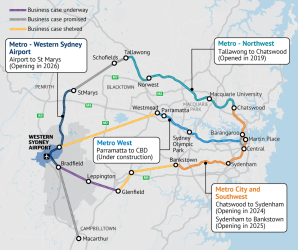
Source
It's interesting that the map on the Sydney Metro web site includes the gray segments ('business case promised') but not the purple segment, which is the only one where the business case is actually being worked on currently. I believe this is likely due to political reasons, i.e. Labor doesn't want to admit that the Liberal-initiated business case may in fact be a good idea, so they are staying as quiet about it as possible. Eventually if they decide to go ahead, they will announce it in a way that makes it seem like entirely their project.
The NSW government's map of proposed metros here:
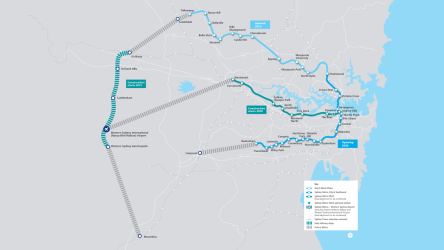
Source
Also note that even if the airport metro is extended to Tallawong, this will require a change of trains to continue on the Metro from there, as the airport line uses different technology and different sized trains that the Tallawong to Chatswood/Bankstown Line. Australia never can seem to learn the lesson about incompatible railway systems...
- Joined
- Nov 12, 2012
- Posts
- 33,396
- Qantas
- Platinum
- Virgin
- Gold
- Star Alliance
- Gold
as the airport line uses different technology and different sized trains that the Tallawong to Chatswood/Bankstown Line.
Great info, thanks. Is the incompatibility due to the fact that the Chatswood to Epping (at least) segment of the metro was originally built as a heavy train extension of the North Shore Line and the Metro had to be adapted to it for all of that line?

Read our AFF credit card guides and start earning more points now.
AFF Supporters can remove this and all advertisements

Bundy Bear
Established Member
- Joined
- Jul 17, 2004
- Posts
- 4,347
- Qantas
- Platinum
- Virgin
- Platinum
- Oneworld
- Emerald
That would be a question for Sharath(Building Beautifully), that guy from youtube he could give you the ins & outs of why.Great info, thanks. Is the incompatibility due to the fact that the Chatswood to Epping (at least) segment of the metro was originally built as a heavy train extension of the North Shore Line and the Metro had to be adapted to it for all of that line?
Transfers between the two airports will be pretty minimal.
Far better to use the rail line to minimise the journey time for the majority of people who will use the airport.
But of course, the airport will be used by people in SW Sydney too, and a rail line to connect them might also be helpful (as it would seem by the plans posted above). It's not quite as big as the west, it's not too far behind in population. Any transfer to SYD itself would just be a bi-product.
- Joined
- Dec 20, 2012
- Posts
- 678
- Qantas
- LT Gold
It is not unusual to need to change trains to access an airport. Singapore is a great example.
Yes, partially. The M1 metro line (not sure if they will use that designator, but let's suppose they do) used existing overhead wiring systems from Epping to Chatswood, and will do the same from Sydenham to Bankstown as well. As a result they use 1500 DC electrical supply, left over from Sydney Trains infrastructure and ultimately a legacy of the original 1920's electrification standards. The Airport Metro (M2?) will use 25kV AC, which is the modern standard for new systems. While it would be possible to design a rail car that could use both systems and switch between voltages, this adds weight, space, and cost and isn't normally done on metro systems.Great info, thanks. Is the incompatibility due to the fact that the Chatswood to Epping (at least) segment of the metro was originally built as a heavy train extension of the North Shore Line and the Metro had to be adapted to it for all of that line?
The other issue is that because the M2 was designed as spur and eventually part of an orbital line, rather than a trunk line through the CBD, the platforms and trains are shorter. If the power issue were solved, while it might be possible to run a shorter train through Tallawong onto the M1 line into the City, this would strand capacity and possibly cause confusion with not all platform doors opening. The longer trains of the M1 can't run to the shorter platforms of the M2. This decision is all about reducing construction costs, primarily at the stations, and to better "right-size" the M2 for the expected lower demand. So this is why there will need to be a change at Tallawong, or at the other end Glenfield (or Bankstown).
Last edited:
True, and that's often because the airport train line is built as an afterthought and not along a main rail line - SYD is a happy coincidence that they were able to divert an existing line, basically, in order to get direct service from the CBD. Many US airports (that have rail service) are served by spurs, often different technology than the primarily rail system (for example, EWR and JFK airports at New York City are close to, but not directly on, major rail lines, so have peoplemover type spurs). However, I feel like these examples reduce patronage quite a bit compared to what's possible when you have a one-seat ride to the CBD. Hong Kong's airport link is the best in this regard, and Tokyo Haneda's Keikyu line trains not far behind, and as a result these have significantly higher share of the ridership compared to Singapore Changi. At Singapore many people use taxis, due to the airport being on a spur (and the main line having many stops and slow average speed).It is not unusual to need to change trains to access an airport. Singapore is a great example.
- Joined
- Nov 12, 2012
- Posts
- 33,396
- Qantas
- Platinum
- Virgin
- Gold
- Star Alliance
- Gold
That would be a question for Sharath(Building Beautifully), that guy from youtube he could give you the ins & outs of why.
Thanks. I haven't checked out that issue, yet, but an interesting site. Will explore it more.
Looks like Scomo is pushing for a cull of the curfew flights at SYD. Decision due end of Jan 24.
Unclear whether its just the freight flights or all flights during the curfew (11pm-6am)

 www.afr.com
Unclear whether its just the freight flights or all flights during the curfew (11pm-6am)
Scott Morrison emerges to fight early morning Sydney Airport noise
Officials are considering cancelling special allowances for cargo operators to fly outside curfew after the ex-PM wrote to Labor demanding it be scrapped.
At Singapore many people use taxis, due to the airport being on a spur (and the main line having many stops and slow average speed).
I think the problem isn't so much being a spur, nor the mainline having many stops, instead it is:
#1 getting to the station in the first place in the heat and humidity especially with luggage.
#2 Frequency... in Singapore we are spoilt, and a 12 min wait for a train at the changeover (which can happen at certain times of the day) feels like an eternity.
#3 Getting to T1 is a pain and T4 an even bigger pain.
At risk of getting off topic here, passenger curfew landings are only allowed from 5am to 6am, right? And only if they can land from over the water, regardless of weather possibly favouring the other direction (this rule also applies to overnight cargo flights).Looks like Scomo is pushing for a cull of the curfew flights at SYD. Decision due end of Jan 24.
Unclear whether its just the freight flights or all flights during the curfew (11pm-6am)
Scott Morrison emerges to fight early morning Sydney Airport noise
Officials are considering cancelling special allowances for cargo operators to fly outside curfew after the ex-PM wrote to Labor demanding it be scrapped.
At risk of getting off topic here, passenger curfew landings are only allowed from 5am to 6am, right? And only if they can land from over the water, regardless of weather possibly favouring the other direction (this rule also applies to overnight cargo flights).
Thats correct for scheduled arrivals outside the regular curfew (shoulder movements)
Although dispensations for pax aircraft happen after 11pm too in the event of delays / weather so on

Lynda2475
Suspended
- Joined
- May 1, 2009
- Posts
- 9,401
- Qantas
- Platinum
- Virgin
- Red
- Oneworld
- Emerald
Looks like Scomo is pushing for a cull of the curfew flights at SYD. Decision due end of Jan 24.
Great idea, curfew is silly, the airport has been there longer than anyone living under the flight path and planes. Being able to land 24*7 really helps when there are weather delays.
Umm, I don’t think the call was for culling the curfew, that’s a different issue, but instead culling the curfew flights - i.e. making a representation to discontinue the temporary permissions granted during covid for certain flights to operate outside the curfew.Great idea, curfew is silly, the airport has been there longer than anyone living under the flight path and planes. Being able to land 24*7 really helps when there are weather delays.



Become an AFF member!
Join Australian Frequent Flyer (AFF) for free and unlock insider tips, exclusive deals, and global meetups with 65,000+ frequent flyers.AFF members can also access our Frequent Flyer Training courses, and upgrade to Fast-track your way to expert traveller status and unlock even more exclusive discounts!
AFF forum abbreviations
Wondering about Y, J or any of the other abbreviations used on our forum?Check out our guide to common AFF acronyms & abbreviations.


Currently Active Users
Total: 4,516 (members: 11, guests: 4,505)