Qantas Project Sunrise & A350-1000ULR Discussion

Hard to really work out. Some seem to have only one leg. Not easy when counting the number of legs and dividing by 2. In order to count the number of prople
Fun fact, the average number of legs per person on the planet is less than two. Ok that's enough to derail this thread...
 
Latest episode of AvTalk podcast from FR24 had an interview with Xavier Pepin, the ‘pilot in charge’ of the ULR flight. Starts at 13:30 (you’ll want to avoid the ‘banter’ at the beginning).

A few snippets:

* Originally planned TLS-TLS only but Qantas suggested Australia.

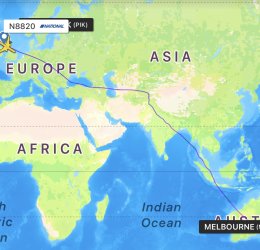
* Originally then planned SYD - over Rolls Royce in Derbyshire - TLS, but Qantas asked for MEL origin (interesting!) and that added distance caused the route to be re- planned. Then 2 days before flight, the winds dropped and they were going to drop the UK if the wind didn’t pick up. They did!

* Not sure if I understood correctly. He said 5 pilots. Three Airbus test pilots and, at the request of Qantas, 2 Qantas pilots - ex BA who were qualified on the aircraft. 4 hour shifts, but changing one every 2 hours. One AB pilot in the coughpit at all times. Allowing the client to fly ‘hands on’ at this stage must be unusual?

* New, separated ‘twin’ pilot rest areas not used - given over to instrumentation ( temp, ventilation)

* No First or Business seating on board - instrumentation.

* The TLS go-arounds ( his description ) were scheduled up front, subject to fatigue.
 
The 'Simple Flying' website is probably not the best source as IIRC it's been criticised on AFF for deficient research.

However a 6 May 2022 article was the only one I could quickly find estimating the supposed cost to QFi of operating return nonstop flights Sydney-London-Sydney.

The four year old (and hence dated) estimate was US$280,000 each way, which at 90 per cent occupancy 'Simple Flying' claimed would need QFi to receive an average of (presumably US$)1307 from each of 214 passengers to break even. Fares would need to be higher to cover the costs of security and other airport charges plus a possible fuel surcharge, as well as a margin for QFi.

At 2 August 2026 exchange rates, US$1307 equates to approximately A$1860 one way, so a return trip supposedly has to generate an average fare of A$3720 plus the items mentioned above.

The article was silent on freight revenue that contributes up to 30 per cent of revenue on some flights. QFi has said these flights will carry freight, though at what revenue per kilogram is unknown.

The article claimed fuel would be more than 50 per cent of the cost of operating each flight.

Has anyone access to a 2026, rather than 2022, likely cost and hence required revenue estimate?

Fuel cost depends on QF's hedging strategies, and whether Iran v Israel/USA and Russia/Ukraine wars continue.

My guess is QFi will make a reasonable profit from these flights with premium class passengers being 'fundies', CEOs of ASX-listed companies, highly paid entertainers and sportsmen, public servants on junkets and politicians who claim to be time poor, even though the time saving compared with using SQ, QR, JL, NH, EK, EY, MH, KE or others with efficient connections at their hubs isn't huge.

 
Last edited:
Possibly VH-VKF then which has seemingly been grounded in MEL since 25 July.

Edit. Forgot JQ didn't use RR, but seemingly also a possible answer.
 
Last edited:
I just realised that JL a350-1000 is configured very similarly to the PS planes. 239 seats with 6F 54J 24W 155Y. Quite similar to QFs 238 6F 52J 40W 140Y
 
Elevate your business spending to first-class rewards! Sign up today with code AFF10 and process over $10,000 in business expenses within your first 30 days to unlock 10,000 Bonus PayRewards Points.
Join 30,000+ savvy business owners who:

✅ Pay suppliers who don’t accept Amex
✅ Max out credit card rewards—even on government payments
✅ Earn & transfer PayRewards Points to 10+ airline & hotel partners

Start earning today!
- Pay suppliers who don’t take Amex
- Max out credit card rewards—even on government payments
- Earn & Transfer PayRewards Points to 8+ top airline & hotel partners

AFF Supporters can remove this and all advertisements

I just realised that JL a350-1000 is configured very similarly to the PS planes. 239 seats with 6F 54J 24W 155Y. Quite similar to QFs 238 6F 52J 40W 140Y
Interesting.
Does a desire for a premium focused cabin lead to the same outcome even without the PS weight/range requirements?
 
Interesting.
Does a desire for a premium focused cabin lead to the same outcome even without the PS weight/range requirements?
Possibly. Also interesting to note I think QF and JL are both using the same base J and Y seats on this plane.

So it'll be a case that QF flagship will have very similar hardware to JLs flagship which many hold in reasonably high esteem.
 
This story in the AFR on-line Mannequins and dry ice: test pilot spills on Qantas’ longest flight reveals a few things in a long article:

* Airbus test pilot Chetan Takalkar is an Australian

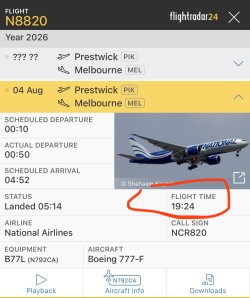
The softly spoken Australian from Burwood, in Melbourne’s south-east suburbs, has seen his career go full circle, from starting as an air force cadet who went plane-spotting to becoming the chief test pilot at the French aircraft manufacturer and landing the maiden flight after 19 hours and 12 minutes in the air.
“Before the departure we were driving around the back side of Melbourne Airport and all the spotter areas – that’s where I used to be,” he says.
“I used to drive out there on Friday evenings with my friends from the air force cadets and just watch aircraft,” he recalls.

The A350-1000 ULR testing will take about two months – not years – because the airframe is already certified. The main thing that the pilots focused on during its trip between Toulouse and Melbourne was fuel use.

“We were focused on the fuel system and focused on stretching the legs of the aircraft for a longer duration flight, and we’ve done that incrementally through the two flights,” says Takalkar.

On board were flight engineers, as well as pilots, but strapped into the seats in the cabin were robotic mannequins similar in weight to passengers with “instruments” attached to measure the cabin conditions.

“For around about three quarters of the cabin length, they have the robotic mannequins in each of the seats. These have highly sensitive instrumentation in them measuring temperature, pressure, vibration and noise parameters. There’s a huge amount of data that we need to collect,” he explains.

“They’re shaped a bit like a humanoid. Looks a bit freaky.

Airbus engineers were also on board, moving up and down the aircraft injecting non-toxic “visualisation” gas into the air. The flight came as Airbus marks 45 years since it started doing business in Australia.

“Basically, it looks like dry ice or smoke, and you can then video this visualisation of the air and see where the air is actually tracking and where it flows to, making sure that all of our extraction systems are working the right way,” says Takalkar.

“They move from seat to seat, from row to row. Again, the level of detail and the level of data that that’s collected is mind-boggling, actually.”

But for Coull, who has been part of the Qantas team working on Project Sunrise since its inception in 2018, and for those on board, seeing two sunrises and two sunsets was a phenomenal experience.

“We had a sunset just after top of climb [the point were an aircraft reaches cruise altitude], a sunrise over the Pacific, a sunset as we went up over into Canada, and then the second sunrise as we approached the United Kingdom,” says Coull.
 

Become an AFF member!

Join Australian Frequent Flyer (AFF) for free and unlock insider tips, exclusive deals, and global meetups with 65,000+ frequent flyers.

AFF members can also access our Frequent Flyer Training courses, and upgrade to Fast-track your way to expert traveller status and unlock even more exclusive discounts!

AFF forum abbreviations

Wondering about Y, J or any of the other abbreviations used on our forum?

Check out our guide to common AFF acronyms & abbreviations.
Back
Top