Looming Jet Fuel Shortages?

Yes. Talked about this last night. The question is - why?

It's also answered in the video, it would impact their trade partners a lot, which trickles back to China's export-oriented economy.
 
Yes. Talked about this last night. The question is - why?
Nothing concrete, but educated guesses on a few points.

1) it greatly affects many of China's trade partners which would have a flow on effect back to China's economy too if it lets the world take an oil shock.

2) signalling regarding blockading to stop oil imports to China. US can block Malaca Straits which would in theory severely hamper Chinese Oil imports. By doing this they're showing a bit of their hand on how much oil reserves they have that a block isn't going to be as effective if some sort of US - China conflict breaks out.

3) related to 2, but also it projects a lot of soft power in the global oil trade balance. Up until now. Its bren thought of as US, Saudi and Russia being the biggest influence on oil prices. Iran (strait of Hormuz control) has shown its also got a very strong hand and China with this move is also showing that it too can control oil prices - just not in ways that are obvious.

There's more tin foil hat speculation about secret deals during Trumps Beijing visit, but we'll leave that in the tin foil hat section even if there are possibilities.
 
It can't last forever though.
I think when you see China start taking the stage regarding the conflict is when they're feeling the pressure seriously. They've been sitting back relatively speaking during this war so far.
 
Previous posts:
#45 Tuesday 10/3/26
#165 for 31/3/26
#214 for 07/04/26
#307 for 14/4/26
#351 for 21/4/26
#382 for 28/04/26
#393 for 05/05/26
#412 for 12/5/26
#415 for 19/5/26
#418 for 26/5/26
#419 for 02/6/26
#434 for 09/6/26
#453 for 30/06/26


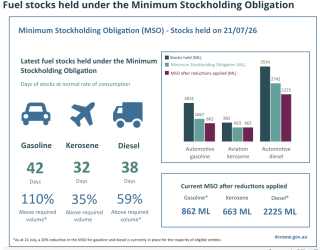
Compared to 10/3/26
Petrol increased by 215ML
Jet Fuel increased by 82ML
Diesel increase by 746ML


Screen Shot 2026-07-26 at 6.13.52 pm.png
 
Today's rise in the retail cost of petrol may see some motorists (especially in large cities) driving a bit less, especially if from a cash-strapped household dealing with a costly home mortgage and car loan repayments and car sharing, public transport or even walking/cycling to the shops is feasible.

However, recommencement of the Federal government's collection of fuel excise is largely irrelevant to the cost or supply of Jet A1.

There has been a drone strike to two gas tankers in Egyptian waters that (pardon the pun) is reigniting safety concerns about Saudi Arabian oil exports using the Suez canal. The Saudi company Aramco is the biggest worldwide oil exporter but a goodly percentage goes to mainland China, South Korea and the United Arab Emirates, perhaps not so much to the Singaporean refineries on which Australia depends. However any hiccups with Saudi exports in theory should push up the Brent crude price per barrel, which eventually would affect us.

From what one reads, it'll be a while until the Iranian war ends and the Strait of Hormuz is again open to shipping without the threat of being bombarded or having to pay an humongous toll to Iran. I don't perceive we're yet out of the woods.
 
Today's rise in the retail cost of petrol may see some motorists (especially in large cities) driving a bit less, especially if from a cash-strapped household dealing with a costly home mortgage and car loan repayments and car sharing, public transport or even walking/cycling to the shops is feasible.

However, recommencement of the Federal government's collection of fuel excise is largely irrelevant to the cost or supply of Jet A1.

There has been a drone strike to two gas tankers in Egyptian waters that (pardon the pun) is reigniting safety concerns about Saudi Arabian oil exports using the Suez canal. The Saudi company Aramco is the biggest worldwide oil exporter but a goodly percentage goes to mainland China, South Korea and the United Arab Emirates, perhaps not so much to the Singaporean refineries on which Australia depends. However any hiccups with Saudi exports in theory should push up the Brent crude price per barrel, which eventually would affect us.

From what one reads, it'll be a while until the Iranian war ends and the Strait of Hormuz is again open to shipping without the threat of being bombarded or having to pay an humongous toll to Iran. I don't perceive we're yet out of the woods.
We're currently in a weird false status quo that could turn for the worse at any time. Hormuz is still a contested region which means its a trickle at best.

The red sea routes have also come under fire in recent times , although i do believe this one will be easier to retake control more than Hormuz would be - still an increased risk and at least increased cost for saudi oil.

The other big piece is, how long can China drain its reserves before it wants to restart going back up to 10m imported barrels a day. They've shown some of their hand now and its pretty clear they're covering a lot of the forecasted shortages up until now. How long they want to continue for, no-one but the Chinese government knows. They're racing internally to find alternative to all oil products right now it seems.
 
Read our AFF credit card guides and start earning more points now.

AFF Supporters can remove this and all advertisements

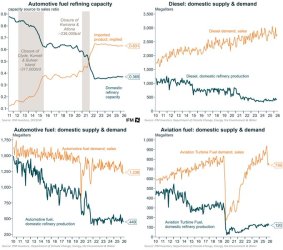
Long term retrospective data.

Automotive fuel consumption has been progressively reducing

Diesel and Aviation fuel on the other hand is increasing
Though Aviation fuel has seen a sharp drop recently


HOHdJw0bwAAS20x.jpeg
 
Long term retrospective data.

Automotive fuel consumption has been progressively reducing

Diesel and Aviation fuel on the other hand is increasing
Though Aviation fuel has seen a sharp drop recently


View attachment 516937

Some of the drop in aviation fuel consumption may be due to QFd (and VAd?) reducing the frequency of flights on some routes, as per QF's stated aim to decrease domestic flights by as much as five per cent.

You make a very important point.

While probably not an 'either/or' situation, if one had to choose one of the three fuels to restrict supply of, that'd be petrol, as especially in larger cities, many trips are discretionary and could be replaced by other modes, or simply don't travel. Electric vehicles are an available but imperfect replacement as resale value may be poor. Recharging availability, speed and type remains variable and apparently sometimes deficient.

Jet A1 is essential for connections between cities (and rural Australia) plus connections overseas with so-called sustainable aviation fuel way too expensive and in limited supply, while Australian agriculture (and to a lesser extent horticulture), mining (think huge iron ore and coal mining trucks), general transport trucks/ B-Doubles and efficient rail freight using dieselelectric locomotives all requiring diesel, with no affordable or practical substitute feasible.
 
Some of the drop in aviation fuel consumption may be due to QFd (and VAd?) reducing the frequency of flights on some routes, as per QF's stated aim to decrease domestic flights by as much as five per cent.

You make a very important point.

While probably not an 'either/or' situation, if one had to choose one of the three fuels to restrict supply of, that'd be petrol, as especially in larger cities, many trips are discretionary and could be replaced by other modes, or simply don't travel. Electric vehicles are an available but imperfect replacement as resale value may be poor. Recharging availability, speed and type remains variable and apparently sometimes deficient.

Jet A1 is essential for connections between cities (and rural Australia) plus connections overseas with s-called sustainable aviation fuel way too expensive, while Australian agriculture (and to a lesser extent horticulture), mining (think huge iron ore and coal mining trucks), general transport trucks/ B-Doubles and efficient rail freight using dieselelectric locomotives all require diesel, with no affordable or practical substitute feasible.

Quick question - which of the QF fleet would use more fuel - the A388 or the older gen A332/333 fleet?
 
Quick question - which of the QF fleet would use more fuel - the A388 or the older gen A332/333 fleet?
I don't think you're asking the right question here because there's a very simple and obvious answer - the a380. But I'm not sure if you're asking about per passenger or fuel economics in other capacity.

But at face value for your question its an obvious one being the a380. You need a lot more fuel to fly something that is significantly larger than the a330 in physical size, let alone the 4 engine vs 2 equation.
 

Become an AFF member!

Join Australian Frequent Flyer (AFF) for free and unlock insider tips, exclusive deals, and global meetups with 65,000+ frequent flyers.

AFF members can also access our Frequent Flyer Training courses, and upgrade to Fast-track your way to expert traveller status and unlock even more exclusive discounts!

AFF forum abbreviations

Wondering about Y, J or any of the other abbreviations used on our forum?

Check out our guide to common AFF acronyms & abbreviations.
Back
Top