Chinese electric car ?spontaneously ignites.

I wonder how many ice cars caught 🔥 at the same time somewhere else in the world? I'm no more worried about this happening to our ev as I am a plane falling on me when I walk outside.
EV's have a similar risk to catching fire as other vehicle types but the battery fire is another matter.
 
EV's have a similar risk to catching fire as other vehicle types but the battery fire is another matter.
The stats say EV’s are much less likely than ICE vehicles to catch fire in the first place … it’s likely because they’re not pumping flammable hydrocarbons around pipes that can potentially leak.

If the battery happens to discharge in a fire, though, it can be very … intense. Given that in Australia a high percentage of new cars are EV’s (last month as many EV’s were sold as petrol-powered), the fact that there are so very few EV fires kinda shows how low the chance of that runaway battery fire happening is. Especially given that most of those EV cars are CCP cars with … “buyer beware” expectations on build-quality.
 
Asking a genuine question .. I guess EVs are rated for collisions that might cause a fire in them? The fire in the OP seems to have been caused by a prior collision and only erupted some time later, which is a worry (may be garaged etc).

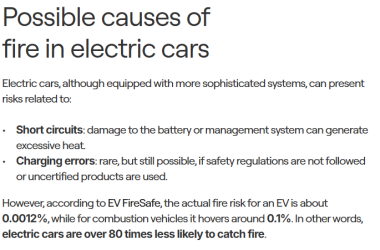
I googled, and there was a lot of discussion of 'advanced protection systems' on EVs and the likelihood of an EV simply catching fire and stuff like the following, where the risk of a collision-induced fire isn't even considered, other than a 'short circuit'.


1786531236903.png

So, what's the testing and tolerance for a collision of an EV, not to cause a fire? Are they crash-tested, like dummy testing? Not being provocative, just interested.

 
Asking a genuine question .. I guess EVs are rated for collisions that might cause a fire in them? The fire in the OP seems to have been caused by a prior collision and only erupted some time later, which is a worry (may be garaged etc).

I googled, and there was a lot of discussion of 'advanced protection systems' on EVs and the likelihood of an EV simply catching fire and stuff like the following, where the risk of a collision-induced fire isn't even considered, other than a 'short circuit'.


View attachment 518029

So, what's the testing and tolerance for a collision of an EV, not to cause a fire? Are they crash-tested, like dummy testing? Not being provocative, just interested.
It's not an unfair question, bro; arguably from a bad smash there's as much risk from a fuel tank, though.
 
Asking a genuine question .. I guess EVs are rated for collisions that might cause a fire in them? The fire in the OP seems to have been caused by a prior collision and only erupted some time later, which is a worry (may be garaged etc).

I googled, and there was a lot of discussion of 'advanced protection systems' on EVs and the likelihood of an EV simply catching fire and stuff like the following, where the risk of a collision-induced fire isn't even considered, other than a 'short circuit'.


View attachment 518029

So, what's the testing and tolerance for a collision of an EV, not to cause a fire? Are they crash-tested, like dummy testing? Not being provocative, just interested.

It’s a bit more complicated than that.

- what is the construction technique of the battery (ie new blade battery from BYD or upcoming solid state battery from Toyota)

- chemicals used in the battery NCM or LFP
 
It's not an unfair question, bro; arguably from a bad smash there's as much risk from a fuel tank, though.

Undoubtedly - but interested in just what sort of testing is done - is there an Australian standard? Recalling Ralph Nader's exposure of the dangerous fuel tank position of the Ford Pinto etc that led to design changes.

It’s a bit more complicated than that.

- what is the construction technique of the battery (ie new blade battery from BYD or upcoming solid state battery from Toyota)

- chemicals used in the battery NCM or LFP

Sure, but for each, what is the safety standard? How is it tested?
 
Undoubtedly - but interested in just what sort of testing is done - is there an Australian standard? Recalling Ralph Nader's exposure of the dangerous fuel tank position of the Ford Pinto etc that led to design changes.


Sure, but for each, what is the safety standard? How is it tested?
Is there an Australian standard worth measuring on anything? Even our PM can't register the importance of melons.
 
Read our AFF credit card guides and start earning more points now.

AFF Supporters can remove this and all advertisements

Undoubtedly - but interested in just what sort of testing is done - is there an Australian standard? Recalling Ralph Nader's exposure of the dangerous fuel tank position of the Ford Pinto etc that led to design changes.


Sure, but for each, what is the safety standard? How is it tested?

Most of the cars whether EV or not apply and get tested for ANCAP ratings. Part of that is crash testing.
 

Become an AFF member!

Join Australian Frequent Flyer (AFF) for free and unlock insider tips, exclusive deals, and global meetups with 65,000+ frequent flyers.

AFF members can also access our Frequent Flyer Training courses, and upgrade to Fast-track your way to expert traveller status and unlock even more exclusive discounts!

AFF forum abbreviations

Wondering about Y, J or any of the other abbreviations used on our forum?

Check out our guide to common AFF acronyms & abbreviations.
Back
Top