




Card payment sucharges banned in Australia from 2026

Are you happy with the RBA's proposed changes to surcharging and interchange fees?


  • Total voters
    178
Don't forget most businesses didn't apply a surcharge prior to covid, but those costs still existed prior to surcharging becoming rampant. Businesses had already built those costs into their prices.

So when they added a surcharge, they should have reduced the price for cash payers. I doubt any did.

Most were just pocketing the surcharge as extra profit.
Prices also went up though - we saw more blended rates or single rates, and we saw smarter terminals that could apply the appropriate surcharge.

Prior to the blended rate, a debit Mastercard could have a different fee to a debit Visa to a credit Mastercard or a credit Visa or an eftpos SAV/CHQ transaction - making it almost impossible to apply manually.

But bring on smarter terminals or simpler processing fees, surcharging becomes much easier to pass on.
 
I think you missed the point. Most businesses had already included these costs in their prices before they started surcharging, so when they later added a surcharge, say 2%, they should have reduced their prices by 2%, because they started charging those costs separately instead of including them in the price. But they didn't, so they are just pocketing the surcharge as increased profit.
 
If the Govt cant get it right, it should just keep its nose out of it.
This change to surcharging is the government getting its nose out of it. Originally there was no rules around this, so the card networks banned surcharges in their terms and conditions. Then the RBA intervened and made a regulation that the card networks couldn't do that as part of their T&Cs. Now the RBA is removing that regulation (getting their noses out of it, to use your term) and allowing the card networks to decide for themselves if they want to include conditions around surcharging or not.
To implement this, the RBA has removed its prohibition on ‘no-surcharge’ rules with effect on and from that date. When effective, these changes will allow the designated card networks to impose a ban on surcharging for credit, debit and prepaid card payments on their networks.

The networks have all decided that, now they have the choice, they'll prohibit surcharges as part of their T&Cs.
The three designated card networks, eftpos, Mastercard and Visa, have each decided to introduce ‘no-surcharge’ rules from 1 October 2026. American Express has also decided to remove surcharging from 1 October 2026. American Express is not currently subject to formal regulation by the RBA.
 
That would help explain why surcharges are so rare around the world.

Australia must have been one of the only countries that put in extra regulation to overrule the default 'no surcharge' rules from Mastercard/Visa/Amex.
 
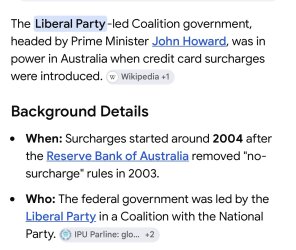
Yes you can thank the ‘shiney coughd’ coalition govt led by John Howard for permitting surcharges:

View attachment 520953

But now you can truly thank Labour for getting rid of them 👍👍👍
This change to surcharging is the government getting its nose out of it.
Thank or blame neither government - they have no specific control of the matter.

It is true that these respective governments controlled parliament at the time credit card surcharges were introduced and are currently being removed.

However, it was a central bank decision under the Payment Systems (Regulation) Act 1998 and no parliamentary vote was needed for the 2003 changes nor is one required now.

The RBA's Payments System Board introduced the framework in January 2003. The RBA abolished card scheme "no-surcharge" rules with the goal of forcing transparency regarding the real cost of payment processing.

The recent RBA review has concluded amongst other things that "surcharging is no longer achieving its intended purpose. Surcharging was to encouraged consumers to use cheaper payment methods. However, it has become harder for consumers to avoid surcharges. Consumers and businesses find surcharging rules complex and confusing, and surcharges are often not well disclosed."

 
Last edited:
This change to surcharging is the government getting its nose out of it. Originally there was no rules around this, so the card networks banned surcharges in their terms and conditions. Then the RBA intervened and made a regulation that the card networks couldn't do that as part of their T&Cs. Now the RBA is removing that regulation (getting their noses out of it, to use your term) and allowing the card networks to decide for themselves if they want to include conditions around surcharging or not.
No it isn't. If they only got rid of the ban on Visa and Mastercard from forbidding surcharges then you would be right, but they are actively sticking their nose into the market by price controlling private businesses.

That's not getting your nose out of the market, it is far more control than previously.
 
One thing that seems strange to me is that quite a few card issuers aren't changing their sign up bonus offerings for their top cards.

Though I guess many changed already from 12 months to 24 months exclusion period in the last few years, so maybe less need to do so? Also reduced earn rates also maybe means the banks need to use the carrot of the bonus points even more so than before....
 
One thing that seems strange to me is that quite a few card issuers aren't changing their sign up bonus offerings for their top cards.

Though I guess many changed already from 12 months to 24 months exclusion period in the last few years, so maybe less need to do so? Also reduced earn rates also maybe means the banks need to use the carrot of the bonus points even more so than before....
NAB Qantas Signature 100k first year bonus ends on 30th September and most of the MyCard bonus offers now have an end date of 30th September. Presumably there will be lower offers that replace them from 1st October. If that's the case, then combined with the already reduced bonus offers (ANZ Qantas, Qantas Money) and the "stealth devaluations" for cards where the bonus is paid in bank reward points and there is a devaluation of the bank reward point to frequent flyer point ratio, most of the bonus offers will have been reduced. But as you mentioned, there are a quite a few that (as of now remain unchanged).

My guess is that the reason that bonus sign-up points aren't as affected as uniformly and dramatically as much as the ongoing earn rate is because the banks have already responded to churning with the almost universal 24 month exclusion periods.
 
No it isn't. If they only got rid of the ban on Visa and Mastercard from forbidding surcharges then you would be right, but they are actively sticking their nose into the market by price controlling private businesses.

That's not getting your nose out of the market, it is far more control than previously.
Who are they? To be clear it is the RBA doing this.
 
Who are they? To be clear it is the RBA doing this.
They would be the RBA which is placing limits on the interchange fees that private companies are allowed to charge. That is them putting their noses into it and controlling the market.

You're trying to solve the RBA meddling in the market with more RBA meddling in the market.
 

Become an AFF member!

Join Australian Frequent Flyer (AFF) for free and unlock insider tips, exclusive deals, and global meetups with 65,000+ frequent flyers.

AFF members can also access our Frequent Flyer Training courses, and upgrade to Fast-track your way to expert traveller status and unlock even more exclusive discounts!

AFF forum abbreviations

Wondering about Y, J or any of the other abbreviations used on our forum?

Check out our guide to common AFF acronyms & abbreviations.
Back
Top