




Air Traffic Control Issues

²
A take off every three minutes compared to every 90 seconds at Heathrow
Don't know where your 3 min comes from; total 80/hour in Sydney, av. 40/hour take-offs = every 90 seconds capacity.
But if you're talking about ACTUAL takeoffs, it's just that Sydney actually doesn't have the same demand, and has more capacity than it uses; demand midmorning, midafternoon, and late-ish evenings is lower, sometimes much lower, than 80/hour capacity.
 
²

Don't know where your 3 min comes from; total 80/hour in Sydney, av. 40/hour take-offs = every 90 seconds capacity.
But if you're talking about ACTUAL takeoffs, it's just that Sydney actually doesn't have the same demand, and has more capacity than it uses; demand midmorning, midafternoon, and late-ish evenings is lower, sometimes much lower, than 80/hour capacity.

well… whatever the ‘capacity’ it wasn’t happening today. I set the timer on the phone… it was actually a lot longer than 3 mins cause we waited for two aircraft, both out past the headlands, coming in to land. No takeoffs in between.
 
Don’t need larger aircraft to turn 3 flights at 60% occupancy into two flights.

Load factors overall tend to be for most major routes in the 80 to 90 per cent range, occasionally greater.

Possibly during the middle of the day and very late on some nights may be examples when some flights have substantially fewer percentages of seats occupied.
 
Every MEL to BNE flight I have been on in the last 2 months has been almost full
Same for MEL-SYD! Only one flight this year has been like ‘so so’ with maybe 70%. The rest have been one or two spare seats (QF).

When I was commuting on VA - not even peak flights - they were almost always full!

The main reason is that they cancel one flight and all of a sudden everything else is chockers!
 
We are also running the triangle without that extra competitor, we had TigerAir for all those years, then Rex replaced that capacity, then that all got taken away.

It’s hard to get a seat at a reasonable price (under $250 each way) last minute especially non mid week days.
 
Same for MEL-SYD! Only one flight this year has been like ‘so so’ with maybe 70%. The rest have been one or two spare seats (QF).

When I was commuting on VA - not even peak flights - they were almost always full!

The main reason is that they cancel one flight and all of a sudden everything else is chockers!

So effectively they are already “consolidating” to some extent. Cancelling flights and moving passengers to other flights.
 
Quite amazing when you look at it, on some days, approximately every 12 mins between 6am and 10pm there's a flight departing Sydney for Melbourne, and a flight arriving every 11mins between 7:25am and 10:25pm.... so basically a Melbourne movement every 6 mins.
 
So effectively they are already “consolidating” to some extent. Cancelling flights and moving passengers to other flights.
Nope.

Cancelled for engineering, bad weather, crew member reporting sick, etc

Not ‘planned’ cancellations to consolidate flights.

They just have to move them as per their contract of carriage to the next available flight(s)
 
Which is easier said than done when they're running at high load factors, particularly on the triangle.
Especially on VA with their tiny business class cabins and super cheap upgrades which are processed the day before :(

At least QF seems to hold some seats back for on departure upgrades like at the Qantas club.
 
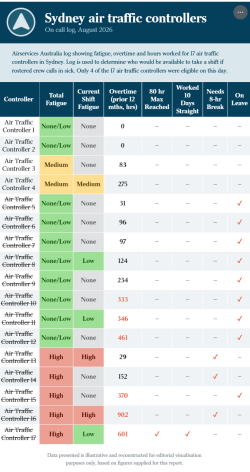
Article in the Oz on-line about ATC hours, overtime and fatigue levels, including some real data about one shift, which generated this graphic.


1787141638410.png

The data, shared anonymously with The Australian and verified by two Airservices employees, supported claims by union Civil Air that the government organisation is relying on overtime to keep control towers and operations centres going.

You'd need to read the article to get the full gist.
 
Another one !

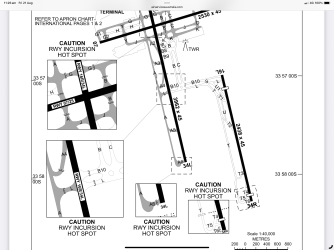
The ATSB is investigating a taxiing conflict involving an Airbus A321, VH-OGA, and a Boeing 737, VH-VXL, at Sydney Airport, New South Wales, on 18 August 2026.

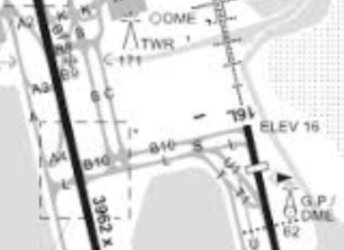
After landing at Sydney on runway 34 right, the crew of a Boeing 737, operating Qantas flight QF589 from Gold Coast, Queensland, taxied west along taxiway L with a clearance to turn right at taxiway B. Meanwhile, an Airbus A321, operating Qantas flight QF405 to Melbourne, Victoria, taxied south along taxiway C with a clearance to turn right onto taxiway L. As the Airbus approached taxiway L, the crew observed the Boeing approaching from the left and stopped the aircraft.

The evidence collection phase of the investigation will involve interviewing involved air traffic controllers and flight crew, retrieving and reviewing available recorded data, and the collection of other relevant information.

A final report will be released at the conclusion of the investigation. Should a critical safety issue be identified during the course of the investigation, the ATSB will immediately notify relevant parties, so that appropriate safety action can be taken.

 
Read our AFF credit card guides and start earning more points now.

AFF Supporters can remove this and all advertisements

In relation to this Tuesday 18 August 2026 incident, the media statement from ATBS in part states:

"...The ATSB notes there was no immediate risk of collision, with the Qantas A321 aircraft braking normally before coming to a stop.

As such the ATSB has classified this as a safety “incident”, rather than a “serious incident”, but has elected to conduct an investigation to understand the potential conflicting instructions to the flight crews and whether there are any contributing factors common across the other Sydney Airport incidents currently under investigation..."

ATSB must have a significant workload as it's very unusual to have three or four 'mainline' jet incidents occurring over a short timeframe.
 
'The Australian' has just posted another article, with now six 'close calls' recorded at SYD between 27 July and 25 August 2026.

The latest two have been classified by ATSB as 'safety incidents', a lower ranking than 'serious incidents.'

On Sunday 16 August, a VAd B738 that had landed on runway 16L was told to give way to a QFd B738 as the latter vacated runway 16R, but apparently the VAd crew didn't read back the ATC instruction in full, and nor did the controller(s) acknowledge that failure. The QFd crew stopped their aircraft using 'normal braking' and clarified what was meant to occur.

On Tuesday 25 August, a JQd A320 pushed back from its SYD gate, but a Dash-8 (presumably QFd's) was taxiing behind it. The JQd crew stopped their plane and returned to the gate, with the ATSB stating the JQd crew were given incomplete information on what other aircraft were taxxing.

The ATSB says that with both incidents, there was no immediate risk of collision, thanks to the aircraft crews.

Airservices Australia claims that these are so-called 'business as usual occurrences'.

This doesn't engender a lot of confidence, especially since that authority says since January 2021 there's been an average of 34.1 occurrences per month reported for SYD, 21.3 at BNE and 12.2 in MEL. That's more than one per day in SYD.

Interestingly, MEL is substantially busier than BNE for aircraft movements and passenger numbers. Is there something about BNE's runway or taxiway configurations that increases the risk of safety/serious incidents? Given the large number of rural cities in Queensland with c.45-50 per cent of the population not living in Brisbane or southeast Queensland/Gold Coast, BNE must have more small turboprop flights than MEL.
 
Last edited:

Become an AFF member!

Join Australian Frequent Flyer (AFF) for free and unlock insider tips, exclusive deals, and global meetups with 65,000+ frequent flyers.

AFF members can also access our Frequent Flyer Training courses, and upgrade to Fast-track your way to expert traveller status and unlock even more exclusive discounts!

AFF forum abbreviations

Wondering about Y, J or any of the other abbreviations used on our forum?

Check out our guide to common AFF acronyms & abbreviations.
Back
Top