





You are using an out of date browser. It may not display this or other websites correctly.
You should upgrade or use an alternative browser.
You should upgrade or use an alternative browser.
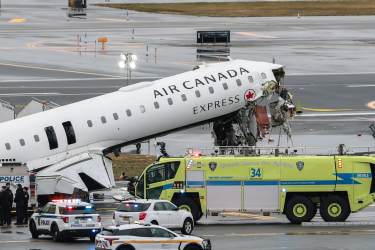
Air Canada RJ impact with ground vehicle, at least 2 fatalities
- Thread starter markis10
- Start date

- Joined
- Nov 12, 2012
- Posts
- 33,397
- Qantas
- Platinum
- Virgin
- Gold
- Star Alliance
- Gold
Extended ATC audio, covering all the United issue, calls and movements and leading through to the Jazz CRJ collision, with some speculative animation.
Appears from this that the truck proceeded onto the runway after it was told to stop, although the instruction was unclear and not immediately followed up.
This may be useful when listening re the taxiways etc
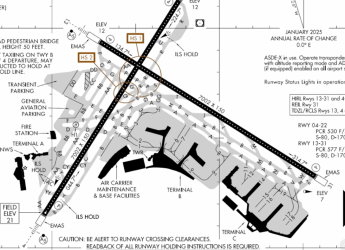
Appears from this that the truck proceeded onto the runway after it was told to stop, although the instruction was unclear and not immediately followed up.
This may be useful when listening re the taxiways etc

jb747
Enthusiast
- Joined
- Mar 9, 2010
- Posts
- 13,680
Early clearances are yet another of the silly things done by ATC in the USA. It was common going into LAX to be issued with a clearance with a couple of aircraft in front of you for the same runway. Might make it easier, but devalues the entire idea of a clearance.2. Clearance for the ground vehicle movement was given probably 20-30 secs before a number of stop commands were issued, a cancellation of the landing clearance/go around commandshould have been given at that stage.
The timing is interesting....something like 20 seconds before impact the aircraft would have been landing, and once reverse is selected, the go around option effectively expires.

markis10
Veteran Member
- Joined
- Nov 25, 2004
- Posts
- 33,274
- Qantas
- Platinum
- Virgin
- Red
- Oneworld
- Emerald
I agree, I posted that before seeing a better breakdown of the timeline, no go around was possible. I doubt the truck was at the holding point when crossing was requested.Early clearances are yet another of the silly things done by ATC in the USA. It was common going into LAX to be issued with a clearance with a couple of aircraft in front of you for the same runway. Might make it easier, but devalues the entire idea of a clearance.
The timing is interesting....something like 20 seconds before impact the aircraft would have been landing, and once reverse is selected, the go around option effectively expires.
MEL_Traveller
Veteran Member
- Joined
- Apr 27, 2005
- Posts
- 34,046
Not sure if it’s been posted already but there’s footage of the moments leading up to, and of the impact, in this post by OMAAT: Ugh: The Runway Lights That Should've Prevented The LaGuardia Tragedy
- Joined
- Nov 12, 2012
- Posts
- 33,397
- Qantas
- Platinum
- Virgin
- Gold
- Star Alliance
- Gold
FWIW (and maybe not much!), here is an early NTSB press briefing. It actually starts at 44:10 (and early interesting comment that NTSB officers were delayed getting into ?terminal because of TSA delays and 'queues around the building'). Guy gives a pre-impact timeline from about 48:55, aircraft 500' above ground.

justinbrett
Enthusiast
- Joined
- Mar 6, 2006
- Posts
- 12,354
- Qantas
- Platinum 1
- Oneworld
- Emerald
and thus frequencies were not being rebroadcast,
This has now been shown to be incorrect - as the Truck 1 request to cross the runway, and ATC clearance to do so, were heard on the CVR - and the multiple directions to Truck 1 to stop.
markis10
Veteran Member
- Joined
- Nov 25, 2004
- Posts
- 33,274
- Qantas
- Platinum
- Virgin
- Red
- Oneworld
- Emerald
That’s good, as it should be. Unfortunately it’s another back up system that didn’t change the outcome.This has now been shown to be incorrect - as the Truck 1 request to cross the runway, and ATC clearance to do so, were heard on the CVR - and the multiple directions to Truck 1 to stop.

Himeno
Senior Member
- Joined
- Jun 15, 2011
- Posts
- 5,792
At least one of the NTSB team was stuck at TSA in Texas.FWIW (and maybe not much!), here is an early NTSB press briefing. It actually starts at 44:10 (and early interesting comment that NTSB officers were delayed getting into ?terminal because of TSA delays and 'queues around the building'). Guy gives a pre-impact timeline from about 48:55, aircraft 500' above ground.
markis10
Veteran Member
- Joined
- Nov 25, 2004
- Posts
- 33,274
- Qantas
- Platinum
- Virgin
- Red
- Oneworld
- Emerald
What’s not mentioned in that article is the system requires two sides to work, the network installed (millions $) and the ground traffic to have an appropriate transponder costing less than $1K onboard. None of the trucks had this, not one that could have been the lead responder. The industry learns from its mistakes and systems issues, Zagreb and the airspace divided by altitude rather then geography is a case in point. Here we have a massive investment that was never going to work while half the solution was not in place. It’s not a magic bullet, but it might have helped reduce the impact.Not sure if it’s been posted already but there’s footage of the moments leading up to, and of the impact, in this post by OMAAT: Ugh: The Runway Lights That Should've Prevented The LaGuardia Tragedy
LGA has had numerous calls for safety improvements, I am starting to understand why.

Elevate your business spending to first-class rewards! Sign up today with code AFF10 and process over $10,000 in business expenses within your first 30 days to unlock 10,000 Bonus PayRewards Points.
Join 30,000+ savvy business owners who:
✅ Pay suppliers who don’t accept Amex
✅ Max out credit card rewards—even on government payments
✅ Earn & transfer PayRewards Points to 10+ airline & hotel partners
Start earning today!
- Pay suppliers who don’t take Amex
- Max out credit card rewards—even on government payments
- Earn & Transfer PayRewards Points to 8+ top airline & hotel partners
Join 30,000+ savvy business owners who:
✅ Pay suppliers who don’t accept Amex
✅ Max out credit card rewards—even on government payments
✅ Earn & transfer PayRewards Points to 10+ airline & hotel partners
Start earning today!
- Pay suppliers who don’t take Amex
- Max out credit card rewards—even on government payments
- Earn & Transfer PayRewards Points to 8+ top airline & hotel partners
AFF Supporters can remove this and all advertisements
MEL_Traveller
Veteran Member
- Joined
- Apr 27, 2005
- Posts
- 34,046
I’m not sure OMAAT is a definitive source for analysis. The video was the interesting bit.What’s not mentioned in that article is the system requires two sides to work, the network installed (millions $) and the ground traffic to have an appropriate transponder costing less than $1K onboard. None of the trucks had this, not one that could have been the lead responder. The industry learns from its mistakes and systems issues, Zagreb and the airspace divided by altitude rather then geography is a case in point. Here we have a massive investment that was never going to work while half the solution was not in place. It’s not a magic bullet, but it might have helped reduce the impact.
LGA has had numerous calls for safety improvements, I am starting to understand why.
I would have thought, ultimately, any vehicle crossing an active runway should be looking for oncoming aircraft. Regardless of any clearances. Much like it’s a wise action for folk to look both ways at a level crossing, just in case the barriers have malfunctioned.
La Guardia seems to be an airport to avoid in dawn/dusk or nighttime. Anytime lighting is low.
justinbrett
Enthusiast
- Joined
- Mar 6, 2006
- Posts
- 12,354
- Qantas
- Platinum 1
- Oneworld
- Emerald
Don't need high tech solutions.
When I did my ATC training, we were taught whenever you give a clearance for something to go on to the runway, you put a strip in your runway bay.
You clear an aircraft to land, it goes in your runway bay.
You want to clear a vehicle to cross the runway, you check your runway bay - and then you see the strip of the aircraft that's been cleared to land.
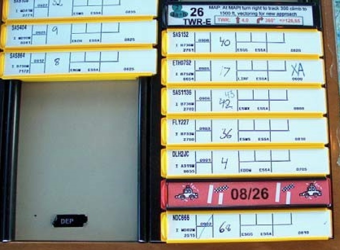
(not my pic but similar principle).
When I did my ATC training, we were taught whenever you give a clearance for something to go on to the runway, you put a strip in your runway bay.
You clear an aircraft to land, it goes in your runway bay.
You want to clear a vehicle to cross the runway, you check your runway bay - and then you see the strip of the aircraft that's been cleared to land.
(not my pic but similar principle).
markis10
Veteran Member
- Joined
- Nov 25, 2004
- Posts
- 33,274
- Qantas
- Platinum
- Virgin
- Red
- Oneworld
- Emerald
Cannot argue against that, same here, didn’t have many SAS flights though in YSSYDon't need high tech solutions.
When I did my ATC training, we were taught whenever you give a clearance for something to go on to the runway, you put a strip in your runway bay.
jb747
Enthusiast
- Joined
- Mar 9, 2010
- Posts
- 13,680
Exactly. Even with clearances that we'd all confirmed hearing, we still had every pilot, look out to make sure the runway was clear. You only need to be wrong once!I would have thought, ultimately, any vehicle crossing an active runway should be looking for oncoming aircraft. Regardless of any clearances. Much like it’s a wise action for folk to look both ways at a level crossing, just in case the barriers have malfunctioned.
- Joined
- Nov 12, 2012
- Posts
- 33,397
- Qantas
- Platinum
- Virgin
- Gold
- Star Alliance
- Gold
I would have thought, ultimately, any vehicle crossing an active runway should be looking for oncoming aircraft. Regardless of any clearances. Much like it’s a wise action for folk to look both ways at a level crossing, just in case the barriers have malfunctioned.
Def. If you look at the angle of taxiway Delta to the runway, and the fact that the driver is in the LH seat, so the RH guy has to crane and look back over his RH shoulder, in this case while the vehicle is moving up to the runway, to see a small jet that's already on the ground with the usual spectrum of other lights behind the jet - I don't think they had a chance. Even if the lookout saw the jet 2 seconds before they entered the runway, still too late - guy calls out, driver hears, then reacts. Thought they had clearance (didn't hear the first 'Truck 1 stop' which would have prevented this) so didn't stop.

RSD
Established Member
- Joined
- Feb 13, 2010
- Posts
- 3,308
- Qantas
- Platinum
It was an Oshkosh Striker 1500, and in those the driver actually sits on the logitudinal centreline, the other crewmember usually sits in a seat that is to the right of the (not) centre console and back a bit. If it is carrying extra crew then they sit in two seats that are on the back wall to the left of the driver. Even with the angle of taxiway Delta, the crewmember on the right is far enough back that the driver would have had a clear view up the runway - and the glass on the sides goes back far enough that the view wouldn't have been impeded. The guy in the right seat should have been looking up the runway too to make sure that nothing was coming.Def. If you look at the angle of taxiway Delta to the runway, and the fact that the driver is in the LH seat, so the RH guy has to crane and look back over his RH shoulder, in this case while the vehicle is moving up to the runway, to see a small jet that's already on the ground with the usual spectrum of other lights behind the jet - I don't think they had a chance. Even if the lookout saw the jet 2 seconds before they entered the runway, still too late - guy calls out, driver hears, then reacts. Thought they had clearance (didn't hear the first 'Truck 1 stop' which would have prevented this) so didn't stop.
justinbrett
Enthusiast
- Joined
- Mar 6, 2006
- Posts
- 12,354
- Qantas
- Platinum 1
- Oneworld
- Emerald
Thought they had clearance (didn't hear the first 'Truck 1 stop' which would have prevented this) so didn't stop.
They did have clearance. Clearances can be rescinded but it's not immediate and not guaranteed. The phraseology used by the controller was sloppy in this instance and should definitely have included the reason - eg "Truck 1 Hold Short Runway 4, aircraft on short final". He ran the instruction into the previous instruction to Frontier 4195 to stop and it's really unclear he's trying to tell two different people to stop. Even if you mess the callsign up or omit it, give the reason and maybe he can work it out - and also gives a heads up to the aircraft that there's a problem (not that they can do much at this point).
The instruction to stop was 9 seconds before the end of the CVR, most likely the time of impact, so it was probably all over by this point unfortunately. The clearance to cross was 20 seconds before, and read back 17 seconds before. I think he just forgot about the aircraft on final until it was too late.
Last edited:
- Joined
- Nov 12, 2012
- Posts
- 33,397
- Qantas
- Platinum
- Virgin
- Gold
- Star Alliance
- Gold
Thanks @RSD . With your experience I can't argue, but considering the angle of the taxiway it still seems a steep ask to have someone in the centre to look that far behind; and the person sitting behind and to the right has virtually no glass to look back through (seems to me).
Q: Which crewmember is on the radio with Ground?
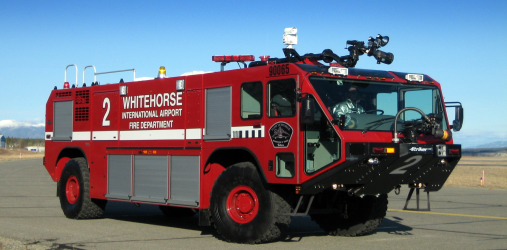
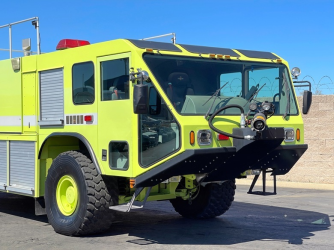
Q: Which crewmember is on the radio with Ground?
RSD
Established Member
- Joined
- Feb 13, 2010
- Posts
- 3,308
- Qantas
- Platinum
Those are an earlier model of the Striker - I actually did my ARFF qual on the 8x8 version of that model. You can see how far forward the driver sits in this one - the truck involved in the incident was a 4x4 version of the one in this photo. This later model is a lot nicer to drive than the earlier model that I trained on - a lot of the time in the old model the body felt like it wasn't connected to the chassis when cornering - they had the handling of a very drunken pig.Thanks @RSD . With your experience I can't argue, but considering the angle of the taxiway it still seems a steep ask to have someone in the centre to look that far behind; and the person sitting behind and to the right has virtually no glass to look back through (seems to me).
Q: Which crewmember is on the radio with Ground?
View attachment 501736
View attachment 501735
I was always trained to treat an active runway as having a giveway sign even if you had clearence.
jb747
Enthusiast
- Joined
- Mar 9, 2010
- Posts
- 13,680
It doesn't really matter where the driver was sitting. You simply must confirm that the runway is clear. And whilst the sea of lights that exists at an airport can be confusing, looking straight into an aircraft's landing lights should draw your attention.
I wonder what state the engines were in after it came to a stop? Still running, or did the damage in the coughpit area cause them to shut down.
I wonder what state the engines were in after it came to a stop? Still running, or did the damage in the coughpit area cause them to shut down.



Become an AFF member!
Join Australian Frequent Flyer (AFF) for free and unlock insider tips, exclusive deals, and global meetups with 65,000+ frequent flyers.AFF members can also access our Frequent Flyer Training courses, and upgrade to Fast-track your way to expert traveller status and unlock even more exclusive discounts!
AFF forum abbreviations
Wondering about Y, J or any of the other abbreviations used on our forum?Check out our guide to common AFF acronyms & abbreviations.


Currently Active Users
- mcbling
- AIRwin
- cgichard
- vm3365
- VALifetimeGold
- coonarossa
- year of the roo
- fletty
- equus
- RnD
- mole
- TerenceM
- jase05
- stewartedin
- Dudditz
- SYD
- Amber_PP
- asterix
- PineappleSkip
- ols
- Hors Ey
- *A Flyer
- kerfuffle
- flyingfan
- Hawk529
- kpc
- Happy Dude
- Tacan2
- eric2011
- born2fly_4ever
- MattyK
- angetho663
- wenglock.mok
- kamchatsky
- ADLhighflyer
- jkbaus
- esquire
- Nanachi
- CMA222
- ALEX LANGTON
- Flyfrequently
- FishFood
- Harrison_133
- Chrizztofa
- jamesatfish
Total: 3,361 (members: 59, guests: 3,302)