





You are using an out of date browser. It may not display this or other websites correctly.
You should upgrade or use an alternative browser.
You should upgrade or use an alternative browser.
Ask The Pilot
- Thread starter NM
- Start date
- Featured
Do pilots have to remember and study the IAP and airport chart before flying there? Like photographic memory and/or remember numbers.
Don’t need to study every chart as the good folk at your airline (or the pilot themself if it’s a smaller company) supplies a set of charts (Jeppesen or DAPs) on each aircraft.
Once upon a time they’d be in several paper manuals so you got the experience of almost breaking your back carrying them, taking them out of the folder as needed for that flight, then placing them back into the folder in the correct order once the flight was completed. And then there was also the joy of manual amendments, where they’d mail you a big set amendments every month (usually just some minor grammar change) that you’d then have the excitement of laboriously taking out each old page from the manual and replacing it with a new one. When you got to a bigger airline there was usually a “Flight Library” department who’s sole job was to do the manual amendments and place them in each aircraft.
These days we all have iPads so amendments are done at a touch of a button and we can call up any chart for any airport on the route network instantly.
Last edited:

jb747
Enthusiast
- Joined
- Mar 9, 2010
- Posts
- 13,663
I'd have a very good read of all of the paperwork for any airport that I hadn't been to before. Beyond that though, you read it off as you need it. Never action them from memory (though you do end up remembering the details of places you go to often enough).Do pilots have to remember and study the IAP and airport chart before flying there? Like photographic memory and/or remember numbers.

RSD
Established Member
- Joined
- Feb 13, 2010
- Posts
- 3,296
- Qantas
- Platinum
LATAM flight LA2482 (a 767-300) has had a "interesting" landing in ATL - passengers reported that the touchdown didn't feel like a hard landing etc and then it felt like the plane was running over rumble strips as it continued up the runway - and it didn't make it off the runway for obvious reasons -
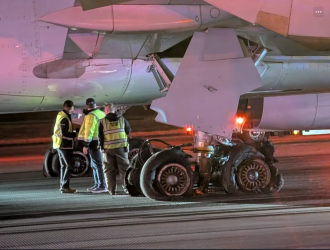
Any idea what might have caused all eight tyres on the mains to go like this given what the passengers said they felt?
Any idea what might have caused all eight tyres on the mains to go like this given what the passengers said they felt?
jb747
Enthusiast
- Joined
- Mar 9, 2010
- Posts
- 13,663
A heavy landing is not going to cause this. Or, if it did, the tyres won’t be the only thing broken.
He’s burst all of the tyres, which is a good effort. They look to have been worn through, so brake lockup. Normally you’d expect the anti-skid to ensure you can’t do this, so for whatever reason, that has to be non functional. An anti-skid failure is going to show up on EICAS, so it shouldn’t be a surprise. Procedurally, you make a normal landing. Use the longest available runway. Make a single moderate brake application, and then do not cycle them. On a dry runway there should be no further issue, but on a wet runway you’ll use a lot more (distance).
I’ll dig out a 767 manual and see if there’s any more to find.
He’s burst all of the tyres, which is a good effort. They look to have been worn through, so brake lockup. Normally you’d expect the anti-skid to ensure you can’t do this, so for whatever reason, that has to be non functional. An anti-skid failure is going to show up on EICAS, so it shouldn’t be a surprise. Procedurally, you make a normal landing. Use the longest available runway. Make a single moderate brake application, and then do not cycle them. On a dry runway there should be no further issue, but on a wet runway you’ll use a lot more (distance).
I’ll dig out a 767 manual and see if there’s any more to find.
Last edited:
RSD
Established Member
- Joined
- Feb 13, 2010
- Posts
- 3,296
- Qantas
- Platinum
Cheers. It all seems a bit odd - happened on 27L which is 9000 feet long, 27R is 12,390 feet long and as you said they would have opted for the longer runway if they were aware through EICAS that anti-skid was non-functional. Nothing in any of the photos or videos that I saw indicated any sign of that so I would be pretty confident the runway was dry.A heavy landing is not going to cause this. Or, if it did, the tyres won’t be the only thing broken.
He’s burst all of the tyres, which is a good effort. They look to have been worn through, so brake lockup. Normally you’d expect the anti-skid to ensure you can’t do this, so for whatever reason, that has to be non functional. An anti-skid failure is going to show up on EICAS, so it shouldn’t be a surprise. Procedurally, you make a normal landing. Use the longest available runway. Make a single moderate brake application, and then do not cycle them. On a dry runway there should be no further issue, but on a wet runway you’ll use a lot more (distance).
I’ll dig out a 767 manual and see if there’s any more to find.
jb747
Enthusiast
- Joined
- Mar 9, 2010
- Posts
- 13,663
The anti skid system requires approximately 800 extra metres for the landing calculation. 9,000' would probably still be okay, on a dry runway.
The system normally provided individual protection to each wheel. There is a backup mode in which it works for wheel pairs across a bogie. I'm not seeing a smoking gun anywhere.
The system normally provided individual protection to each wheel. There is a backup mode in which it works for wheel pairs across a bogie. I'm not seeing a smoking gun anywhere.
RSD
Established Member
- Joined
- Feb 13, 2010
- Posts
- 3,296
- Qantas
- Platinum
Cheers @jb747. Hopefully there might be some more information released from the authorities as to how this has ended up happening - its a bit of an odd one.The anti skid system requires approximately 800 extra metres for the landing calculation. 9,000' would probably still be okay, on a dry runway.
The system normally provided individual protection to each wheel. There is a backup mode in which it works for wheel pairs across a bogie. I'm not seeing a smoking gun anywhere.
jb747
Enthusiast
- Joined
- Mar 9, 2010
- Posts
- 13,663
A comment that has come up, but for which there’s no verification, is that the tyres blew almost immediately after landing. The auto brake activates very quickly, but it does not normally command all that much braking. It tries for a deceleration rate, and most landings use it at the minimum setting. The only setting that commands enough braking to engage the anti skid (on a dry runway) is RTO, and you can’t select that in flight.
RSD
Established Member
- Joined
- Feb 13, 2010
- Posts
- 3,296
- Qantas
- Platinum
That is consistent with what the passengers reported - initial touch was unremarkable but then it felt like they were running over rumble strips as the plane proceeded down the runway.A comment that has come up, but for which there’s no verification, is that the tyres blew almost immediately after landing.
Sounds like its still a bit of a mystery then as to what has happened - but to do all 8 tyres suggests that whatever it was it was pretty severe - and anti-skid didn't work as desired.The auto brake activates very quickly, but it does not normally command all that much braking. It tries for a deceleration rate, and most landings use it at the minimum setting. The only setting that commands enough braking to engage the anti skid (on a dry runway) is RTO, and you can’t select that in flight.
jb747
Enthusiast
- Joined
- Mar 9, 2010
- Posts
- 13,663
It's a rabbit hole of "what went wrong", if you don't have any real information. Assuming the landing was normal (well, normal for a 767), then you don't start with any heavy landing damage. The brakes are gently applied during wheel retraction, but that pressure will be released immediately afterwards. So, you would seem to need two things to happen. Something (or one) commands sufficient pressure to lock up all of the wheels, and the anti skid fails to operate.
RSD
Established Member
- Joined
- Feb 13, 2010
- Posts
- 3,296
- Qantas
- Platinum
Pretty much.It's a rabbit hole of "what went wrong", if you don't have any real information. Assuming the landing was normal (well, normal for a 767), then you don't start with any heavy landing damage. The brakes are gently applied during wheel retraction, but that pressure will be released immediately afterwards. So, you would seem to need two things to happen. Something (or one) commands sufficient pressure to lock up all of the wheels, and the anti skid fails to operate.
About all that is reasonably confirmable at this stage is
- the landing wasn't a hard one (or else for sure the passengers would have said so in their media interviews)
- as you said - someone or somthing has caused the brakes to lock up all of the wheels
- the anti-skid didn't work
I'm guessing a pilot would need to stand on the brakes pretty hard to lock up all the wheels - certainly far harder than on a normal landing and so this would seem like an unlikely cause. Which leads to something has caused both the brakes to lock on and the antiskid to fail across all wheels.
RSD
Established Member
- Joined
- Feb 13, 2010
- Posts
- 3,296
- Qantas
- Platinum
No details, but apparently there was a MEL on the anti-skid on that LATAM aircraft.It's a rabbit hole of "what went wrong", if you don't have any real information. Assuming the landing was normal (well, normal for a 767), then you don't start with any heavy landing damage. The brakes are gently applied during wheel retraction, but that pressure will be released immediately afterwards. So, you would seem to need two things to happen. Something (or one) commands sufficient pressure to lock up all of the wheels, and the anti skid fails to operate.
jb747
Enthusiast
- Joined
- Mar 9, 2010
- Posts
- 13,663
Long time since I've looked at 767 MELs. A search on the net shows a couple of variations, but it seems that it is allowed to be totally u/s. There's various conditions applied, for instance the runway must be dry, and there are performance adjustments to be made. I'm actually surprised that it exists, and I doubt that I would have accepted it. You can never guarantee the runway will be dry for a start. Yes, your destination may be forecast to be dry, but you could never guarantee that a diversion to a wet runway wouldn't be required. Perhaps I could see it domestically, but not for an international operation. Plus, MELs don't consider multiple issues. A diversion with the MEL applied simply doesn't exist!No details, but apparently there was a MEL on the anti-skid on that LATAM aircraft.
So, that gives us an avenue for no anti skid, but still doesn't explain the heavy application.
Last edited:

Read our AFF credit card guides and start earning more points now.
AFF Supporters can remove this and all advertisements
RSD
Established Member
- Joined
- Feb 13, 2010
- Posts
- 3,296
- Qantas
- Platinum
As soon as I started reading your post and got to "the runway must be dry" I thought "that is a pretty unusable MEL" for the reasons that you went on to state. For say DXB-CAI in summer you would be pretty confident that CAI and any diversion airports would have dry runways, but for Europe, the USA, Australia, Asia etc - no chance.Long time since I've looked at 767 MELs. A search on the net shows a couple of variations, but it seems that it is allowed to be totally u/s. There's various conditions applied, for instance the runway must be dry, and there are performance adjustments to be made. I'm actually surprised that it exists, and I doubt that I would have accepted it. You can never guarantee the runway will be dry for a start. Yes, your destination may be forecast to be dry, but you could never guarantee that a diversion to a wet runway wouldn't be required. Of course, MELs don't consider multiple issues. A diversion with the MEL applied simply doesn't exist!


Montien
Intern
- Joined
- Jan 17, 2026
- Posts
- 58
- Qantas
- Bronze
- Virgin
- Silver
First off, thanks to the pilots here for the incredible insights.
As a frequent traveler on the CBR-SYD hop, I’ve always been fascinated by the logistics of such a short sector. From a pilot's perspective, how do you manage the fuel planning and "warm-up" cycles for a 737 or A320 when the flight is so short that you're practically starting your descent as soon as you hit cruise altitude?
As a frequent traveler on the CBR-SYD hop, I’ve always been fascinated by the logistics of such a short sector. From a pilot's perspective, how do you manage the fuel planning and "warm-up" cycles for a 737 or A320 when the flight is so short that you're practically starting your descent as soon as you hit cruise altitude?
jb747
Enthusiast
- Joined
- Mar 9, 2010
- Posts
- 13,663
A manufacturer may apply reduced crosswind limits on a wet runway, but your rudder usage is normal. Just use what you need. But at lower speeds, where nose gear steering is doing the work (roughly once below about 30 knots), you need to limit the rate and degree of any application. It's not really an issue, it just means slow down before you turn. The 380 was prone to nose gear skidding in the dry, so it was quite easy to make it skid on a wet surface. A little differential power was very helpful at times.How are aircraft wheels/traction on a wet runway? Do you need to take a different rudder approach on a wet runway?
The rudder/nose gear steering interconnect was limited to about 7º of steering with full rudder application, which means you'd rarely have more than a couple of degrees. But once you changed to using the tiller, the steering can be moved up to 70º degrees.
jb747
Enthusiast
- Joined
- Mar 9, 2010
- Posts
- 13,663
Well, AV will be the master of these sectors, though we did some in the 767, and even occasionally in the 747. Singapore to KL was about 20 minutes. You'd get the arrival information before takeoff, and have the expected arrival loaded. It's easy enough to change if necessary. And you'd brief for the arrival before departure. The shortest sector with passengers that I did in the 747 was 27 miles (Heathrow to Stansted). Same deal. Just get everything done that you could before getting airborne. Remember that we all flew training circuits in these aircraft, and we had to get through all of the procedures and checklists in the few miles of a downwind leg.As a frequent traveler on the CBR-SYD hop, I’ve always been fascinated by the logistics of such a short sector. From a pilot's perspective, how do you manage the fuel planning and "warm-up" cycles for a 737 or A320 when the flight is so short that you're practically starting your descent as soon as you hit cruise altitude?



Become an AFF member!
Join Australian Frequent Flyer (AFF) for free and unlock insider tips, exclusive deals, and global meetups with 65,000+ frequent flyers.AFF members can also access our Frequent Flyer Training courses, and upgrade to Fast-track your way to expert traveller status and unlock even more exclusive discounts!
AFF forum abbreviations
Wondering about Y, J or any of the other abbreviations used on our forum?Check out our guide to common AFF acronyms & abbreviations.
Recent Posts
-
 Luggage checked through QF dom to QF dom on seperate tickets
- Latest: esseeeayeenn
-
-