





QF Automated Boarding Gate - Sydney Domestic

But the hardware installed is clearly biometric capable. You can see the pillars with cameras within in them or capable of housing cameras.

So the question is - if this is merely a better scanning facility, why invest in that extra hardware which isn’t necessary? You don’t need a hardware gate to have computer say no and go no further. Per the comments above they won’t do away with gate agents.

So again, why install these biometric capable gates?

My guess is the company is giving them a free trial of the complete package and Qantas, ever looking into the future, is happy to give it a go. I wonder if they are using the biometrics for in-house training at some time.
 
I mean, that's kind of why I asked the question...

Is it a cost cutting move? Is it a trial of gates for future use of gates for international flights? I understand that the gates don't need biometric yet, but if the trial was just for less ground staff then why put in biometric gates in?
IIRC currently QF requires two people per gate to board a domestic flight. One of those people is a crew member who (re)boards near the end of the process, while the other one is ground staff.

I guess this automated process could reduce the staff required down to one - so one ground staff member. Normally if there is a problem (e.g. red beep), the ground staffer deals with the issue at the gate desk and that lane of boarding is suspended. With automated gates, boarding could - in theory - continue instead of being suspended if the ground staff needs to perform an intervention.
 
Read our AFF credit card guides and start earning more points now.

AFF Supporters can remove this and all advertisements

I guess this automated process could reduce the staff required down to one - so one ground staff member.
In that scenario, that’s not reducing staff. The on board member would still be on board.

But I think there are commonly two ground based staffat a gate so if they are looking to reduce that by one I guess that’s a number of positions saved. But it still doesn’t explain whether that why they are trialling biometric capable gates.
 
In that scenario, that’s not reducing staff. The on board member would still be on board.

But I think there are commonly two ground based staffat a gate so if they are looking to reduce that by one I guess that’s a number of positions saved. But it still doesn’t explain whether that why they are trialling biometric capable gates.
In the former, you're right, it doesn't reduce staff overall, but it means in theory that crew member can do something else besides help at gate.

Maybe these types of gates will be the future. QF at SYD have been chosen to be the guinea pigs to see how they work and any bumps or lumps that go wit it. I dunno.... help me out here....
 
Trust AFF to create a conspiracy and make assumptions.

It’s quite clear from the ET article why they are there and that the biometrics are disabled.
Where is the conspiracy? These gates are clearly biometric capable and since we sort of know that biometrics aren’t being used, my question remains.

Why install biometric capable gates?

It’s a genuine question. I’ve given my postulated answer which isn’t a criticism of the airline but a compliment if anything. So, what do you ( and others of a similar mind ) think the reason is?
 
But the hardware installed is clearly biometric capable. You can see the pillars with cameras within in them or capable of housing cameras.

So the question is - if this is merely a better scanning facility, why invest in that extra hardware which isn’t necessary? You don’t need a hardware gate to have computer say no and go no further. Per the comments above they won’t do away with gate agents.

So again, why install these biometric capable gates?

My guess is the company is giving them a free trial of the complete package and Qantas, ever looking into the future, is happy to give it a go. I wonder if they are using the biometrics for in-house training at some time.
Maybe they can get cheaper models that don't have the cameras at all. But maybe not, looking at other airlines who already use them in this manner.

AY HEL use them for Schengen in the boarding pass only mode. They even use them for lounge entry. I thought we discussed this at great length. The manufacturer talks about adding biometrics, not them coming as standard (sure might come with the cameras but disabled by software).

Since we are quite outnumbered in having domestic only terminals that don't require ID, the market for such devices is probably small and it's probably just cheaper to have a standardised model and add the extra features as required. It's a pretty safe bet SITA charge an ongoing fee for these that probably increase the more features are used. BMW seat heaters anyone?
 
In 2015 BNE with VA had a self boarding gate trial. Wonder why it was never rolled out further?
 
AY HEL use them for Schengen in the boarding pass only mode. They even use them for lounge entry. I thought we discussed this at great length. The manufacturer talks about adding biometrics, not them coming as standard (sure might come with the cameras but disabled by software).

Well, I don't know about 'discussing at great length' ;), but on reviewing, your post about Helsinki and its lounge illustrated a completely different scanner
1779779570855.png

1779779628408.png

No posts for cameras there - it was only when I highlighted the camera posts from the OP image, that you pointed out that the unit seemed to be SITA Smart Path.

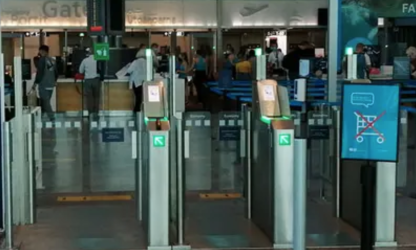
I found an image of the units you illustrated in use - they exist - but these are gates to enter the security area at HEL.

1779780570019.png

But Helsinki is a red herring. We are talking about Qantas at Sydney.

I don't give a toss whether Qantas installs the biometric-capable thing or just keeps manual BP checking - I'll always be near the front of the PB queue. But I'm simply curious if anyone can come up with a good reason why they would install a more sophisticated and inevitably more expensive unit (I really can't see them being cheaper than the type in the pic above). No need to be defensive about it. I've given my reason .
 
Well, I don't know about 'discussing at great length' ;), but on reviewing, your post about Helsinki and its lounge illustrated a completely different scanner

View attachment 508145

View attachment 508146

No posts for cameras there - it was only when I highlighted the camera posts from the OP image, that you pointed out that the unit seemed to be SITA Smart Path.

I found an image of the units you illustrated in use - they exist - but these are gates to enter the security area at HEL.

View attachment 508148

But Helsinki is a red herring. We are talking about Qantas at Sydney.

I don't give a toss whether Qantas installs the biometric-capable thing or just keeps manual BP checking - I'll always be near the front of the PB queue. But I'm simply curious if anyone can come up with a good reason why they would install a more sophisticated and inevitably more expensive unit (I really can't see them being cheaper than the type in the pic above). No need to be defensive about it. I've given my reason .

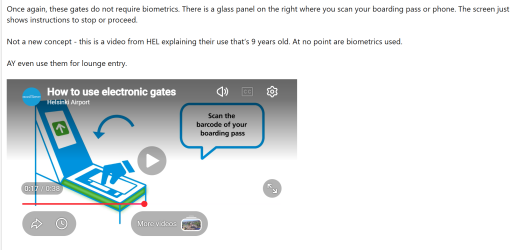
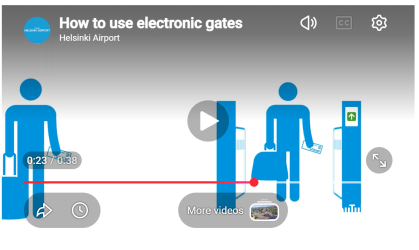
The HEL video is 9 years old. I posted the video to show how it wasn't a new thing. It's not the current model in use and I never said it was.

I'm going from my own experience in HEL last year they (gate AY used to board our schengen flight) look almost identical to the current SITA models. The SITA site itself says they've been used for lounge entry.
 
But I'm simply curious if anyone can come up with a good reason why they would install a more sophisticated and inevitably more expensive unit (I really can't see them being cheaper than the type in the pic above).
Who knows if they’re necessarily significantly more expensive? These days the hardware isn’t always a cost driver. If SITA are providing the solution as a service contract, then it may not be obvious.

But anyway, a reason to trial these models is potential to have a common fit at Domestic AND International gates (the later with biometrics). But simpler and less risk starting at the domestic ops.
 
But anyway, a reason to trial these models is potential to have a common fit at Domestic AND International gates (the later with biometrics). But simpler and less risk starting at the domestic ops.

Which is what I was saying with there being a very small market that would suit AU domestic style gates.

In the Schengen environment, it makes sense to have a common model between intra Schengen and external. For US, they use the same gates for domestic and international, but don't check IDs for domestic, so would need to be able to configure at the gate for each flight.

It makes total sense to have a common model for all applications.
 
Where is the conspiracy? These gates are clearly biometric capable and since we sort of know that biometrics aren’t being used, my question remains.

Why install biometric capable gates?

It’s a genuine question. I’ve given my postulated answer which isn’t a criticism of the airline but a compliment if anything. So, what do you ( and others of a similar mind ) think the reason is?
I think theres a couple of reasons.

1) WSI would be using these gates for boarding and I strongly now also suspect this trial doubles for WSI ops training as well.
2) QF (or maybe SYD) are already known to overspec things. 321XLR for SYD -MEL ? I know their reasoning for fleet commonality and this could be along those lines.
3) if it's a trial and literally just one gate, why not install the higher specced version. You could always play around with things and see how it works in real life. Perhaps the screen os useful for instructions too and the camera is disabled.

I don't think the camera modules here would realistically make much material difference in cost for a couple of gates during trial.
 
3) if it's a trial and literally just one gate, why not install the higher specced version. You could always play around with things and see how it works in real life. Perhaps the screen os useful for instructions too and the camera is disabled.

Yes, esp as I suggested the supplier is subsidising the trial, so cost is a lesser issue. But maybe a trial at an international gate would make more sense? The biometric module potentially more useful there, in the future.

If you've got a couple of things sticking up like that the only thing that can happen is that something will snag on them or elbows bump etc. And you'll get people like me saying 'hey, is that thing taking my picture?' 🤣
 
In that scenario, that’s not reducing staff. The on board member would still be on board.

But I think there are commonly two ground based staffat a gate so if they are looking to reduce that by one I guess that’s a number of positions saved. But it still doesn’t explain whether that why they are trialling biometric capable gates.
Great - frees up the crew member to be more active in direction of stowage of bags on board and traffic flow to help with OTP.
 
If I recall, Japan Airlines is also using automatic boarding gates with no biometric, even if it was allowed for the future.
You simply just scan the boarding pass, or tap your JCB card and the gate will open. If there's issues, there are 2 Japan Airlines staff who are at the gate to assist.
Back to Qantas, I sincerely hope I will be able to simply scan my Frequent Flyer card to allow access.
Great - frees up the crew member to be more active in direction of stowage of bags on board and traffic flow to help with OTP.
Or to see if passengers are bringing in excessive cabin baggage?
 
Sydney Airport trialled this all the way back in 2013, so not the first time it has been attempted.


Become an AFF member!

Join Australian Frequent Flyer (AFF) for free and unlock insider tips, exclusive deals, and global meetups with 65,000+ frequent flyers.

AFF members can also access our Frequent Flyer Training courses, and upgrade to Fast-track your way to expert traveller status and unlock even more exclusive discounts!

AFF forum abbreviations

Wondering about Y, J or any of the other abbreviations used on our forum?

Check out our guide to common AFF acronyms & abbreviations.
Back
Top