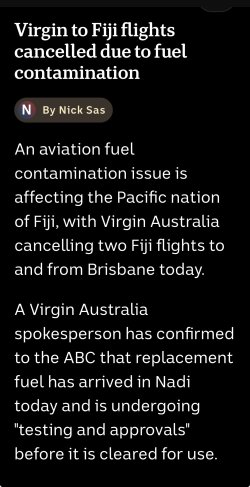





Nadi - Fiji Jet Fuel Contamination

Interesting

Also affecting Jetstar on the same route..

JQ 121 refueled at BNE enroute from MEL to NAN and on the return JQ122 is routing via AKL (presumable where they will take on fuel and a new crew, given they will arrive at AKL 12 hrs after originally scheduled MEL departure).
 
Read our AFF credit card guides and start earning more points now.

AFF Supporters can remove this and all advertisements

Fuel contamination can be quite costly. I remember an issue at Singapore a long time ago, Tiger Singapore had a couple of A320s impacted and took months to fix them. Screwed their whole schedule.
 
Oh dear - just read in The Australian that there is a current fuel shortage in Fiji - it commented on QF and VA saying both had diversions and cancellations - Fiji Airways was not mentioned.

We're off to Fiji tomorrow on Fiji Air - hope there's no disruption to flights.
 
Fuel contamination is interesting, any ideas how this could have happened?

I have absolutely no knowledge of airport fuel holding areas, but I am guessing the fuel storage tanks must have had a leak and water got in?
 
The ABC is reporting that the contamination relates to "an excessive electrical charge in a batch of fuel stored at the airport". Presumably that means some kind of chemical reaction in the fuel related to the storage container being charged.

Qantas, Virgin forced to BYO fuel to Fiji after 'very rare' contamination issue

Following with interest myself as I'm off to Fiji with FJ next week.
 
The ABC is reporting that the contamination relates to "an excessive electrical charge in a batch of fuel stored at the airport". Presumably that means some kind of chemical reaction in the fuel related to the storage container being charged.

Qantas, Virgin forced to BYO fuel to Fiji after 'very rare' contamination issue

Following with interest myself as I'm off to Fiji with FJ next week.
The same article says QF is temporarily operating the SYD-NAN service with an A330 instead of the 737, to avoid the need to refuel. Good for those in J!
 
The ABC is reporting that the contamination relates to "an excessive electrical charge in a batch of fuel stored at the airport". Presumably that means some kind of chemical reaction in the fuel related to the storage container being charged.
Fuel builds up static charge when it is pumped because of friction during fuel flow (and this may also happen during tanker or drum transport). That's why fuel tankers (or fuel pumping hydrant systems) and aircraft need to be properly earthed when being refueled to avoid excess static charge and particularly discharge of static which can cause vapours to ignite.

So sounds to me like this fuel has not been properly earthed at some points in its transport and handling and now has built up charge above what can be safely/conveniently discharged by the local infrastructure.

My source: 10 years as a RAAF Fuels Officer. They are right it is very rare - with proper handling, should not happen.
 
Fuel builds up static charge when it is pumped because of friction during fuel flow (and this may also happen during tanker or drum transport). That's why fuel tankers (or fuel pumping hydrant systems) and aircraft need to be properly earthed when being refueled to avoid excess static charge and particularly discharge of static which can cause vapours to ignite.

So sounds to me like this fuel has not been properly earthed at some points in its transport and handling and now has built up charge above what can be safely/conveniently discharged by the local infrastructure.

My source: 10 years as a RAAF Fuels Officer. They are right it is very rare - with proper handling, should not happen.
Thank you, that's really interesting.

I'm familiar with earthing the aircraft during refuelling (from the GA world) but didn't realise that the fuel itself retained a charge during storage if not correctly earthed.
 
I thought jet fuel has antistatic additives?
And I thought excessive static electricity can be quickly resolved through grounding?

So why is this then an issue?
 
Last edited:
I thought jet fuel has antistatic additives?
And I thought excessive static electricity can be quickly resolved through grounding?

So why is this then an issue?
It does, but they are not a complete solution and friction activities such as pumping and transport can cause static charge to build even with anti-static additives.

And yes, it is usually resolved by earthing during friction activities so that there is no unintended discharge of static especially while doing refuelling - kaboom 💣.

So, the fact that it is an issue of static build up suggests to me that there might have been some improper pumping actions (unearthed) at some point in the life cycle of this fuel, thus allowing static charge to build. I think the reason it is an issue is probably that the earthing contacts are rated to a particular charge and there must be a higher charge built up in this fuel - so a bit like popping a fuse when there is an electrical surge, there is enough static charge that a discharge could exceed the capactiy of the earthing contact to deal with it. Speculation on my part though, and happy for anyone with better/more recent experience to chip in. What I do know is that the RAAF was paranoid about this sort of thing, which is a particular issue for drum stock fuels.
 
If jet fuel is stored in steel tanks as bd transported in steel fuel tanks , shouldn't any buildup of electrostatic charge be quickly dissipated.

I would have thought that if fuel was in bounded plastic tanks that electrostatic charge could persist,

Maybe the electrical conductivity of fuel is poor so even in a steel tank it can take a while to dissipate
 
If jet fuel is stored in steel tanks as bd transported in steel fuel tanks , shouldn't any buildup of electrostatic charge be quickly dissipated.

I would have thought that if fuel was in bounded plastic tanks that electrostatic charge could persist,

Maybe the electrical conductivity of fuel is poor so even in a steel tank it can take a while to dissipate
Now we are beyond my former pay grade 😂
 
Sparked my former professional interest so I asked chatGPT and got this

“If the charged fuel enters a tank, the charge gradually relaxes. But if it hasn’t had enough time to dissipate, the electrical potential between the fuel and surrounding equipment can become large enough that a spark or electrostatic discharge occurs.
Jet fuel can be deliberately treated with a static dissipater additive (SDA). This increases its electrical conductivity enough that charge can dissipate more rapidly.
It doesn’t make the fuel a good conductor—it simply gives the charge a much easier path to dissipate.
Fuel-handling systems are designed to control the rate at which charge dissipates, and tanks need appropriate relaxation time and bonding/grounding arrangements.”

So pretty much suggesting my initial thoughts were in the ballpark - likely charge build up (probably via poor handling practices) that now can’t safely/conveniently dissipate.
 

Become an AFF member!

Join Australian Frequent Flyer (AFF) for free and unlock insider tips, exclusive deals, and global meetups with 65,000+ frequent flyers.

AFF members can also access our Frequent Flyer Training courses, and upgrade to Fast-track your way to expert traveller status and unlock even more exclusive discounts!

AFF forum abbreviations

Wondering about Y, J or any of the other abbreviations used on our forum?

Check out our guide to common AFF acronyms & abbreviations.
Back
Top