





ithongy
Member
- Joined
- Mar 3, 2009
- Posts
- 314
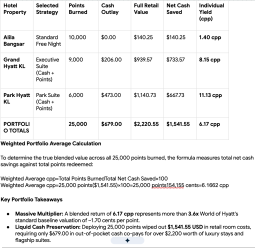
Many US travelers treat 2.0 cents per point (cpp), refusing anything lower. But looking at redemptions through a portfolio lens across an entire trip—rather than evaluating every single stay in isolation—proves you can come out way ahead even when taking a 1.4 cpp redemption.
Here is how the blended math played out across a 3-stay booking in Kuala Lumpur later this year:
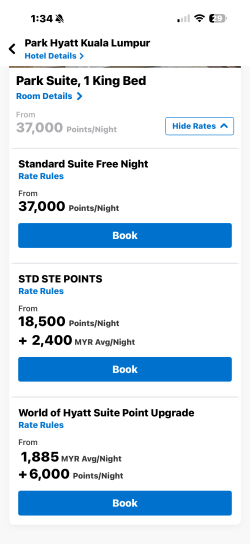
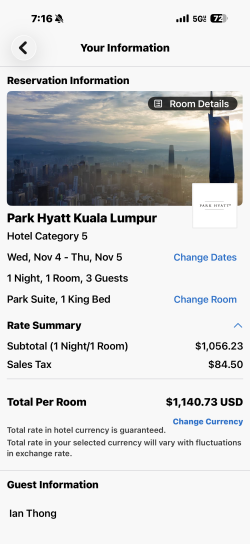
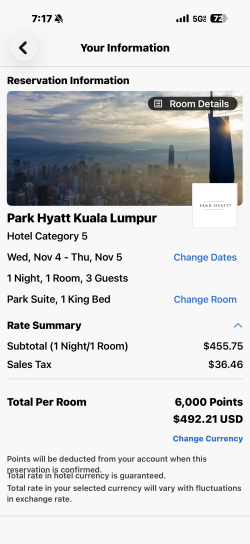
The Spend-Rebate Loop: As a lowly Discoverist holding the Chase World of Hyatt card, paying the $679 in cash co-pays at Hyatt's 9.5x earning rate generates 6,450 points back. That cash rebate completely replaces the 6,000 points burned for the Park Suite upgrade—effectively making the suite upgrade self-funding.
Taking a 1.4 cpp redemption absorbed an out-of-pocket cash bill while the high-yield suite co-pays carried the heavy lifting.
Prices quoted in USD$
Here is how the blended math played out across a 3-stay booking in Kuala Lumpur later this year:
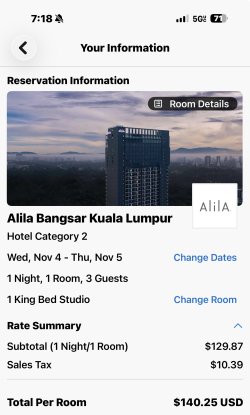
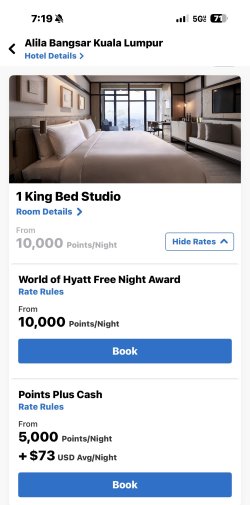
- Alila Bangsar: 10,000 points for a standard night (1.40 cpp).
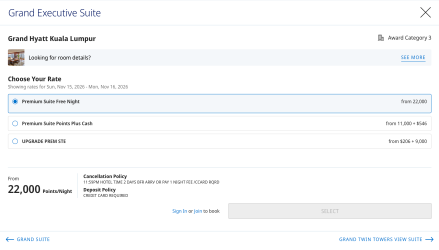
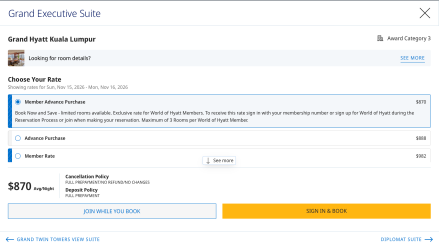
- Grand Hyatt KL: $206 cash + 9,000 points for a 152sqm Exec Suite (8.15 cpp).
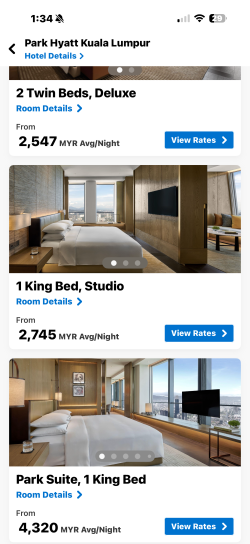
- Park Hyatt KL: $473 cash + 6,000 points for a Park Suite (11.13 cpp).
The Spend-Rebate Loop: As a lowly Discoverist holding the Chase World of Hyatt card, paying the $679 in cash co-pays at Hyatt's 9.5x earning rate generates 6,450 points back. That cash rebate completely replaces the 6,000 points burned for the Park Suite upgrade—effectively making the suite upgrade self-funding.
Taking a 1.4 cpp redemption absorbed an out-of-pocket cash bill while the high-yield suite co-pays carried the heavy lifting.
Prices quoted in USD$
Attachments
-
 Screenshot 2026-08-11 at 5.36.19 PM.png255.7 KB · Views: 12
 -
 Screenshot 2026-08-11 at 6.26.27 PM.png229 KB · Views: 10
 -
 Screenshot 2026-08-11 at 6.26.53 PM.png284.6 KB · Views: 4
 -
 IMG_7568.png1.9 MB · Views: 6
 -
 IMG_7569.png1.9 MB · Views: 5
 -
 IMG_7570.jpeg318.3 KB · Views: 5
 -
 IMG_7571.jpeg391.4 KB · Views: 10