General Medical issues thread

The whole aged care system is a minefield
Then there are changes to Aged Care in the home
Previously called Home Care Packages
Now called Support at Home Program to assist people staying at home

An ACAT assessment is required including a means test

There are 8 levels with funding attached
Level 1 $10000
Level 8 $78000


The level of co contribution depends on the type of care:
Medical related care 0% co contribution
Independence related care up to 50%
Everyday living care up to 80%

Your at home care is given a budget which is split up into quarters. With that you can access services as recommended by the assessment with accredited providers who might charge different fees.

Yes very complicated

 
Last edited:
Then there are changes to Aged Care in the home
Previously called Home Care Packages
Now called Support at Home Program to assist people staying at home

An ACAT assessment is required including a means test

There are 8 levels with funding attached
Level 1 $10000
Level 8 $78000


The level of co contribution depends on the type of care:
Medical related care 0% co contribution
Independence related care up to 50%
Everyday living care up to 80%

You care given a budget which is split up into quarters. With that you can access services as recommended by the assessment with accredited providers who might charge different fees.

Yes very complicated

QS - you have a unique skill set being medical and good at aged care funding.
You could set up a lucrative retirement career given the demographics in forthcoming years and the demand for knowledge. Simultaneously give advice to the family and then treat their (justified) anxiety going through the process. I am being (almost) serious here
 
Then there are changes to Aged Care in the home
Previously called Home Care Packages
Now called Support at Home Program to assist people staying at home

An ACAT assessment is required including a means test

There are 8 levels with funding attached
Level 1 $10000
Level 8 $78000


The level of co contribution depends on the type of care:
Medical related care 0% co contribution
Independence related care up to 50%
Everyday living care up to 80%

You care given a budget which is split up into quarters. With that you can access services as recommended by the assessment with accredited providers who might charge different fees.

Yes very complicated

One thing to remember is that Support at Home participants can only have one provider who will deliver their services either directly or through third parties. The participant pays an admin fee to the provider for care management. We often see correspondence from people who think that they will receive their funding directly to spend as they wish.
Quickstatus you are obviously well versed in the aged care system :)
 
Quickstatus you are obviously well versed in the aged care system
Only because mum and dad went through the process.

The AusGov does not explain it clearly with all the info in one spot, although it is improving. It does require sitting down and reading a lot

The support at home has been expanded which hopefully will assist with people ageing at home (this also reduces cost to the taxpayer). Correct, the funding is not a money in the bank to spend on whatever.

good at aged care funding.
I suspect the aged care consultants and support at home provides know much more.
What I know is just scraped from the Governemnt websites which are easy to find.
 
Last edited:
Folks spend most of a lifetime with a financial adviser helping tham to be financially independent, and what is left seeking help to survive a bureaucratic nightmare.
There clearly needs to be a system to cope with the flood of oldies, but the system seems to be more about skimming us than securing a graceful exit.
 
Sometime I will have to do the sums on utilising the care system in some form or spending the ski fund on private arrangements.
A powerful incentive for the ski slope is being able to make decisions absent the heavy breathing of bureaucracy and lowest common denominator services...
 
Its almost frightening contemplating aged care in the future and the right fit.
Both of our sets of parents have passed on now. And none of them moved into aged care facilities.

It must be so hard for those who do not have strong family advocates.
 
but the system seems to be more about skimming us than securing a graceful exit.
The biggest hollow log that the government is accessing belong to the self funded retirees.
Expect the contribution from these people only increase over time

Actuaries say the average length of stay in NH is 1.7 years. You can see it in how aged care fees are constructed.

RAD - used to be 100% refundable, now 2% is deducted per year for 5 years max
I can't imagine that they would not over time increase the cap to x years for those long stayers and or increasing the % that can be deducted from the rAD

Similarly for the means test fee, Used to be lower with a max lifetime cap of $86,000 which was usually reached in 2.5 years.

Now the max means test fee has increased substantially. One section the hoteling contribution is capped at $22.15 per day no lifetime cap and the non clinical care contribution section has a lifetime cap of $137917 over 4 years

Self funded retirees will be paying substantially moving forward.....

Note also that Services Australia looks back up to 5 years when you do your means test assessment if self funders think they can give away their assets before they enter a NH. Gifted assets in excess of $30k in the 5 years prior to application are considered Deprived assets and counted in the means test assessment.

Maybe @tgh should just put that $ in the ski fund and just spend it.??🤣
 
Last edited:
just spend it


Encapsulates my greatest regret..not spending it..
A lifetime of frugality is not like a coat, to be so easily discarded.. all those J fares could have been in F.. and in hindsight would have made s/all difference to the ski fund.
Now I don't care, the ten year old truck remains in the shed and travel ( even in f ) is all too hard for swmbo….
All that remains worthwhile is fending off the sticky fingers of guvmn't
 
Read our AFF credit card guides and start earning more points now.

AFF Supporters can remove this and all advertisements

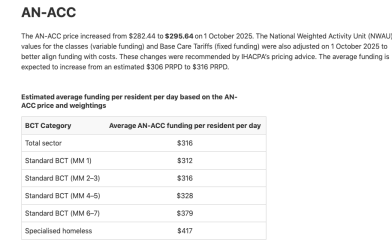
The Govt is expecting to spend on average $316 per resident per year on residential aged care.

The "An-ACC Price" is the base subsidy
The NWAU is the algorithm by which an efficient price of a service can be determine including the An-ACC price
The BCT (base care tariff) is the Aged care Facility's calculated fixed subsidy per resident - irrespective of the composition of the residents.

The govt subsidy consists of Fixed subsidy + Variable Subsidy

Fixed subsidy = BCT = NWAU for the facility x An-ACC price.
Variable subsidy = resident's An-ACC classification x NWAU

Total estimated subsidy illustrated below
$316 per day = $115340 per year

Helping people be independent at home is cheaper.

Screen Shot 2026-08-01 at 11.25.28 am.png
 
Last edited:
I have pondered the viability of a small agency to assist self funded oldies to remain independent.
There is likely some efficiencies, if not actual savings, in managing groups of high quality carers.
I assume the process requires importing folks who expect to work on a contract basis, ( in much of the world folks actually expect to work)
until they eventually find that they can have a great wage without actually making any effort and move on.
Guvmn't has rewarded otherwise low wage level workers who have limited skillsets with a high wage structure.
Why work hard at a high level of competence when you can bludge on the Guvmn't wage.
Story of our brave new Australia really …..
 
There is likely some efficiencies
high wage structure.


Read the Productivity Commission's report into the Care Industry
They are tinkering around the edges.

The problem is that the Care Industry - NDIS, Support at Home programs, has an incentive to increase labor costs upwards - after al lthat is how the providers get paid. No wonder NDIS costs are exploding

How do we incentivise reduction in labour costs without compromising care and outcomes???
 
I have pondered the viability of a small agency to assist self funded oldies to remain independent.
There is likely some efficiencies, if not actual savings, in managing groups of high quality carers.
I assume the process requires importing folks who expect to work on a contract basis, ( in much of the world folks actually expect to work)
until they eventually find that they can have a great wage without actually making any effort and move on.
Guvmn't has rewarded otherwise low wage level workers who have limited skillsets with a high wage structure.
Why work hard at a high level of competence when you can bludge on the Guvmn't wage.
Story of our brave new Australia really …..
I have also been thinking along similar lines of a co-op of people needing care employing a pool of nurses, carers etc. the idea being pay staff well enough that they become trusted long term employees. Would this be less costly than services provided by some dodgy 3rd party supplier? I'd expect there would be geographic considerations and if the pool got to a critical level a manager would be needed, etc., etc.. Just the kernel of an idea.
 
Just want to point out the the current rad which has up to 10% being held is the same as it was back in 2014 when my mother went into care . Mum had to pay a bond. Fortunately had enough funds and then on average her monthly fees were around the 3 to 4 thousand , including the cafe bill :) cause she loved their hot chocolate
 

Become an AFF member!

Join Australian Frequent Flyer (AFF) for free and unlock insider tips, exclusive deals, and global meetups with 65,000+ frequent flyers.

AFF members can also access our Frequent Flyer Training courses, and upgrade to Fast-track your way to expert traveller status and unlock even more exclusive discounts!

AFF forum abbreviations

Wondering about Y, J or any of the other abbreviations used on our forum?

Check out our guide to common AFF acronyms & abbreviations.
Back
Top