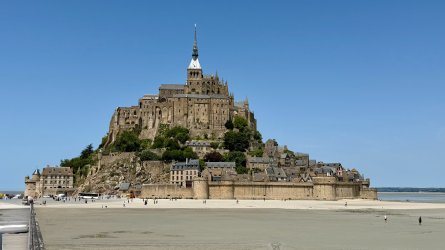
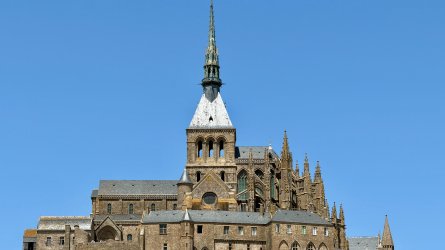
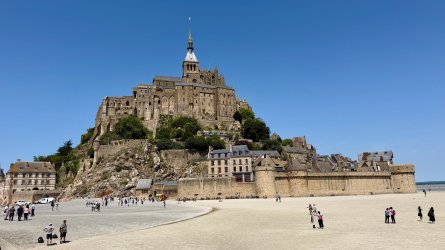
A drive through north-west France

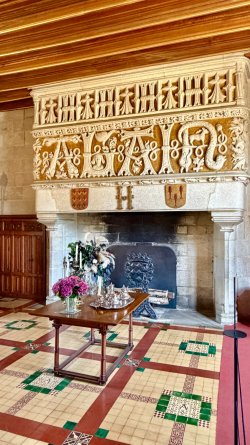
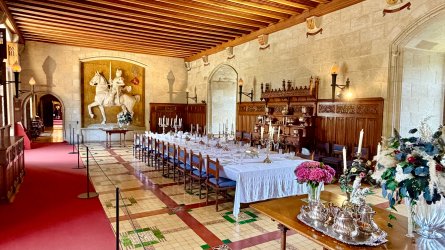
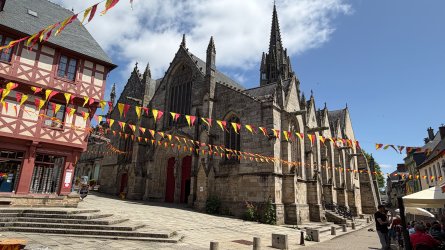
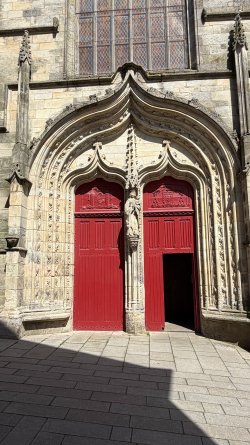
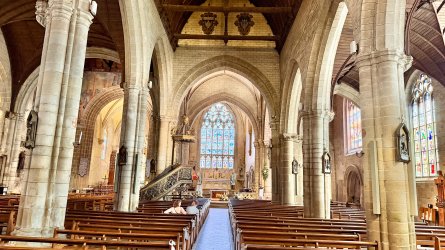
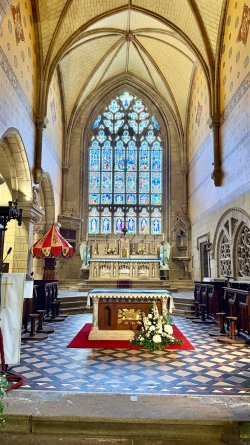
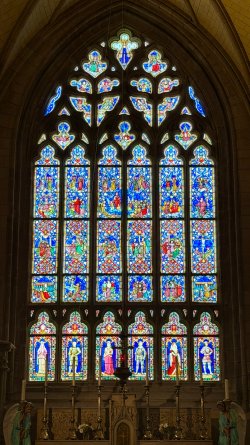
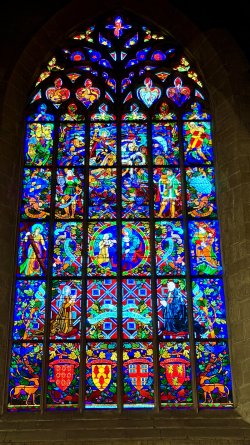
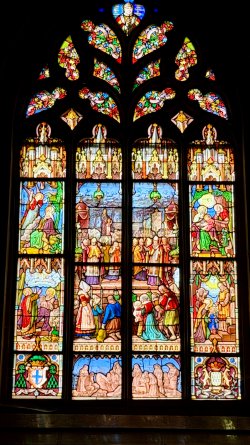
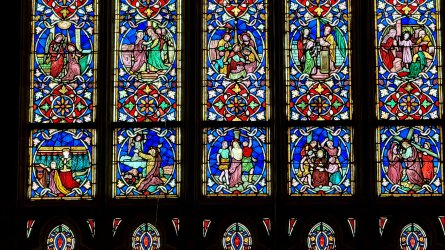
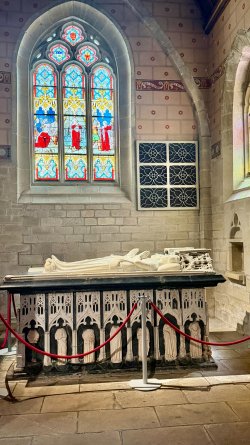
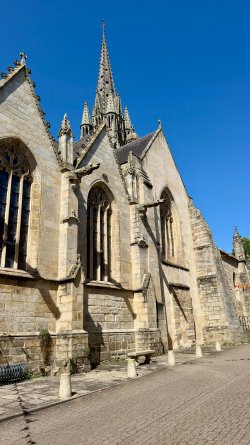
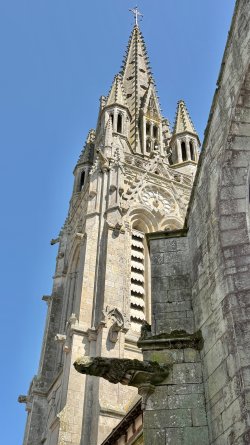
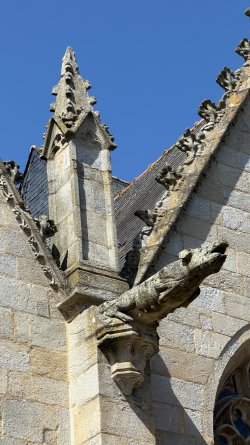
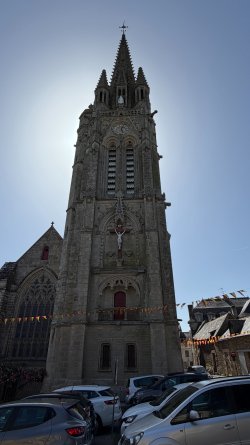
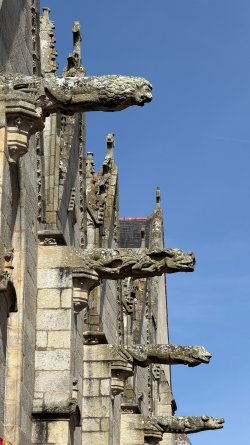
The Basilica of Our Lady of the Bramble (La basilique Notre-Dame-du-Roncier) . As you'd expect a long and involved history

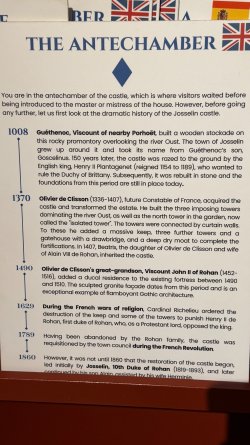
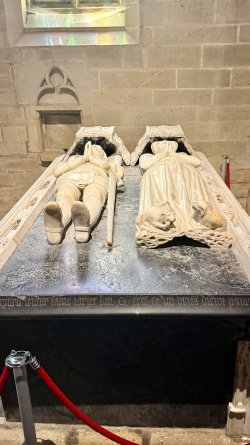
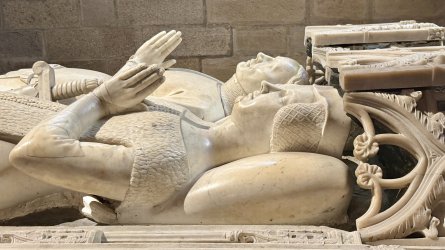
The church was rebuilt at the end of the 12th century after the destruction of the town in 1168 by King Henry II of England . Only the chancel reveals any vestiges of this original structure. The vaulting of the false transept and the enlargement of the chancel were carried out in the following century. At the end of the 14th century , the knight and constable Olivier V de Clisson and his second wife, Marguerite de Rohan, had the south apse transformed into an oratory and private chapel . The nave and south aisle were built between 1461 and 1470 by Lord Jean II de Rohan , while the north aisle was completed in 1491, at which time a square tower was erected in the center of the north aisle. This tower contained a strongroom. In 1705, the upper part of the tower collapsed. During the repair work, a bell tower was placed on top between 1731 and 1734.


IMG_8994.JPEG

IMG_9053.JPEG


IMG_9234.JPEG

IMG_9235.JPEG IMG_9236.JPEG


IMG_9238.JPEG IMG_9239.JPEG


IMG_9237.JPEG

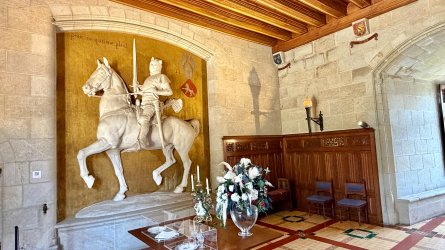
Oliver de Clisson (1336-1407) and his wife

IMG_9245.JPEG IMG_9246.JPEG

IMG_9247.JPEG
 
Read our AFF credit card guides and start earning more points now.
AFF Supporters can remove this and all advertisements

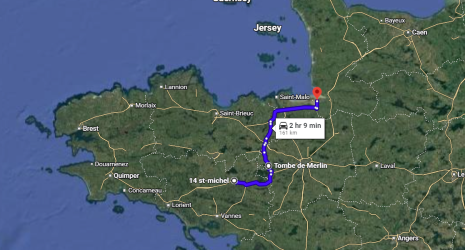
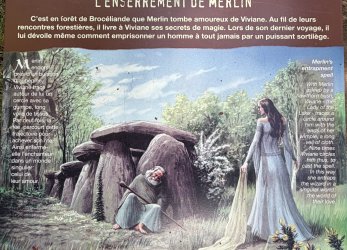
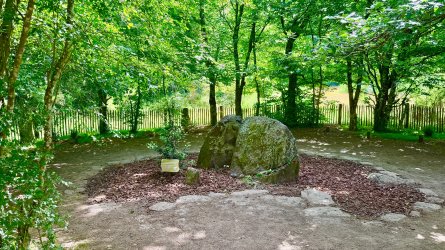
Josselin to Mont St Michel today, via Merlin's tomb.
1781960145451.png

IMG_9292.JPEG

IMG_9293.JPEG

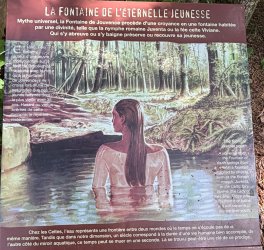
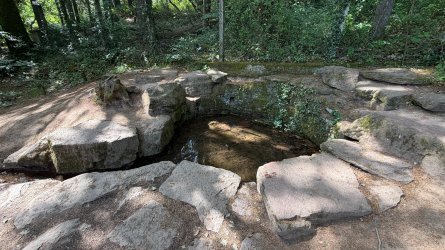
Better still, nearby. Luckily I brought my swimmers!

IMG_9296.JPEG

Maybe not. A sip?

IMG_9298.JPEG

Yes! Voila!

1781960345590.png

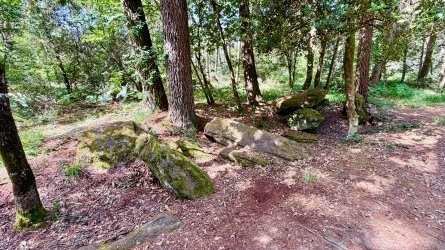
Full of youth & vigour, I added an extra stop - Tombe Anglais

IMG_9306.JPEG

Really just another neolithic site, heavily disturbed, it became known as the Englishman's tomb during the Hundred Years war :)
 
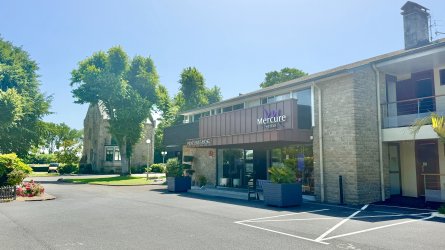
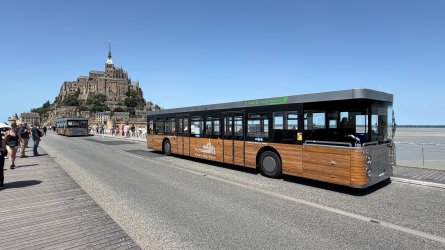
Onto Mont St Michel - one of the highlights of my trip. I booked the Mercure which is excellently placed right on the free shuttle bus ride to the Mont. I covered the actual hotel stay here.

Its typical Mercure standard - basic, but comfortable. A Motel feel about it. An issue though - its in the Caserne area, little service village which is behind a boom gate. The Mercure sent me a code for the gate, which was fine, but I discovered later that it was 20 euro/24hrs.

IMG_9356.JPEG

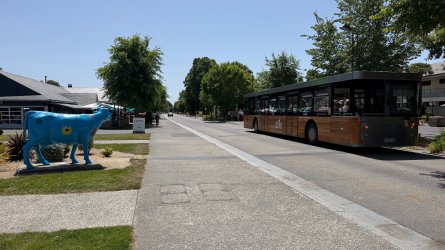
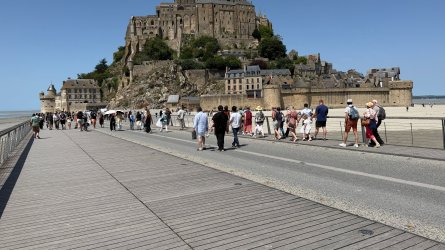
Shuttle busses are bi-directional, saving having to turn around at the Mont (they actually terminate on the bridge about 300m from the Mont entrance. They park, then the driver goes to the other end and drives off, changing side of the road. Every 15 mins from early to 11pm this time of year (June), later in July/August.

IMG_9313.JPEG
 
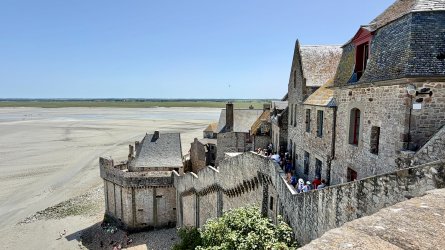
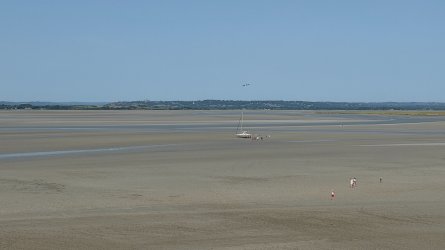
Dumped my gear and I was off to the Mont! Nice fine day, abt 25 degrees. Tide was out; the area has one of the biggest tidal ranges in the world.

IMG_9316.JPEG

IMG_9317.JPEG

IMG_9318.JPEG

There are wide footpaths either side of the roasd on the bridge, but some just need to use the road, notwithstanding ...

IMG_9343.JPEG

IMG_9346.JPEG

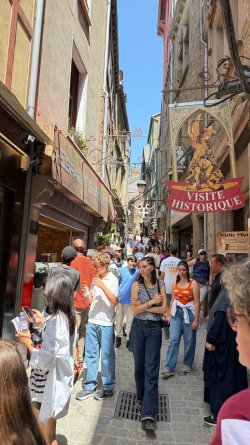
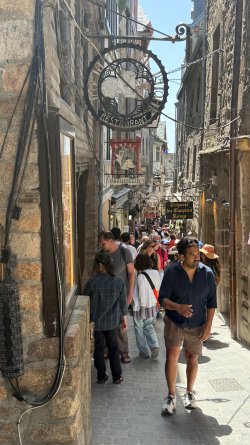
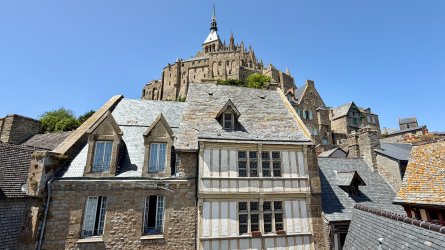
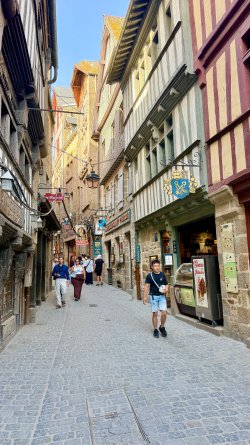
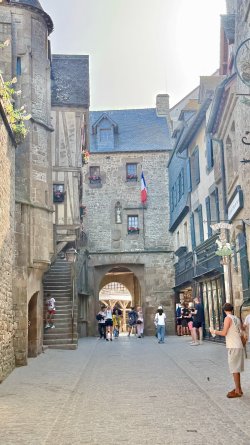
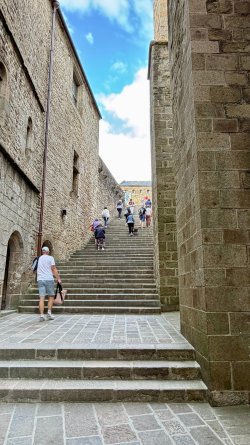
This was just a recce; I have an Abbey tour in the morning. So up the Grande Rue, packed, as expected.

IMG_9325.JPEG

IMG_9326.JPEG

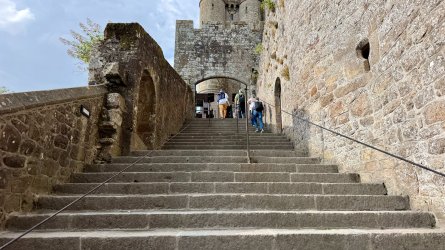
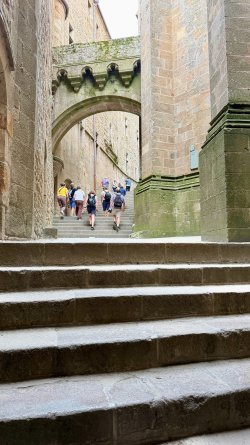
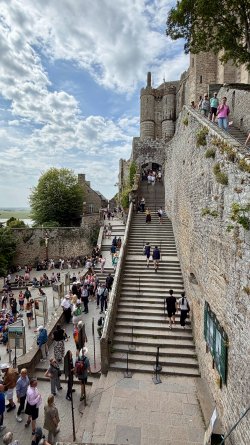
The steps up to the Abbey entrance and ticket office; I turned around at that point -

IMG_9327.JPEG

and walked the ramparts around the town.

IMG_9331.JPEG

IMG_9336.JPEG

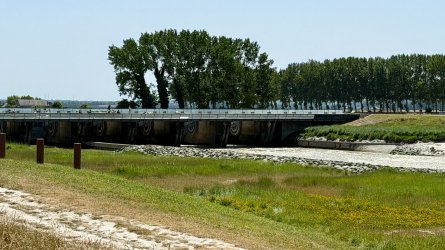
Walked the 2.6km back to the Mercure via the dam.

IMG_9352.JPEG

IMG_9353.JPEG

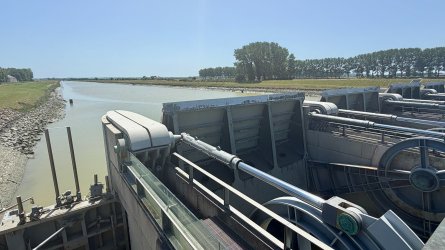
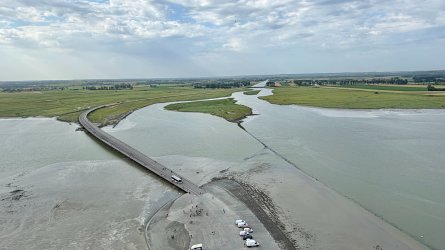
For many years, the Mont was attached to the mainland by a causeway. This caused the area around the causeway to silt up and the Mont would eventually become an isthmus. In 2014 a large project was finished whereby a bridge was built to the Island, the causeway was taken away and a dam was put on the Couesnon River, which is tidal. At high tide, the gates are opened and the river fills with water. The gates close as the tide turns and at some later point they are slowly opened. leading to a stream of water entering the bay close to the bridge, flushing sediment out.
 
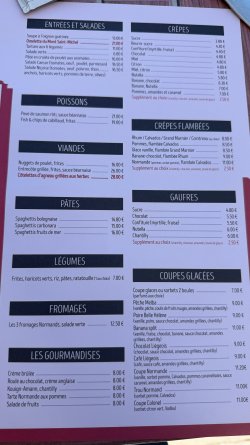
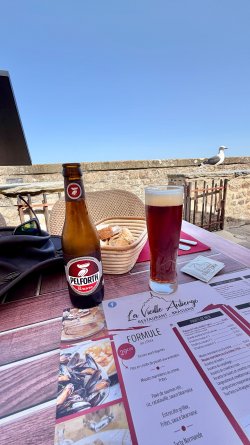
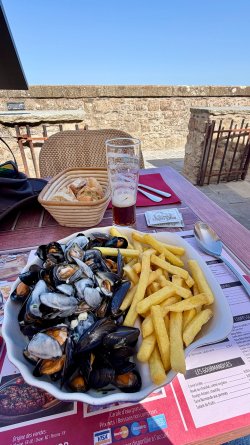
In the evening I went back to have dinner. The only place I could find with an outside terrace turned out to be pretty ordinary - the old saying, good location, cough food/service. The guy managed to forget my beer twice. I had moules frits and a number of little mussels - I later learned that it wasn't mussel season. :mad:

IMG_9360.JPEG


IMG_9364.JPEG

IMG_9365.JPEG IMG_9366.JPEG

IMG_9372.JPEG IMG_9374.JPEG
 
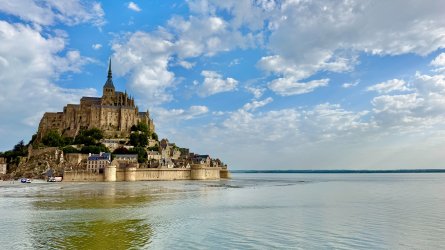
Next day ... out to the Mont about 9am ready for my 10am tour. The tide was in, so the Mont was an island again

IMG_9385.JPEG

And not many people around at 9am

IMG_9387.JPEG IMG_9390.JPEG

IMG_9391.JPEG IMG_9392.JPEG

And the final climb up to the ticket office (I pre bought mine), reception and the

IMG_9393.JPEG

IMG_9394.JPEG IMG_9397.JPEG

The history of establishment, construction and ruin and repai of the abbey is complex and you'll find the detail here. It was first established as a small church in the 10th century (long since engulfed by the later abbey but rediscovered recently and named Notre-Dame Sous-Terre).

To create a base for the abbey church, several crypts were built around the mount peak

The new church-abbey first had three crypts built: the Trente-Cierges chapel (under the North wing), the choir crypt (to the East) and Saint-Martin chapel (under the South wing) (1031–1047). Then Abbot Ranulphe started the construction of the nave in 1060. In 1080, three levels were built to the North of Notre-Dame-Sous-Terre, including the "salle de l’Aquilon", which served as chaplaincy to host pilgrims, the monk promenade and a dormitory.

Badly built, three spans on the West side of the nave collapsed in 1103. Abbot Roger II had them rebuilt in 1115–1125. In 1421, the Romanesque choir collapsed. It was rebuilt in Flamboyant-Gothic style from 1446 to 1523 (with a construction break from 1450 to 1499).

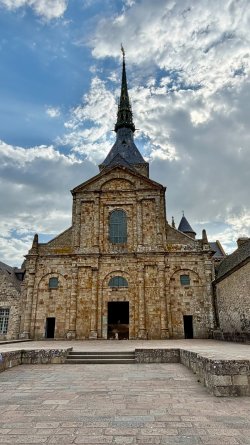
The terrace of the abbey church. Most of this was formerly occupied by some of the Romanesque the nave of the church. After a fire in 1776, the end of the church was re-built in Neo-Classic style.

IMG_9399.JPEG

View from the terrace to the dam

IMG_9398.JPEG
 
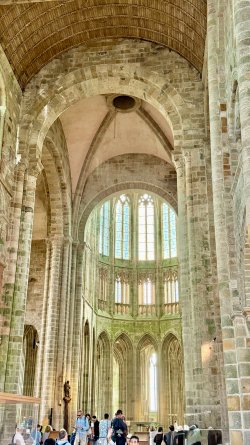
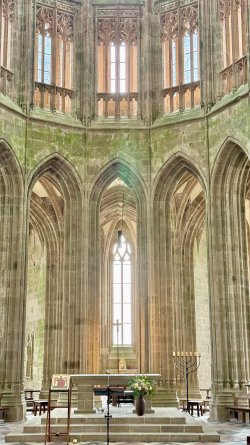
Inside the church. The re-built 'flamboyant gothic' choir 1446 to 1523 (pointed arches).

IMG_9404.JPEG

IMG_9406.JPEG

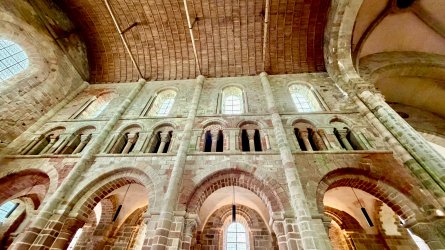
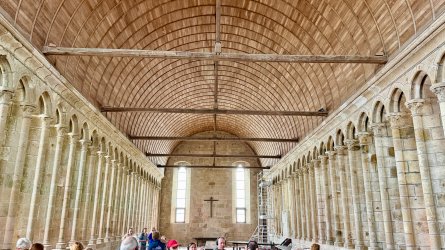
And the older, Romanesque nave (rounded arches)

IMG_9419.JPEG

IMG_9405.JPEG

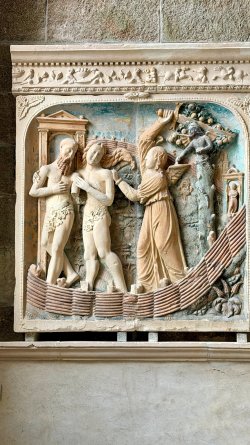
16th century bas-relief of Adam and Eve.

IMG_9411.JPEG
 
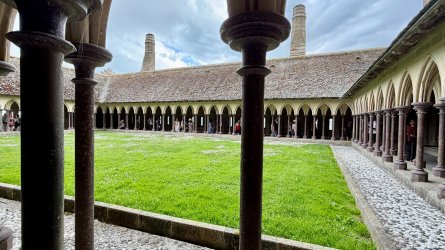
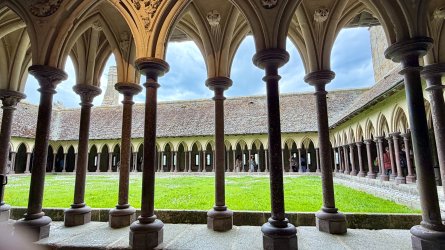
Next to an abbey church is always a cloister, used for meditation. The centre is open to the sky, to be closer to God.

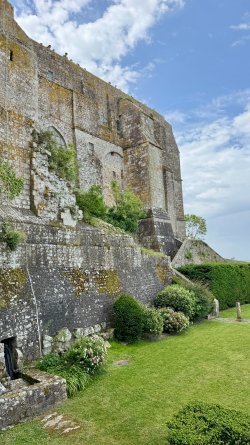
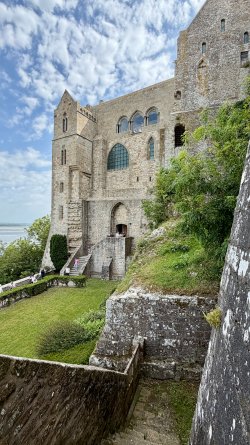
The cloister was built atop a massive extension to the abbey structure , the 'Merveille', begun in the 1200s. From the outside (later) you can see what a massive undertaking this was.

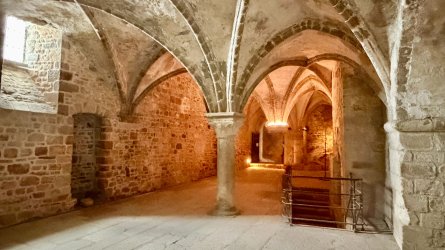
The "Merveille" can be subdivided into two parts: the East and the West sides. The East side was built first (from 1211 to 1218) and has three rooms: the chaplaincy, the hosts room and the dining-hall (from bottom to top). The West side was built seven years later and has three rooms: the wine cellar, the Knights room and the cloister.

The cloister

IMG_9421.JPEG

IMG_9423.JPEG

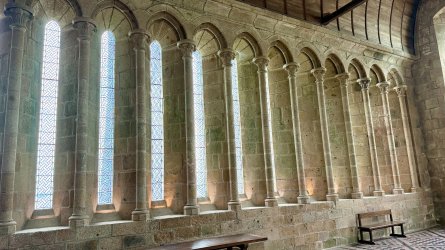
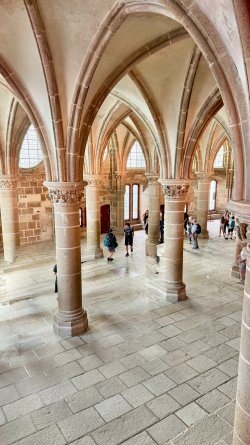
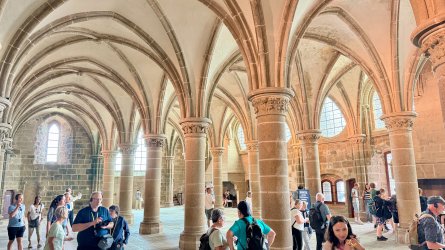
Leading off the cloister, the monk's refectory. This is regarded as one of the marvels of the complex. As you enter, its filled with light, but most of the windows are concealed.

IMG_9429.JPEG

The windows are revealed as you proceed.

IMG_9432.JPEG

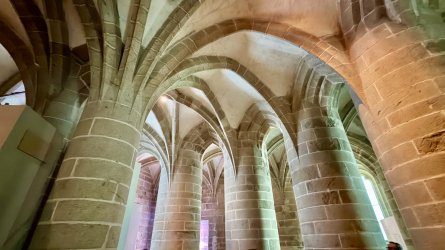
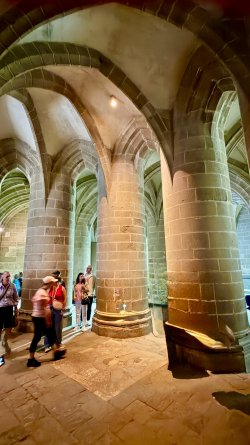
We then proceeded down the the levels underneath and it became confusing where we were and what the rooms were. Here, massive pillars underneath the church to support the new choir.

IMG_9435.JPEG

IMG_9436.JPEG

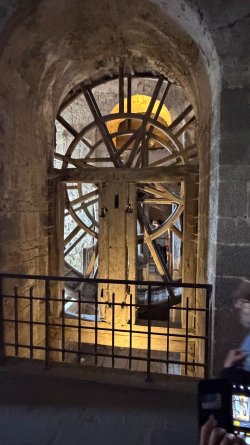
The 'wheel - installed during the French Revolution where the Mont was a prison. Prisoners were inside the wheel, driving it hamster=like to haul up food and water via a sled on the outside.

IMG_9443.JPEG

IMG_9445.JPEG

Lastly, the scriptorium where the monks transcribed books. The archives of the abbey were destroyed by allied bombing in WW2, but many manuscripts survived and are housed in nearby Avranches (visited later).

IMG_9449.JPEG

IMG_9451.JPEG
 
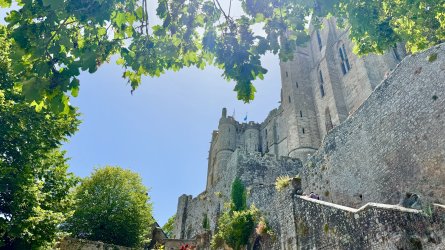
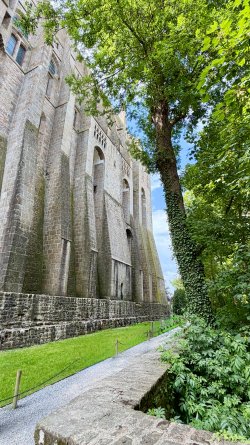
We exited the building down past the Merveille (topped by the cloister and refectory) and you can see in the 2nd and 3rd pics what a massive structure it is. The church terrace is atop the first pic.

IMG_9455.JPEG

IMG_9457.JPEG

IMG_9458.JPEG

And back to the beginning stairs again. I'd like to know how many steps up and down that day!

IMG_9459.JPEG
 

Become an AFF member!

Join Australian Frequent Flyer (AFF) for free and unlock insider tips, exclusive deals, and global meetups with 65,000+ frequent flyers.

AFF members can also access our Frequent Flyer Training courses, and upgrade to Fast-track your way to expert traveller status and unlock even more exclusive discounts!

AFF forum abbreviations

Wondering about Y, J or any of the other abbreviations used on our forum?

Check out our guide to common AFF acronyms & abbreviations.
Back
Top