





Some island cruising - The Canaries and Sicily, then Milan

I got a late checkout, so headed off to the cruise port around 3 but got there quicker than expected, abt 3:20 (boarding from 4pm). I was worried that I'd just have to hang around, but Ponant were there, checking people off and there were chairs set up in an old Magazine, which was cool and sheltered.

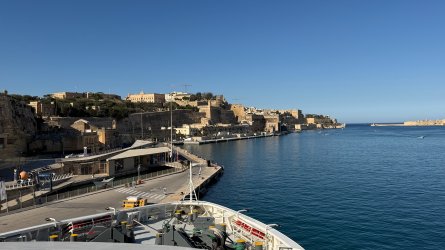
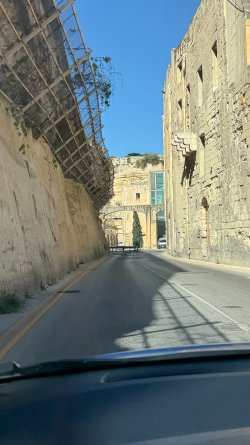
The road along the cruise port area is interesting!
IMG_5272.JPEG

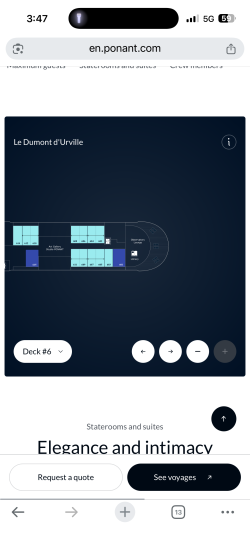
Ponant people were outside, under a marquee. You gave your cabin number and they tagged your main bags and they disappeared. They couldn't find me under my cabin number (deck 4, midships, which I prefer). Oh-oh. :eek: But there I was ... 601. Yes, 601. I had been upgraded (deck 6 all 'better' cabins, including the suites)!! I quickly went to the app to find what type of cabin - ah. 'Deluxe suite'. :cool: Forward and high.

Who knows how they decide upgrades. I'm 'Grand Admiral' status (equiv to Plat on airlines), entitled to an upgrade and I found out later there were only about 10 GAs and above on the cruise (above is Commodore, P1 equiv).
IMG_5273.PNG

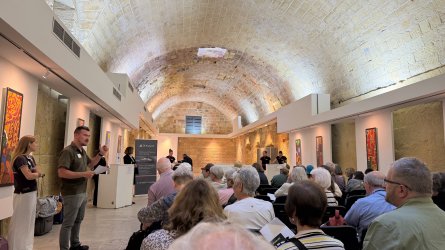
The magazine where we waiting till 4pm, when they started the formalities. I sat down and there was an Aussie lady behind me. Oh! She had the most awful hacking cough. And a mask. More on that later.
IMG_5274.JPEG

The guy on the left was interesting. 'Travel director'. Not in uniform and his assistant to his right. The Cruise Director was absent for the first few days, so this guy - a tri lingual Italian - filled that role, but I never figured out his actual status. I THINK he came along because it turned out that many passengers had booked under Smithsonian (although it wasn't a 'Smithsonian' cruise, which Ponant do do sometimes). Many passengers were American and most had booked under Smithsonian. It ended up maybe 60% non-French and of these 80% American; 40% French. Very unusually, at least for a European cruise, during the cruise a number of announcements were made in English first.

The boat, which is identical to the Le Bougainville which I had just left. 184 pax capacity, I think we had about 140, which was comfortable.
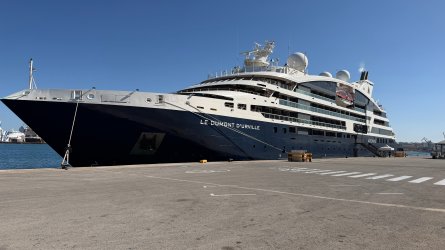
IMG_5277.JPEG

'Priority boarding' for deck 6 :).

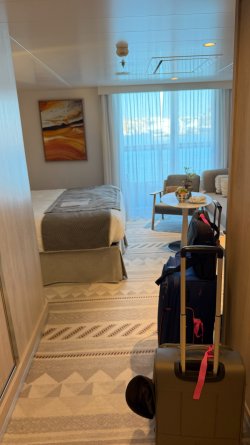
Cabin.

IMG_5284.JPEG

Not a 'suite' in the sense of two spaces, but a ~50% wider cabin. Regular cabins would have their side wall where the bed-side edge of the table is.
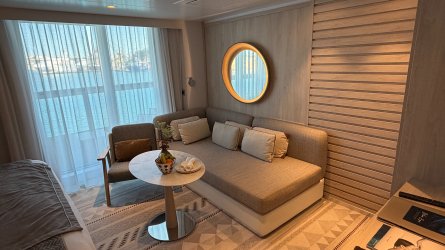
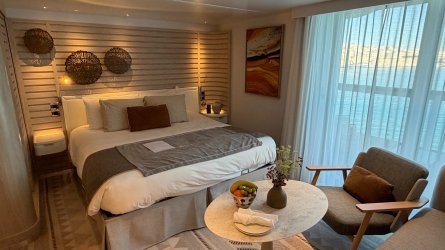
IMG_5278.JPEG

IMG_5279.JPEG

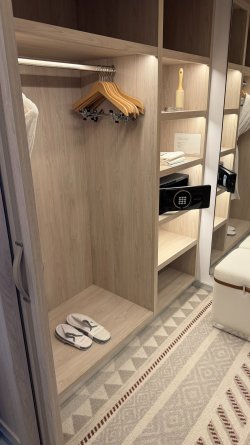
Behind the suitcases is a large walk-in wardrobe / luggage storage area. Its glorious to unpack for a cruise!!
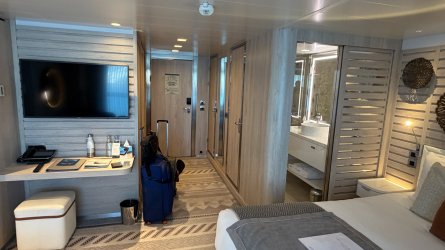
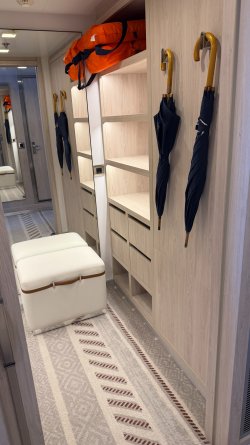
IMG_5280.JPEG

IMG_5282.JPEG

IMG_5283.JPEG

Larger bathroom than regular cabin; shower the same but in reg cabin it ends about half way through the sink here.
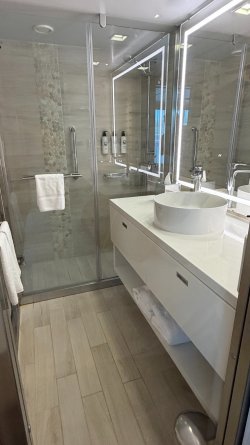
IMG_5281.JPEG

Complimentary minibar, which gets replaced daily and you can ask for your favourite spirits/mixers etc. I hardly used it, because immediately next to my cabin is the forward Observatory Lounge, with its own bar. So I just popped there to get a properly mixed drink.
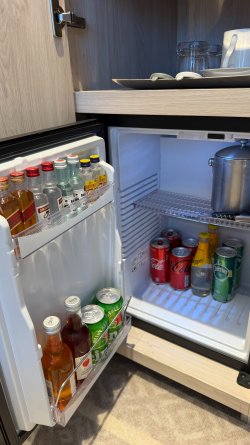
IMG_5286.JPEG

Cabin service guy brought Champagne (never had that before, on arrival)
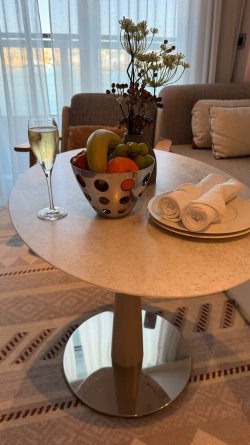
IMG_5287.JPEG

And I contemplated life looking at the view.
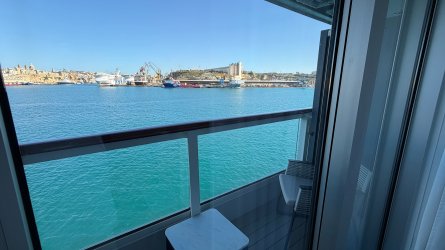
IMG_5285.JPEG
 
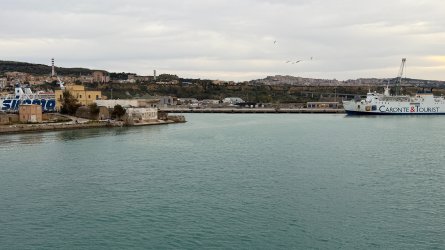
Next morning, went for a walk around Sliema waterfront where @Pushka will be staying later this year. I think it will be a good choice.

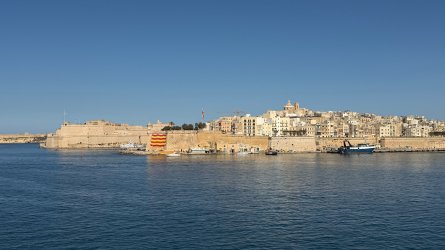
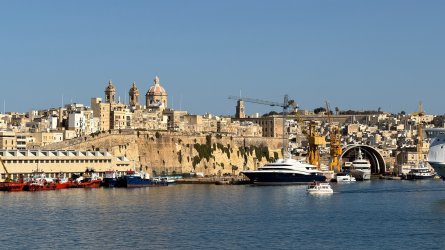
Wide walkway, with restaurants dotted around; some swimming areas (rocky 'beaches'). These pics more-or-less on the outward walk from Spinola Bay to a point where I could see the Valetta breakwater.

View attachment 504756

View attachment 504757

Looking back down Spinola Bay and St Juliens.

View attachment 504758

The waterfront is dotted with old forts and look outs. The Torri ta san Giljan watchtower

View attachment 504759

View attachment 504767

View attachment 504760

View attachment 504761

View attachment 504762

View attachment 504764

View attachment 504768

View attachment 504769

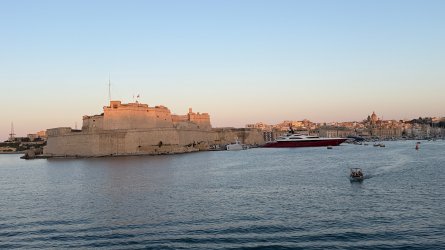
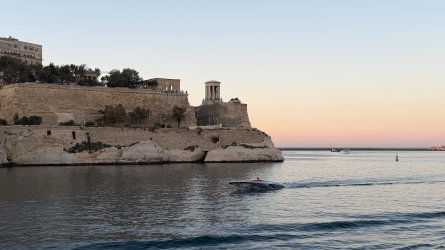
Valetta harbour breakwater.

View attachment 504766
My mouth is watering for my June visit. I have booked refundable accomodation at St Juliens (AC Hotel) , do you have a view on whether Sliema is better? Quiet and less hilly would be preferences.
 
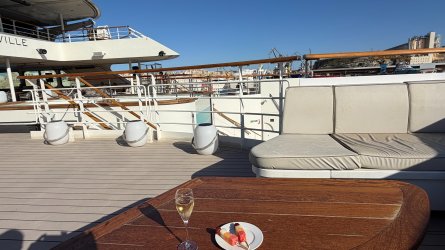
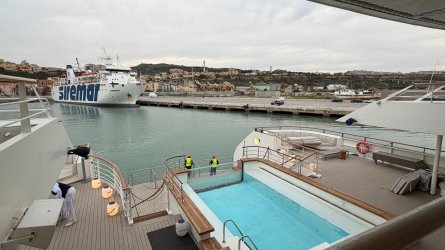
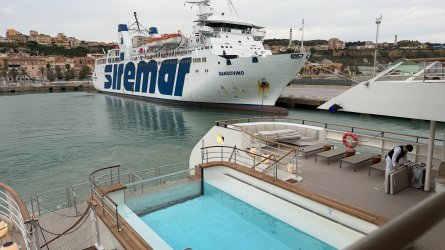
No need to explore the ship - its identical to Le Bougainville I had just left, so I chilled on the pool deck in the late afternoon sunshine.

IMG_5289.JPEG

IMG_5290.JPEG

IMG_5292.JPEG

IMG_5294.JPEG

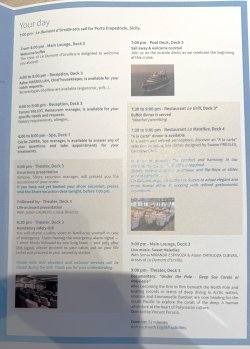
The afternoon program

IMG_5295.JPEG

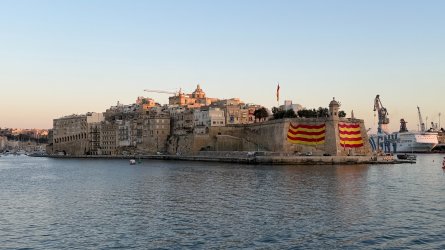
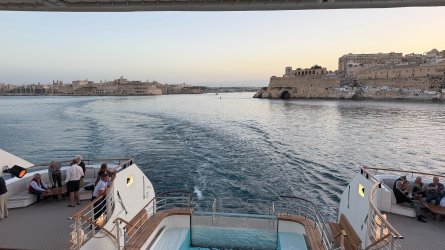
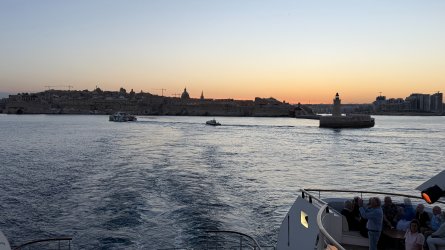
After the mandatory lifeboat demo, and Captain's introduction (he's French, of course, but based in Sydney and is 'relieving' for this cruise), there was Sail-away with drinks and canapes on the pool deck. Not something usually practised by Ponant in Europe, in my experience, but very nice on Valetta harbour.

IMG_5297.JPEG

IMG_5298.JPEG

IMG_5299.JPEG

IMG_5300.JPEG

IMG_5303.JPEG

IMG_5305.JPEG

All very well, but the Captain did warn that the seas would get up overnight, but would be following in our direction, so shouldn't be too noticeable ...

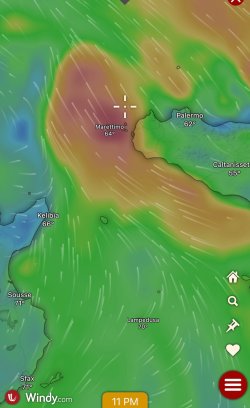
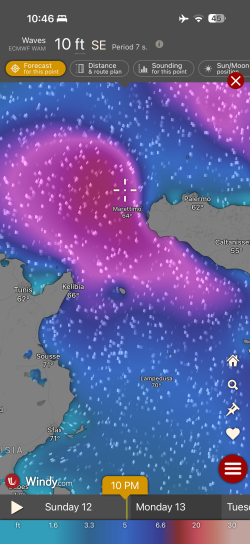
Over the course of the cruise, I looked at the Windy app a lot. Noticed that storms do get up on the Mediterranean - fairly localised, but intense.
 
My mouth is watering for my June visit. I have booked refundable accomodation at St Juliens (AC Hotel) , do you have a view on whether Sliema is better? Quiet and less hilly would be preferences.

I didn't go into Sliema, but I think away from the waterfront it might be quieter than St Juliens. Although where the AC is is away from the waterfront so not as lively as where I was.

Call Sliema quieter, but not as 'done up'.
 
As the afternoon wore on, I got the feeling that the crew weren't quite as good as the last one. Hard to define, but the impression got firmer as the cruise wore on. Not bad by any means - always obliging, but ?not as polished/experienced? supervisor not as tight? There certainly were some organisation issues. Many pax found that their booked excursions had disappeared. I found that 200 of my 350 euro total credit hadn't been 'credited' (fixed overnight).

There was a lot of coughing aboard. That Aussie lady I mentioned was virus tested as soon as she got aboard and obviously passed but it was a distracting thing to hear - very nasty cough, lasted for a few days. The sommelier had a bit of a cough, as did several pax.

The cruise director (one who is involved in pax entertainment etc) appeared after a couple of days - I believe he was crook. He was an absolute dead loss - Italian and complete opposite to the Italian Cruise Director I had on my recent Indonesian cruise. He was pretty formal and not very interactive with pax in a casual sense. I didn't attend any of the evening entertainments.

This is not to say that this impacted on my enjoyment - just noting that there is differences in crews, especially notable on back-to-back cruises on different, but identical vessels.

Passengers. Majority Americans, mainly of retirement age and the ones I met were lawyers, doctors, business people and their spouses. Very nice people, but many were not very switched on. I mean that's not confined to that nationality, but it was obvious here due to numbers (and, on occasion, loudness :) ). I met a number of the French people on board, again, nice and approachable but harder to get to know. Maybe 8 other Aussies, easy to share a table with.

I missed the usual singles get together - somehow it clashed with something else I wanted to do, so kept my own company for the first dinner. Two restaurants - informal on the pool deck Le Grill, and more formal a la carte on the deck above, Le Nautilus. Being an 'old hand' I knew that the prime position of the outside, overlooking the pool in Le Nautilus could be accessed in the evening just before they opened the doors from the inside, by using the ladders from the decks above or below. I nearly always ate breakfast and dinner here.

Lunch I always had on the pool deck - I simply don't understand those who dined a la carte inside when it was a lovely sunny day and a fresh 'special' was prepared on the pool deck.

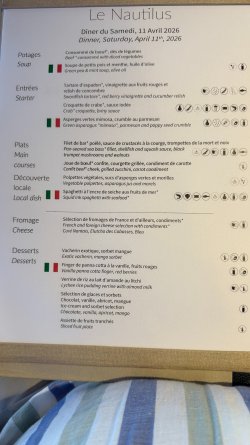
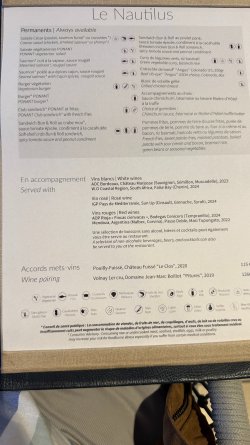
First night's a la carte menu:

IMG_5306.JPEG IMG_5307.JPEG

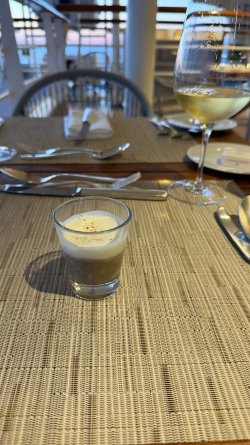
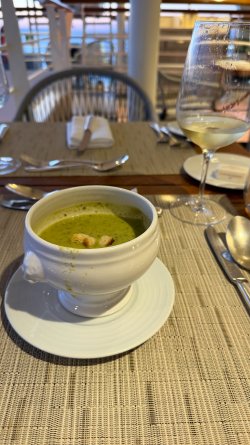
Amuse bouche and a very yummy pea and mint soup.

IMG_5308.JPEG IMG_5309.JPEG

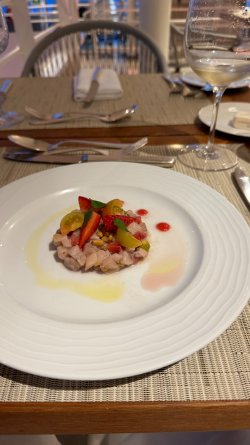
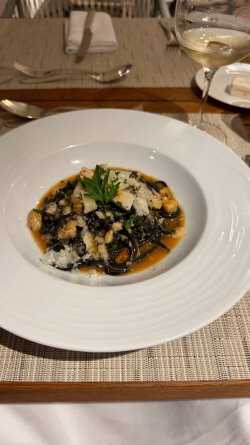
Swordfish tartare and squid ink spaghetti.

IMG_5312.JPEG IMG_5314.JPEG

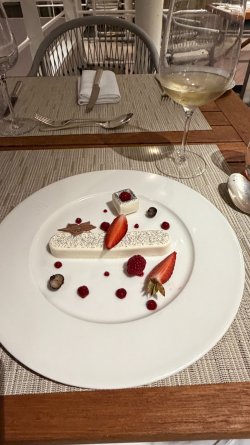
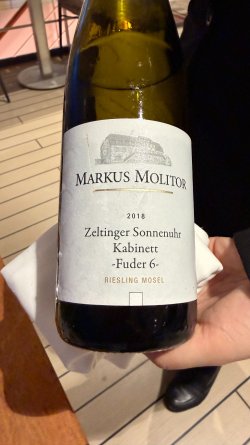
Vanilla panna cotta finger desert, and I bought this German Riesling/Moselle. Gotta use that credit somehow! There are the usual reds and whites on rotation, and they were pretty good overall. But the paid wine list is very extensive, and from around-the-world and reasonable value (esp when its free!). I saw few others purchase wines - mainly the Aussies, it seemed like, although I wasn't often inside the main evening dining area.

IMG_5315.JPEG IMG_5313.JPEG
 
In the morning, it was back to the South Terminal to catch KM Air Malta to Valetta (MLA), where the next cruise departed from. I've flown KM a number of times before and generally like them.

I discovered that my 'business value' fare didn't include lounge access :oops: (and only 20kg luggage, but I knew that).

KM117 dep LGW late 12:09 arr MLA early 4:04pm. A320neo, 1C (I choose a lot of 'C' seats these days as I have an issue with my R leg, that needs it stretched out a lot).

Eurobusness with nothing in the middle seat.

We passed Stromboli - a volcano off Sicily that we would pass on our cruise, but the filthy windows prevented any useful pictures.

View attachment 504715

But then Mt Etna loomed into view - magnificent! 3,300m high, Europe's tallest strata-volcano. We would be close to this on our cruise, too.
Maybe I had thought you had run into an old pommie ack ack. show but limited edition for Row. One only.
 
Would love to. Probably need book early and Sunday best. Bocca Italian is very good but a bit on the high side.
Also good Greek, Thai and seafood . Our local surf club is pretty good pub style but very busy Sunday
Would love to catch up .
Ron..
 
My mouth is watering for my June visit. I have booked refundable accomodation at St Juliens (AC Hotel) , do you have a view on whether Sliema is better? Quiet and less hilly would be preferences.


I stayed in Sliema last year and it’s reasonably flat and there’s a pretty good shopping centre with supermarket if needed.

It’s much quieter than St Julian’s and restaurants not as prolific as SJ. Having said that bolt is incredibly cheap in Malta so less than €10 to get from one to the other.

Rather than hijack this thread I’m happy to answer any questions on my incomplete trip report


I do have a reputation for starting and not finishing TR so we will see how it goes

Your reputation is unsullied :) .

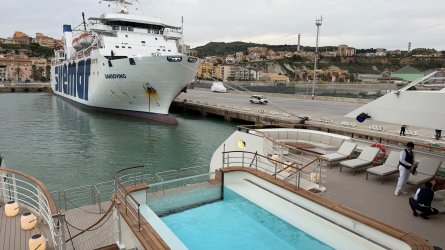
From Valetta, the first stop is Porto Empedocle, to visit the Valley of the Temples.

The port, as with most we docked at in Sicily, was not scenic. I took this series of photos as we manoeuvred backwards and then sideways into the wharf

IMG_5319.JPEGIMG_5322.JPEGIMG_5325.JPEGIMG_5326.JPEG

At most stops, there is a choice of included excursions, usually 3-4 hours, either by bus like here, or walking from the ship as in Syracuse. Occasionally there is an additional paid excursion. You get to choose 1-2 months out from the cruise and they are usually not space limited.

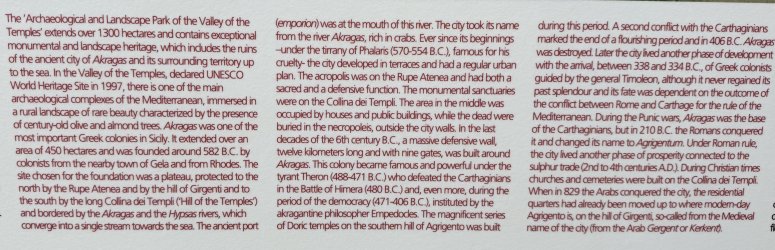
Here there was just the Valley of the Temples, a few km away at Agrigento, one of the best surviving sites of the Greeks in southern Italy.

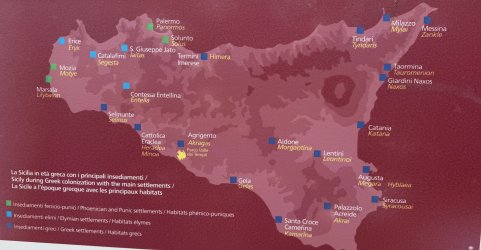
The Greeks settles in southern Italy and Sicily beginning in the 8th century BC and the area became known as Magna Graecia.

It encompassed the modern Italian regions of Calabria, Apulia, Basilicata, Campania, and Sicily. These regions were extensively settled by Greeks beginning in the 8th century BC.

Initially founded by their metropoleis (mother cities), the settlements evolved into independent and powerful Greek city-states (poleis). The settlers brought with them Hellenic civilization, which over time developed distinct local forms due to both their distance from Greece and the influence of the indigenous peoples of southern Italy. This interaction left a lasting imprint on Italy, including on Roman culture.

IMG_5330.JPEG

IMG_5331.JPEG

We were put in groups, and each group on a coache, which were only about 2/3 full each. Separate Anglo and French groups. Each group had a local guide, and as we learned in the course of the cruise, and even on this tour, the locals varied widely in usefulness in understanding what we were visiting.

Here, our group had a trained archaeologist with good English; the next one had a lady who seemed to like talking about herself more than anything ...

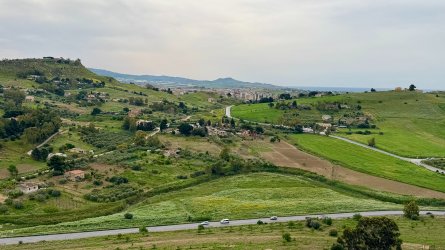
The countryside just looks ancient.

IMG_5335.JPEG

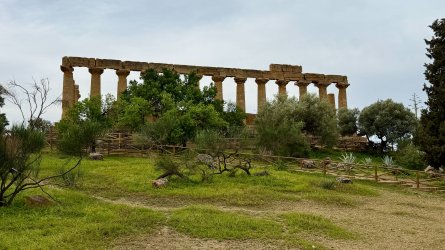
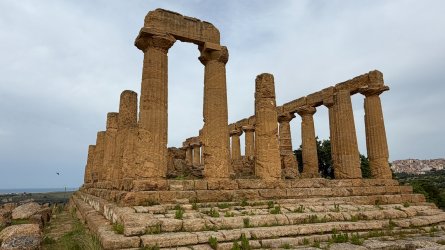
First up was the Temple of Hera - but also known as the Temple of Juno.

It was built about the year 450 BC and in period and in style belongs to the Archaic Doric period. Signs of a fire which followed the Siege of Akragas and the Carthaginian sack of the city of 406 BC have been detected.

The temple was restored in the era of the Roman province of Sicily, with the original terracotta roof being replaced by one of marble, with a more steeply inclined slope on the eastern side.


IMG_5334.JPEG

IMG_5339.JPEG

IMG_5340.JPEG
 
Last edited:
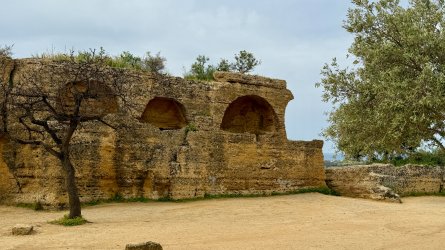
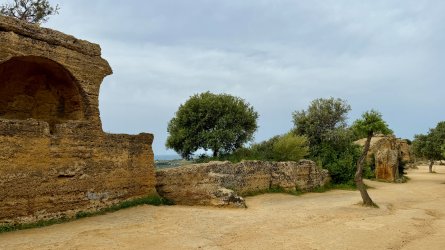
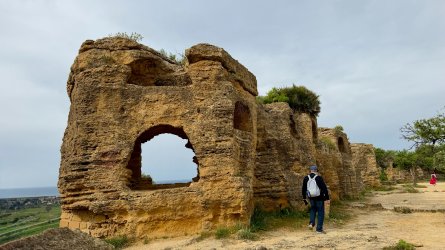
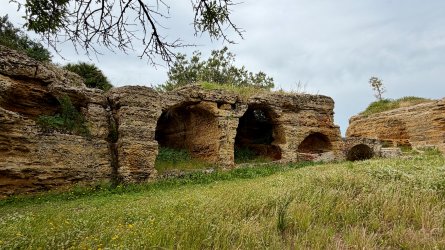
We then walked along the old city wall - but it was hard to get your mind around it. Certainly a wall, but had Roman tomb niches carved into it. Turns out that the wall was actually a natural rise in the ancient days, but a lot of it had been carved back to current ground level, exposing the tombs, which used to be underground.

IMG_5342.JPEG

IMG_5344.JPEG

IMG_5348.JPEG

IMG_5350.JPEG

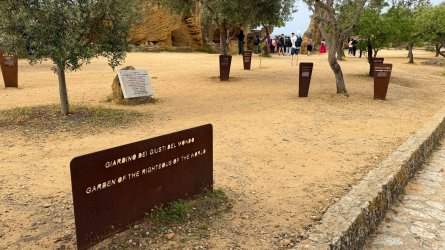
Along the wall was an area of memorials to victims of the Mafia - one of several we saw in Sicily.

IMG_5347.JPEG
 
Last edited:
We walked along the wall, on a well defined old via towards the next temple when of course someone asked for a toilet stop. I gotta say. I'm mid '60s with prostate issues but the number of times some needed a toilet break was surprising. I recall this one as, afterwards, we waited for the group to re-form. Waited, and waited and waited. Missing two. Local guide and Ponant person (each group always had a Ponant person to keep an eye out for everyone, like now). The two never appeared. Toilets checked, calling out. So we kept on - sensible decision (you couldn't really get lost and there were other Ponant groups following) but the Ponant person was naturally very concerned. Eventually discovered that the two had decided to join friends in another group, but didn't both to tell anyone. Wankers.

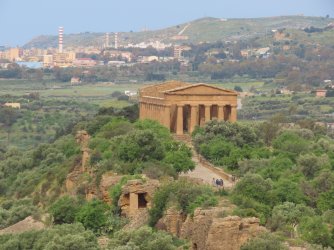
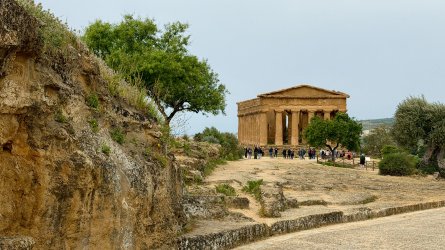
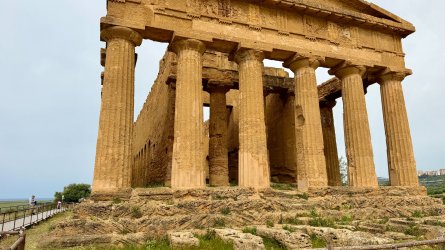
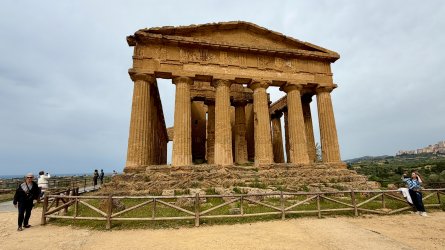
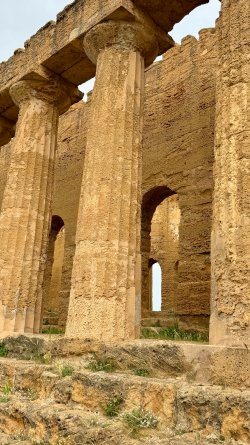
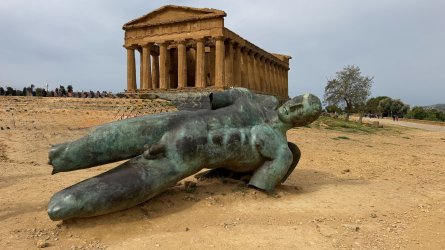
Anyway, approached the Temple of Concordia, the best of this site and the model for the UNESCO logo (all this site is UNESCO World Heritage).

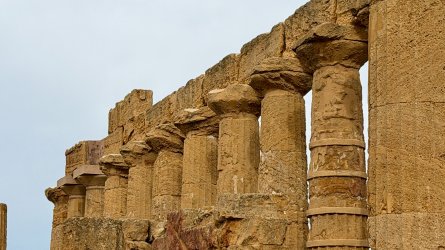
The temple was built c. 440–430 BC. The well-preserved peristasis of six by thirteen columns stands on a crepidoma of four steps (measuring 39.42 m × 16.92 m and 8.93 m high) The cella measures 28.36 m × 9.4 m. The columns are 6 m high and carved with twenty flutes and harmonious entasis (tapering at the tops of the columns and swelling around the middles).

It is constructed, like the nearby Temple of Juno, on a solid base designed to overcome the unevenness of the rocky terrain. It has been conventionally named after Concordia, the Roman goddess of harmony, for the Roman-era Latin inscription found nearby, which is unrelated to it.

Arguably the best preserved Doric temple in the world, after the Parthenon. But its name Concordia comes from a Roman inscription nearby. Its original dedication is unknown.

IMG_1253.JPG

IMG_5353.JPEG

IMG_5357.JPEG

IMG_5358.JPEG

1777511850407.png

One of the reasons its so well preserved is that it was converted into a Christian church in the 6th century. Walls were put in between in the inner columns and arches installed.

IMG_5363.JPEG

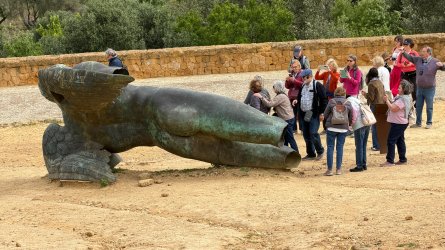
Then there is this guy - Icarus. But its not ancient - it was made for an 'installation' in 2011!! My interpretation is that a lot of work in the gym does you no good, in the end.

IMG_5360.JPEG

A popular attraction, though.

IMG_5362.JPEG
 
Last edited:
Read our AFF credit card guides and start earning more points now.

AFF Supporters can remove this and all advertisements

Hi there. Really interesting posts. Just wondering if you can compare the experience on Ponant’s explorer type ships as well as the sisterships (Le Boreal, L’Austral, Le Lyrial etc. ). The sisterships are a a bit larger and designed for cooler climates?
 
Hi there. Really interesting posts. Just wondering if you can compare the experience on Ponant’s explorer type ships as well as the sisterships (Le Boreal, L’Austral, Le Lyrial etc. ). The sisterships are a a bit larger and designed for cooler climates?

Good questions, I'll answer it here, in a Ponant thread, so to be more widely available to anyone interested in Ponant.
 
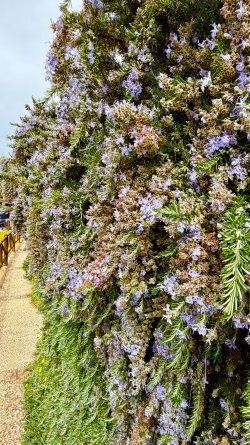
We passed by this lovely weeping rosemary bank to biscuits/juice/toilets (where, as usual, everyone enjoyed their biscuits and juice and then, as they were calling everyone to continue, then they headed for the toilets) :rolleyes:.

IMG_5368.JPEG

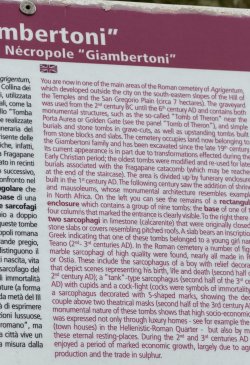
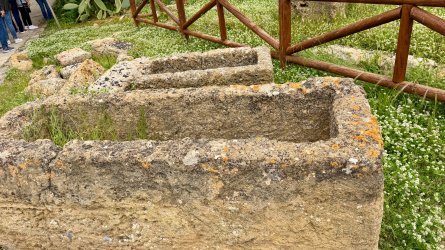
A necropolis with many sarcophagi and niches

IMG_5371.JPEG

IMG_5369.JPEG

IMG_5370.JPEG

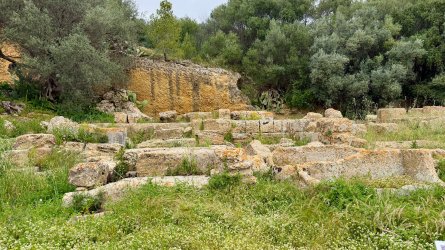
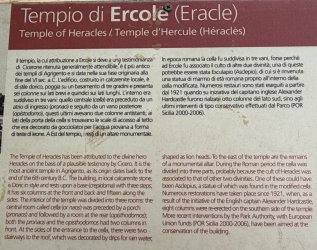
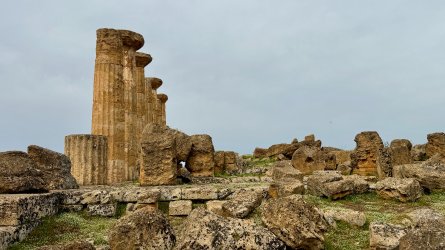
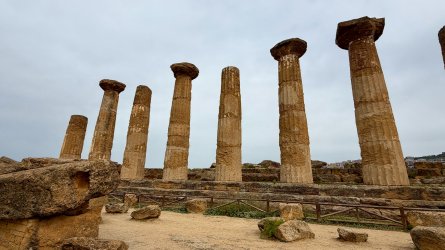
Next, the Temple of Heracles, the oldest here - 6th century BC. The columns were reconstructed in the 20th century.

IMG_5376.JPEG

IMG_5377.JPEG

IMG_5380.JPEG

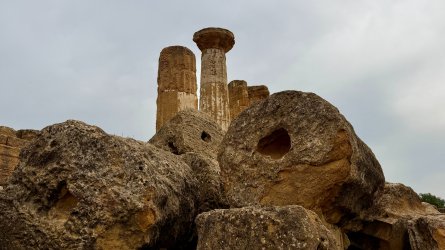
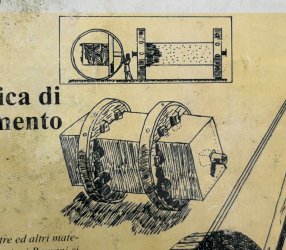
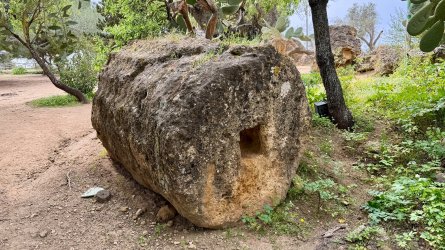
Pieces lying about here show one of the ways the stones were moved around.

IMG_5382.JPEG IMG_5378.JPEG

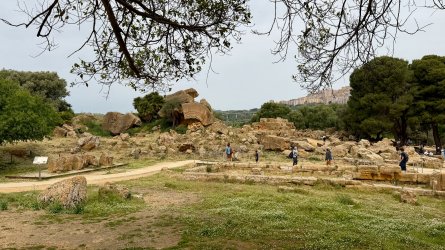
Lastly, a bit of an anti-climax- the Temple of Olympian Zeus which was once the largest Doric temple ever constructed.

The history of the temple is unclear, but it was probably founded to commemorate the Battle of Himera (480 BC), in which the Greek cities of Akragas (Agrigento) and Syracuse, Magna Graecia, defeated the Carthaginians under Hamilcar. According to the historian Diodorus Siculus, the temple was built using Carthaginian slave labour – presumably defeated soldiers captured after the battle. It is otherwise little mentioned in ancient literature. The Greek historian Polybius mentions it briefly in a 2nd-century BC description of Akragas, commenting that "the other temples and porticoes which adorn the city are of great magnificence, the temple of Olympian Zeus being unfinished but second it seems to none in Greece in design and dimensions."

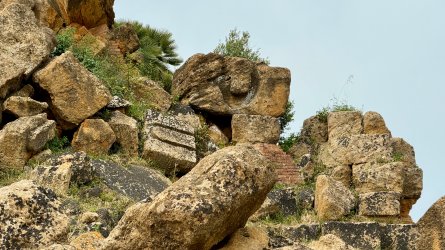
According to Diodorus, it remained unfinished due to the Carthaginian conquest of the city in 406 BC, with the Siege of Akragas. The temple's roof was already missing at this time. The temple was eventually toppled by earthquakes and in the 18th century was quarried extensively to provide building materials for the modern towns of Agrigento and nearby Porto Empedocle. Today it survives only as a broad stone platform heaped with tumbled pillars and blocks of stone.

IMG_5384.JPEG

IMG_5385.JPEG

IMG_5388.JPEG
 
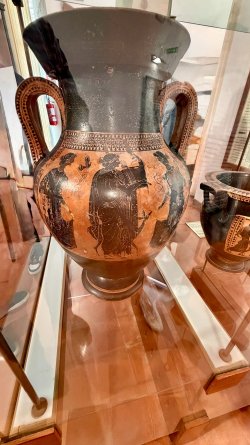
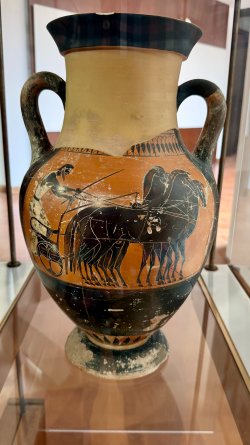
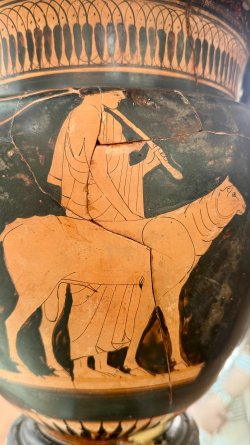
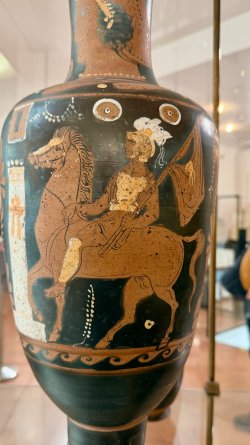
There is a great museum on site, Many, many cases of urns, figurines etc which I frankly eye-glaze over, but for a record's sake:

IMG_5406.JPEG IMG_5407.JPEG

IMG_5409.JPEG IMG_5412.JPEG

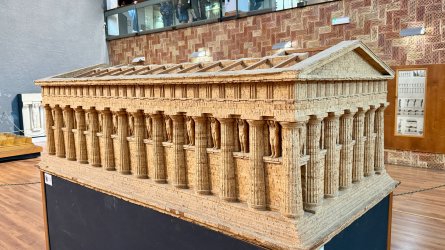
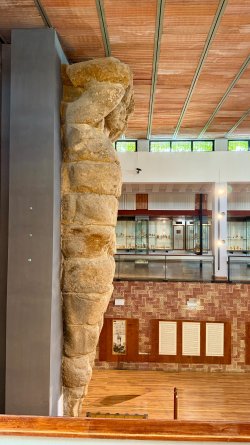
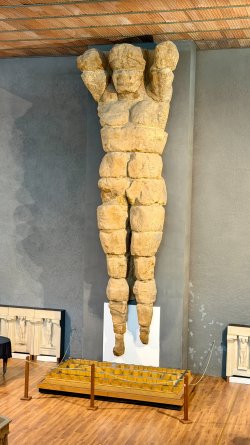
But the star exhibit is a reconstruction of the Temple of Olympian Zeus, the rubble anticlimax above. Stupendous!

IMG_5420.JPEG

Check-out the size of the figures holding up the roof - just one has been able to be re-constructed.

IMG_5430.JPEG IMG_5418.JPEG
 
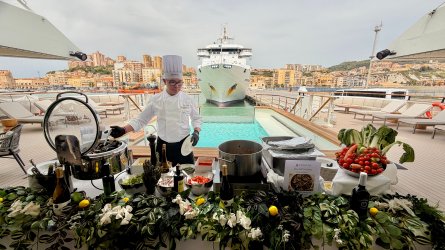
Back to the ship, and lunch, honestly, one of my favourite meals on board. There is always Chef with a live cooking station in front of the pool. In addition there is a full buffet of salads, fish and meat cold cuts, a soup and sweets. Plus, a main course if you wanted it - I never did.

IMG_5434.JPEG

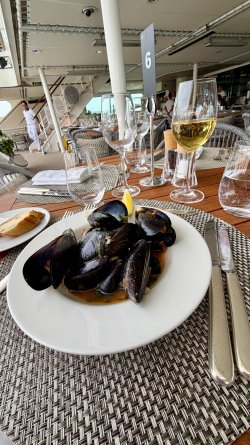
Garlic moules!

IMG_5435.JPEG

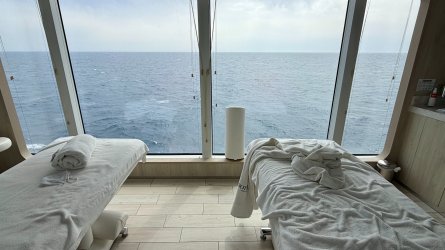
A massage, courtesy of some of my on-board credit - just 30 mins ... they are bloody expensive!

IMG_5439.JPEG

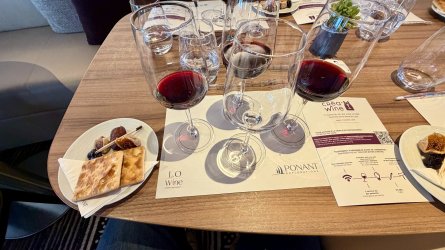
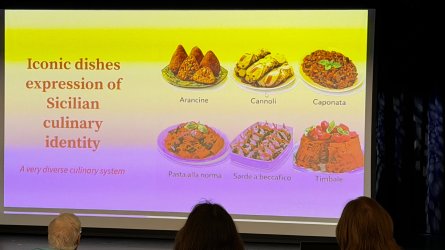
Then onto a wine tasting. Now, this cruise was billed as 'Cruise Epicurean Delights - the food and wine of Sicily'. Now, I didn't choose it for the food and wine, which was just as well, as it was a disappointment there. Others were more severely disappointed. We were expecting the evening and maybe lunch meals to be Sicilian focussed, but they weren't. Italian, yes, but not Sicilian.

What we had were two specialists from Sicily as special guests - a lady who ran a cooking school, and was very good and good company and a guy from a uni who was a wine researcher. He was OK - his English not as great as it might have been. They gave lectures, ran courses etc, but never in the kitchen or with a wine list. There was also a lady from France who had a vineyard and ran wine classes in France and on board, with an emphasis on the art of tasting.

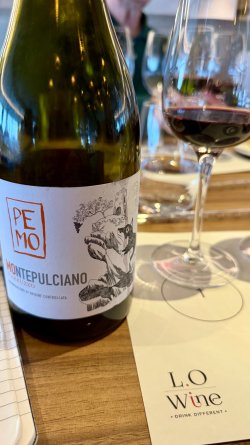
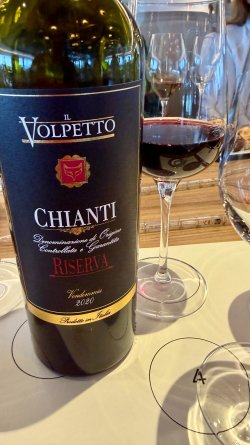
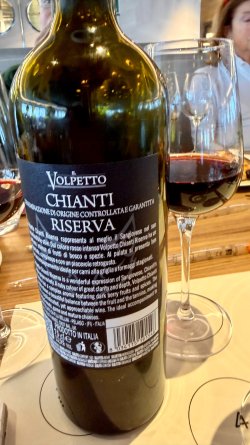
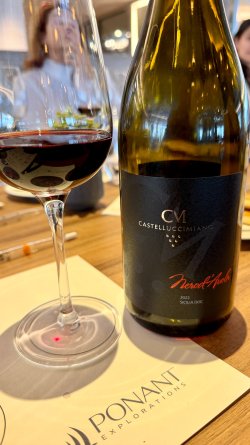
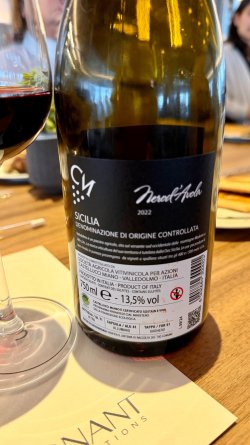
This was one of hers - we tasted 4 Italian/Sicilian reds and she guided the tasting (which was a really good exercise for me, never having had that before). AT the end, we did a 'blend what you'd like' thing, which didn;t really work (the piupette beyond the glasses).

IMG_5445.JPEG

IMG_5446.JPEG


IMG_5447.JPEG IMG_5448.JPEG

IMG_5450.JPEG IMG_5451.JPEG

Fabrizia Lanza was the cooking lady, daughter of the lady Anna who established the live-in cooking school. She was pretty good, although her lectures were a bit abstract for me. The school is meant to be very good - located in the country in the heart of the island.


IMG_5459.JPEG

IMG_5460.JPEG
 
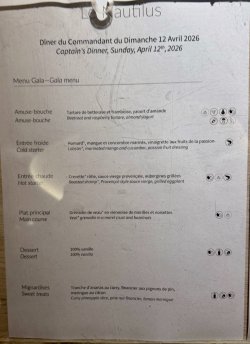
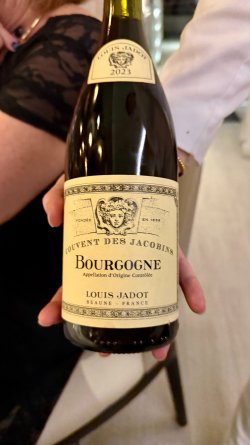
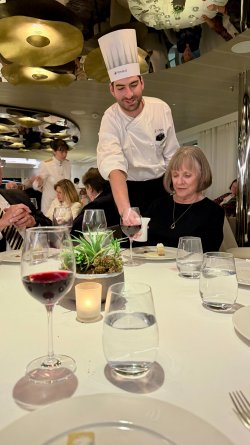
That evening was the Captain's dinner, which I enjoyed with several American couples who were excellent company. Its a set menu and 'special' included wines and this is where people started commenting on the lack of Sicilian specialities.

IMG_5465.JPEG IMG_5468.JPEG

The Executive Chef was on hand. No food pics, as it wasn't that sort of table ..

IMG_5469.JPEG

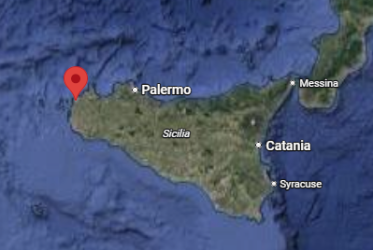
I was wrong above about the weather on the first night. It was on this evening. We were sailing around the NW tip of Sicily, towards EDIT: Trapani and both wind and waves got up a bit, but I personally was fine.

1777531405723.png

IMG_5472.JPEG IMG_5474.PNG
 
Last edited:
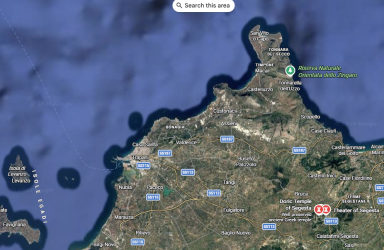
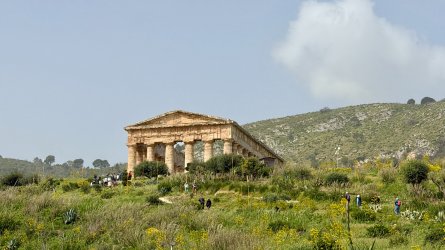
Our next port was Trapani, on the NW coast. There were 2 tours offered - the Greek and Roman ruins at Segesta, or the hill top town of Erece. I chose Segesta.

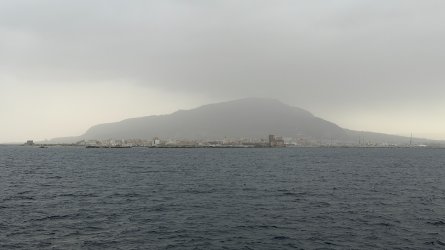
On approach, the weather wasn't appealing.

IMG_5477.JPEG

IMG_5481.JPEG

As usual, the coaches were waiting, and we drove 30-45 mins to Segesta

IMG_5482.JPEG

1777532368747.png

My groups local guide this time was a Hungarian lady, who married a German and they settled near hear. She speaks about 5 languages, and English just OK - frequently searching for words. Also, the ship-supplied audio equipment called 'whispers' - an ear piece, receiver unit worn around the neck, and the guide's head-set didn't work well, and the winds of that day caused static in her microphone. This would occur on several trips.

The history of Segesta is complicated, even for Sicily and contested by ancient sources.

Segesta was one of the major cities of the Elymians, one of the three indigenous peoples of Sicily. The other major cities of the Elymians were Eryx and Entella. It is located in the northwestern part of Sicily in Italy, near the modern commune of Calatafimi-Segesta in the province of Trapani. The hellenization of Segesta happened very early and had a profound effect on its people.

The origin and foundation of Segesta are extremely obscure. The tradition current among the Greeks and adopted by Thucydides, ascribed its foundation to a band of Trojan settlers, fugitives from the destruction of their city; and this tradition was readily welcomed by the Romans, who in consequence claimed a kindred origin with the Segestans. Thucydides seems to have considered the Elymians, a barbarian tribe in the neighborhood of Eryx and Segesta, as descended from the Trojans in question; but another account represents the Elymi as a distinct people, already existing in this part of Sicily when the Trojans arrived there and founded the two cities. A different story seems also to have been current, according to which Segesta owed its origin to a band of Phocians, who had been among the followers of Philoctetes; and, as usual, later writers sought to reconcile the two accounts

TL; DR - Segesta was founded by a distinct group and were 'indigenous' when the Greeks came.

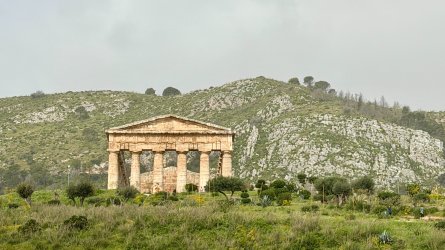
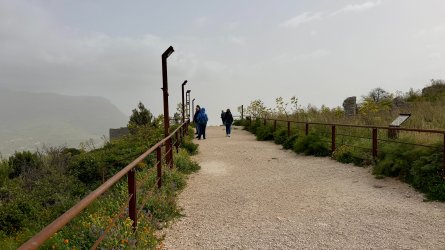
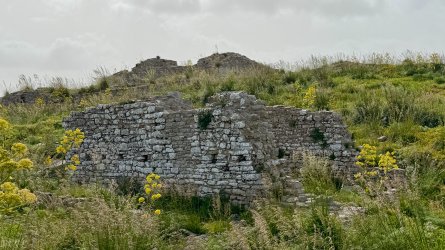
We entered the archaeological park and went past the Greek-temple-that-isn't Greek and joined a site bus that took us to the top of a nearby Monte Bàrbaro at 305 m, where the old city ruins are . Unfortunately by this time is was very windy and a few drops of rain, so we didn't linger.

IMG_5484.JPEG

IMG_5485.JPEG

IMG_5486.JPEG

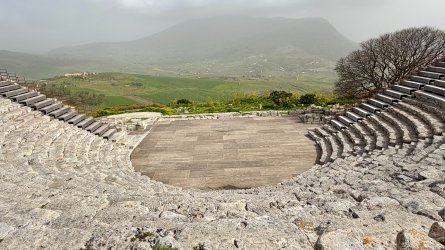
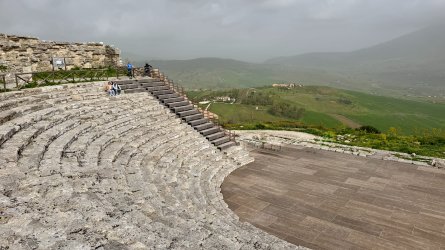
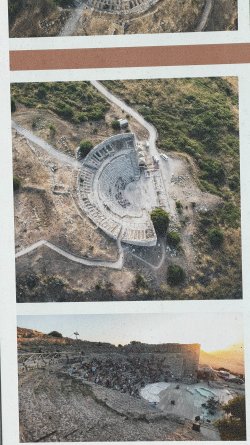
The theatre was probably constructed by the Greeks, then changed by the Romans, then used as building stone for a Muslim necropolis

IMG_5490.JPEG

IMG_5494.JPEG

IMG_5497.JPEG


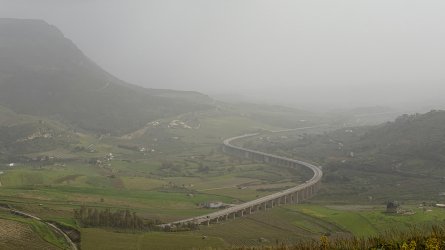
The autostrada extend to Sicily.

IMG_5498.JPEG
 
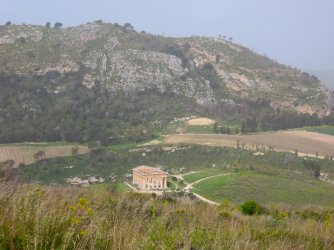
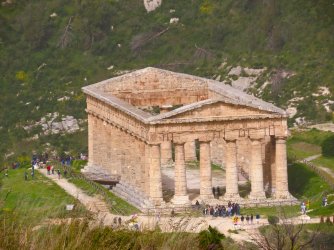
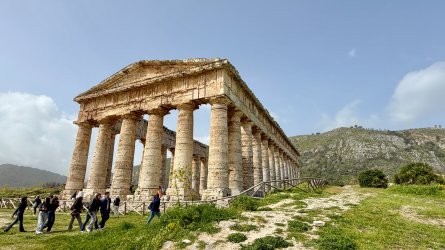
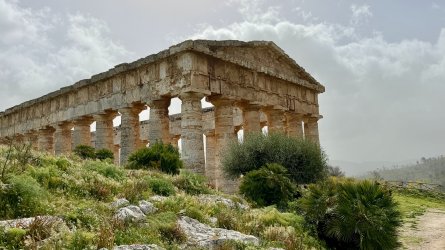
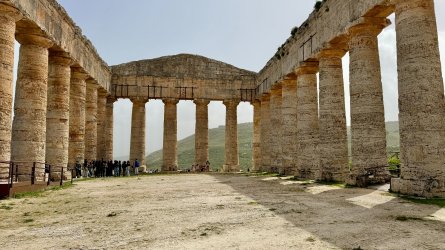
Temple viewed from the hill. It's not what it seems.

IMG_1267.JPG

IMG_1266.JPG


We then went down to the visitors centre where it is a short walk up to the Temple.

IMG_5511.JPEG

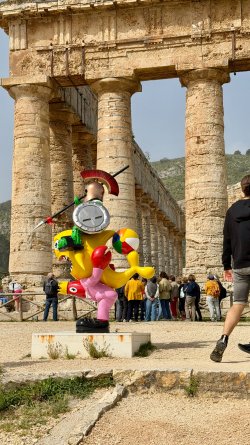
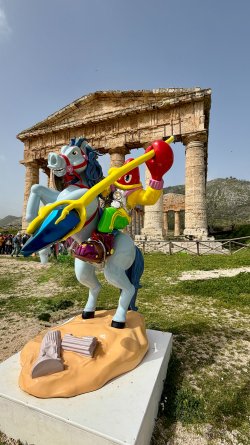
The first thing you then need to get past are these - where apparently some organisation thinks its a good idea to juxtapose ancient and modern 'art'. The problem being, of course the 'art' bit. :mad:.

IMG_5512.JPEG IMG_5513.JPEG

The second thing to get past, here and elsewhere are the groups of Italian school kids on excursions. Loud, disinterested and generally a nuisance, as everywhere.

IMG_5517.JPEG

IMG_5523.JPEG

IMG_5524.JPEG

IMG_5526.JPEG

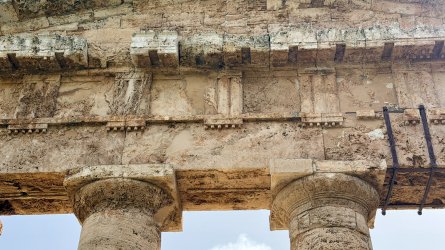
So a pretty cool Greek doric-style theatre, right? Actually no. As I mentioned, the guide's commentarry was not optimal in several ways, but doing some additional Wikipedia-ing, it seems that the local Elymians, being perpetually attacked by the Selinuntines to the south, tried to curry favour and rescue from the Greeks, around 460BC by building this 'Greek' temple. However the scheme fell thpugh and it wasn't completed - there is little fluting to the Doric columns and bosses used to move the stones are still in place. Try to get your head around this 🤣, from Wikipedia:

The first historical notice of the Segestans transmitted to us represents them as already engaged (as early as 580 BC) in hostilities with Selinus (modern Selinunte), which would appear to prove that both cities had already extended their territories so far as to come into contact with each other. By the timely assistance of a body of Cnidian and Rhodian emigrants under Pentathlus, the Segestans at this time obtained the advantage over their adversaries. A more obscure statement of Diodorus relates that again in 454 BC, the Segestans were engaged in hostilities with the Lilybaeans for the possession of the territory on the river Mazarus. The name of the Lilybaeans is here certainly erroneous, as no town of that name existed till long afterwards; but we know not what people is really meant, though the presumption is that it is the Selinuntines, with whom the Segestans seem to have been engaged in almost perpetual disputes. It was doubtless with a view to strengthen themselves against these neighbors that the Segestans took advantage of the first Athenian expedition to Sicily under Laches (426 BC), and concluded a treaty of alliance with Athens. This, however, seems to have led to no result, and shortly after, hostilities having again broken out, the Selinuntines called in the aid of the Syracusans, with whose assistance they obtained great advantages, and were able to press Segesta closely both by land and sea. In this extremity the Segestans, having in vain applied for assistance to Agrigentum, and even to Carthage, again had recourse to the Athenians, who were, without much difficulty, persuaded to espouse their cause, and send a fleet to Sicily in 416 BC. It is said that this result was in part attained by fraud, the Segestans having deceived the Athenian envoys by a fallacious display of wealth, and led them to conceive a greatly exaggerated notion of their resources. They, however, actually furnished 60 talents in ready money, and 30 more after the arrival of the Athenian armament.

That's just the start!

I'm sort of trying to follow it all, as I'll be taking another cruise from mainland Greece, Malta, Sicily, Carthage, Algeria etc in November. 🤞
 
Temple viewed from the hill. It's not what it seems.

View attachment 505008

View attachment 505007


We then went down to the visitors centre where it is a short walk up to the Temple.

View attachment 505009

The first thing you then need to get past are these - where apparently some organisation thinks its a good idea to juxtapose ancient and modern 'art'. The problem being, of course the 'art' bit. :mad:.

View attachment 505010 View attachment 505011

The second thing to get past, here and elsewhere are the groups of Italian school kids on excursions. Loud, disinterested and generally a nuisance, as everywhere.

View attachment 505012

View attachment 505013

View attachment 505014

View attachment 505015

So a pretty cool Greek doric-style theatre, right? Actually no. As I mentioned, the guide's commentarry was not optimal in several ways, but doing some additional Wikipedia-ing, it seems that the local Elymians, being perpetually attacked by the Selinuntines to the south, tried to curry favour and rescue from the Greeks, around 460BC by building this 'Greek' temple. However the scheme fell thpugh and it wasn't completed - there is little fluting to the Doric columns and bosses used to move the stones are still in place. Try to get your head around this 🤣, from Wikipedia:


That's just the start!

I'm sort of trying to follow it all, as I'll be taking another cruise from mainland Greece, Malta, Sicily, Carthage, Algeria etc in November. 🤞


That “art” is horrific
 

Become an AFF member!

Join Australian Frequent Flyer (AFF) for free and unlock insider tips, exclusive deals, and global meetups with 65,000+ frequent flyers.

AFF members can also access our Frequent Flyer Training courses, and upgrade to Fast-track your way to expert traveller status and unlock even more exclusive discounts!

AFF forum abbreviations

Wondering about Y, J or any of the other abbreviations used on our forum?

Check out our guide to common AFF acronyms & abbreviations.

Currently Active Users

Back
Top